
Titan UC-30 30L Benchtop Ultrasonic Cleaner with 35 kHz Frequency and Integrated Drain/Fill System
| Brand | Titan |
|---|---|
| Origin | Shanghai, China |
| Manufacturer Type | Direct Manufacturer |
| Instrument Type | Dedicated Ultrasonic Cleaner |
| Capacity | 30 L |
| Ultrasonic Frequency | 35 kHz |
| Ultrasonic Power Output | 600 W |
| Timer Range | 1–99 minutes (adjustable) |
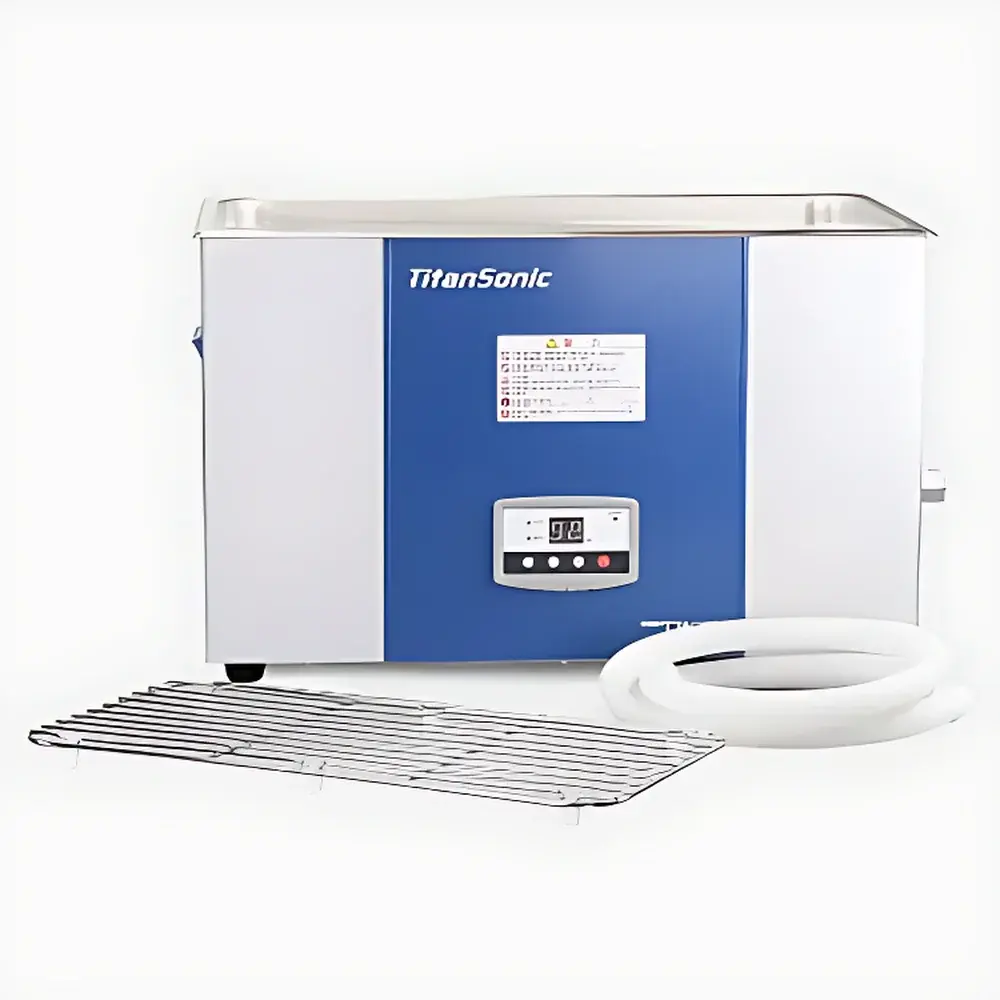
| Sound-Dampening Lid | Included |
| Drain and Fill Ports | Equipped |
Overview
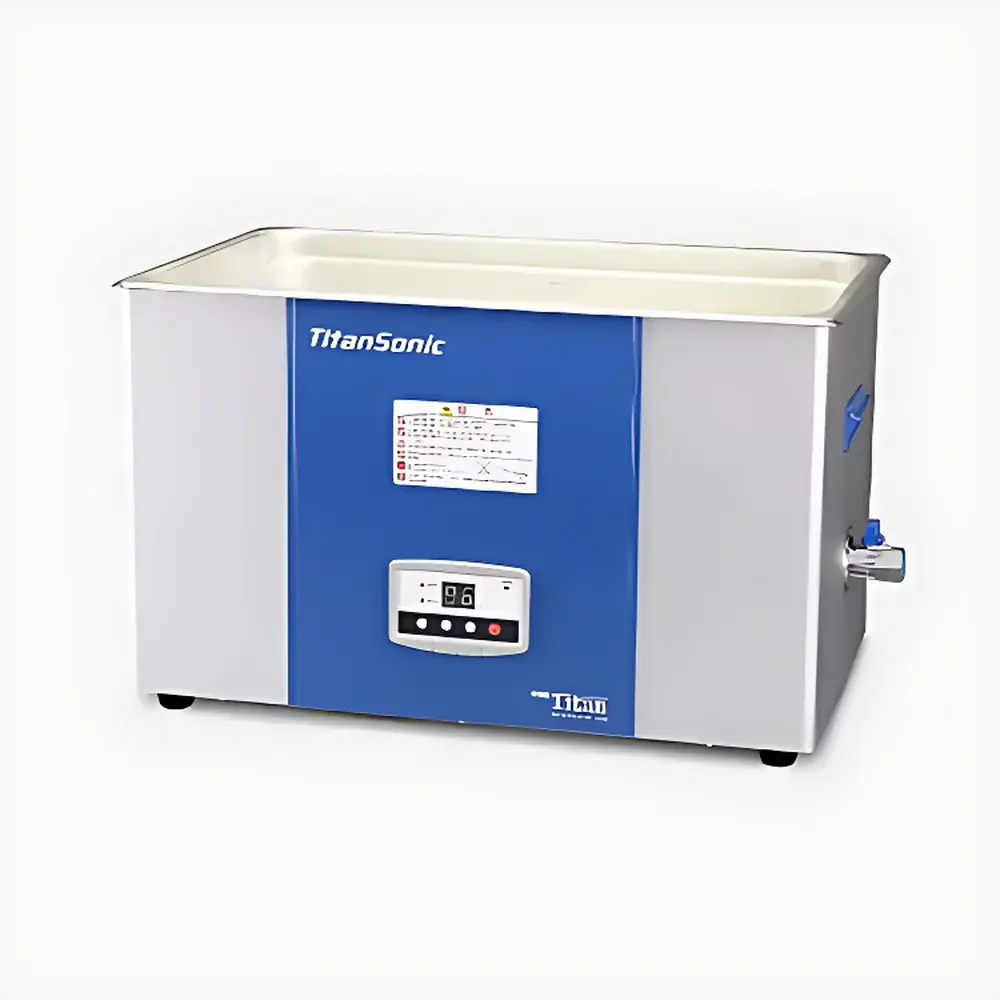
The Titan UC-30 is a robust, benchtop ultrasonic cleaner engineered for consistent, non-destructive removal of particulate contaminants, organic residues, and loosely adhered films from laboratoryware, precision components, optical elements, and small-scale industrial parts. Operating at a fundamental frequency of 35 kHz, the unit leverages cavitation physics—where rapid pressure oscillations in the cleaning liquid generate transient microbubbles that collapse near surfaces—to deliver mechanical energy sufficient for effective cleaning without compromising dimensional integrity or surface finish. Its 30-liter stainless steel tank (304 grade) provides ample volume for batch processing of beakers, flasks, pipette tips, filtration assemblies, and small metal or ceramic substrates. Designed for continuous operation in QC labs, R&D facilities, and maintenance workshops, the UC-30 integrates core engineering safeguards—including overheat protection, timer-based shutdown, and stable transducer mounting—to ensure long-term reliability under routine use.
Key Features
- 600 W total ultrasonic power output distributed across multiple piezoelectric transducers mounted on the tank bottom, ensuring uniform energy distribution and minimizing standing-wave dead zones.
- Precision digital timer with 1-minute resolution, programmable from 1 to 99 minutes; auto-shutdown prevents solvent degradation and overheating during extended cycles.
- Integrated sound-dampening lid constructed from acrylonitrile-butadiene-styrene (ABS) with silicone gasket sealing—reduces airborne noise to ≤55 dB(A) at 1 m distance and minimizes solvent evaporation.
- Dual-function fluid management system: front-mounted quick-connect drain valve and side-positioned fill port enable controlled, spill-free tank emptying and refilling—critical for aqueous, alcohol-based, or low-surface-tension solvent workflows.
- Stainless steel 304 tank with rounded internal corners and polished interior surface to inhibit residue accumulation and simplify manual wipe-down between solvent changes.
- Front-panel LED display with intuitive button interface—no software installation or external PC required for basic operation.
Sample Compatibility & Compliance
The UC-30 accommodates a broad range of sample geometries and material classes, including glassware (volumetric flasks, cuvettes), stainless steel tools, aluminum fixtures, silicon wafers, and polymer-based consumables (e.g., syringe filters, HPLC vials). It supports cleaning protocols compliant with ISO 13485 (for medical device component pre-cleaning), ASTM D2603 (ultrasonic cleaning performance evaluation), and USP particulate matter testing preparation. While not certified for sterilization, the unit facilitates validated cleaning steps within GLP/GMP environments when paired with documented solvent selection, cycle parameters, and post-cleaning verification (e.g., water break test, gravimetric residue analysis). The absence of moving parts in the cleaning chamber eliminates mechanical abrasion risk—a key requirement for delicate optics and MEMS devices.
Software & Data Management
The UC-30 operates as a standalone instrument with no embedded firmware logging or network connectivity. All operational parameters (timer setting, activation/deactivation events) are retained only during active power-on state and are not stored upon shutdown. For laboratories requiring audit-ready records, integration with external environmental monitoring systems or PLC-controlled lab automation platforms is supported via dry-contact relay outputs (optional accessory). While the device itself does not meet FDA 21 CFR Part 11 requirements for electronic records, its mechanical simplicity and deterministic behavior make it suitable for inclusion in SOPs where manual entry of cycle logs (date, operator ID, solvent type, duration, observed outcomes) satisfies regulatory traceability needs.
Applications
- Pre-analytical preparation of HPLC, GC, and ICP-MS sample containers to eliminate trace metal carryover and organic memory effects.
- Cleaning of reusable electrophoresis combs, gel trays, and electrode assemblies prior to nucleic acid or protein separation runs.
- Removal of polishing compounds and embedded particles from optical lenses, mirrors, and laser cavity components in photonics labs.
- Decontamination of reusable surgical instruments and dental handpieces in veterinary or academic teaching labs (when used with appropriate enzymatic or alkaline solutions).
- Surface preparation of metal coupons prior to corrosion testing, adhesion studies, or coating qualification per ASTM B117 or ISO 9227.
FAQ
Is the UC-30 suitable for cleaning delicate semiconductor wafers or MEMS devices?
Yes—when operated with low-power settings (via duty-cycle reduction using timed intervals), deionized water or low-concentration surfactant solutions, and verified through post-clean particle counting (e.g., light-scattering microscopy), the 35 kHz frequency provides adequate energy for sub-micron contaminant removal without inducing micro-fractures.
Can I use flammable solvents such as acetone or ethanol in this unit?
No—the UC-30 is not explosion-proof and lacks solvent vapor monitoring or spark-free construction. Only aqueous, high-flash-point (>60°C), or non-volatile cleaning solutions are recommended.
Does the unit include heating functionality?
No—the UC-30 is a non-heated ultrasonic cleaner. Temperature-sensitive applications require external water baths or heated rinse stations.
What maintenance is required for long-term performance?
Transducer coupling integrity should be inspected annually; tank interior must be cleaned regularly with mild detergent to prevent scale buildup; drain valve O-rings should be replaced every 18–24 months depending on solvent aggressiveness.



