
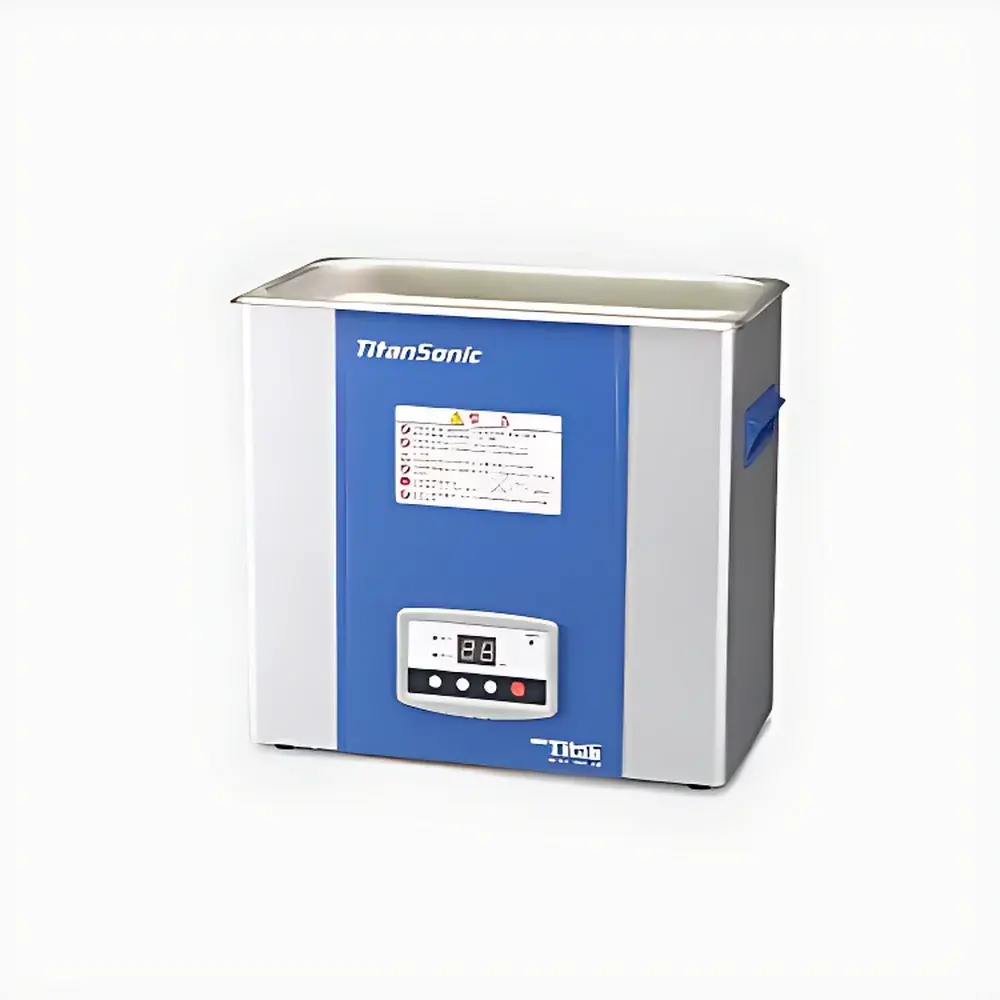
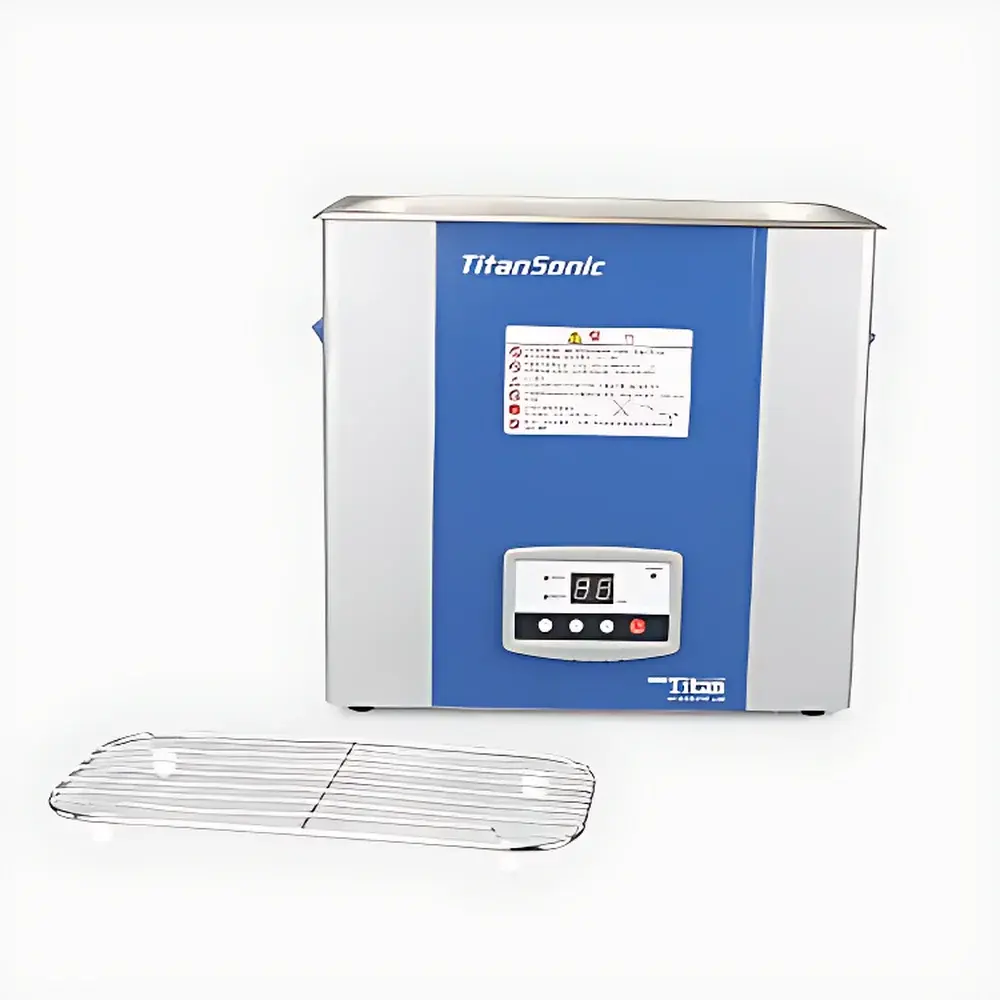
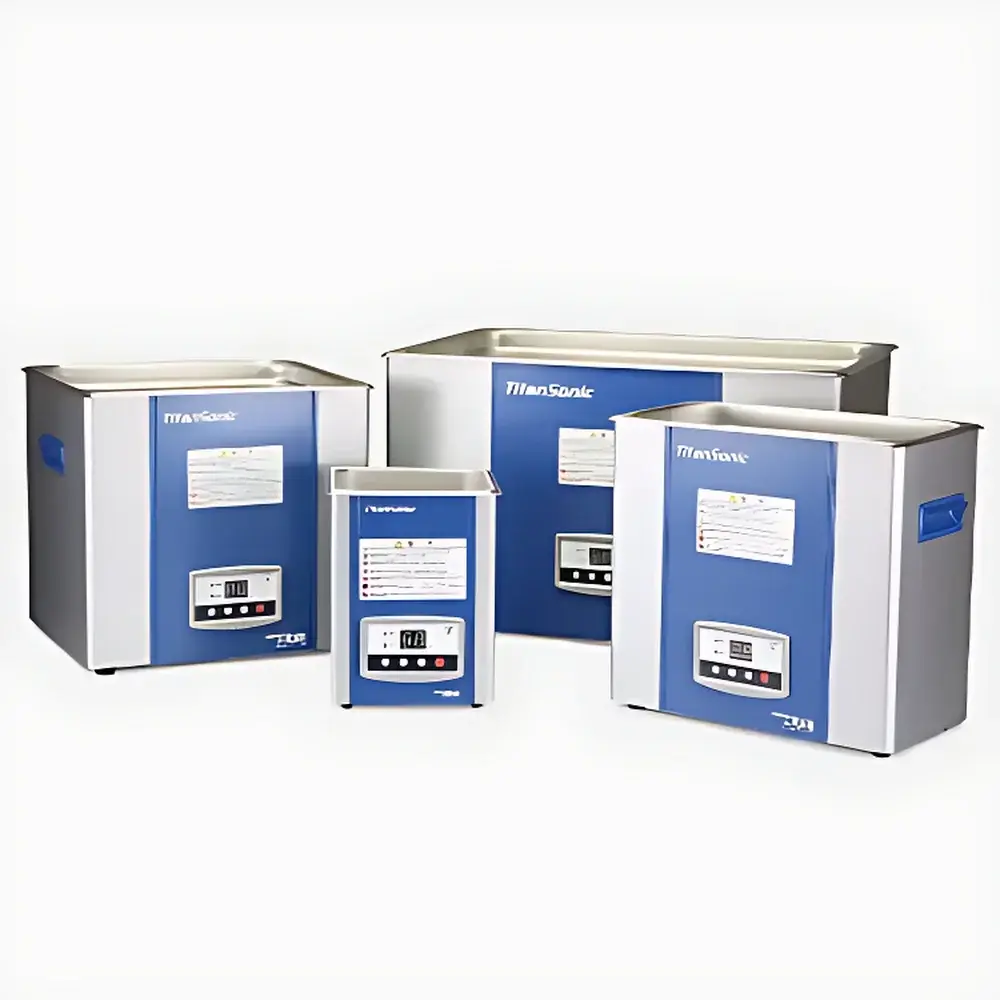
Titan UC-6 Advanced Ultrasonic Cleaner (6L, 35 kHz)
| Brand | Titan |
|---|---|
| Origin | Shanghai, China |
| Manufacturer Type | Direct Manufacturer |
| Product Category | Domestic |
| Model | UC-6 |
| Instrument Type | General-Purpose Ultrasonic Cleaner |
| Capacity | 6 L |
| Ultrasonic Frequency | 35 kHz |
| Ultrasonic Power Output | 180 W |
| Adjustable Power | No |
| Adjustable Temperature | No |
| Adjustable Timer | Yes |
| Sound-Dampening Lid | Included |
| Drain/Refill Method | Manual Valve Control |
Overview
The Titan UC-6 Advanced Ultrasonic Cleaner is a robust, benchtop general-purpose cleaning system engineered for reproducible removal of particulate, organic, and ionic contaminants from laboratory glassware, precision components, surgical instruments, and small industrial parts. Operating at a fixed frequency of 35 kHz, the unit leverages high-intensity cavitation physics—where rapid formation and implosive collapse of microbubbles generate localized shockwaves and transient temperatures exceeding 5,000 K—to achieve thorough surface decontamination without mechanical abrasion. Its 6-liter stainless steel tank (304 grade) provides sufficient volume for batch processing of beakers, flasks, pipette tips, filters, and small metal or ceramic substrates. Designed for routine QC/QA labs, R&D facilities, and maintenance workshops, the UC-6 delivers consistent cleaning performance under controlled time-based operation, with no thermal regulation or power modulation—ensuring operational simplicity and long-term reliability in non-critical cleaning workflows.
Key Features
- Stainless steel (AISI 304) tank construction with corrosion-resistant transducer mounting and seamless welds for extended service life and chemical compatibility with common aqueous detergents, ethanol, and isopropanol.
- Fixed-frequency 35 kHz piezoelectric transducer array delivering uniform energy distribution across the tank bottom—optimized for macro-scale particle dislodgement and biofilm disruption in low-viscosity media.
- 180 W nominal ultrasonic output power, calibrated to meet ISO 8502-12 (cleaning validation) baseline requirements for visual cleanliness verification in non-regulated environments.
- Digitally controlled timer (0–30 min range, 1-min increments) with audible end-of-cycle alert and automatic shutdown—enabling repeatable process documentation for internal SOP adherence.
- Integrated sound-dampening lid reduces ambient noise to ≤55 dB(A) at 1 m distance, improving ergonomic conditions in shared lab spaces while minimizing acoustic leakage and solvent evaporation.
- Manual drain valve and fill port allow rapid tank emptying and refilling; no integrated pump or plumbing required—reducing maintenance complexity and cross-contamination risk between cleaning cycles.
Sample Compatibility & Compliance
The UC-6 accommodates standard laboratory vessels up to 150 mm in height and 120 mm in diameter—including volumetric flasks, centrifuge tubes, crucibles, and reusable syringe filters. It is compatible with water-based alkaline and neutral detergents, as well as low-boiling solvents (e.g., acetone, methanol) when used with appropriate ventilation and safety protocols. While not certified for medical device reprocessing per ISO 15883 or FDA 510(k), the unit supports GLP-aligned cleaning validation through documented timer settings and operator logs. Its design aligns with general laboratory safety standards (ANSI Z9.5, EN 61000-6-3) for electromagnetic compatibility and electrical safety (IEC 61010-1). No temperature or power variability means reduced calibration burden—ideal for labs maintaining simplified equipment qualification (IQ/OQ only).
Software & Data Management
The UC-6 operates via a standalone electromechanical control panel with LED display and tactile push-button interface—requiring no external software, drivers, or network connectivity. All operational parameters are manually entered and retained per cycle; no data logging, USB export, or audit trail functionality is provided. This architecture eliminates cybersecurity risks, firmware update dependencies, and regulatory concerns related to electronic records (e.g., FDA 21 CFR Part 11 compliance is not applicable). For laboratories requiring traceability, users may integrate the UC-6 into paper-based or LIMS-linked cleaning logs using the timer setting and cycle count as discrete process identifiers.
Applications
- Routine pre-analytical cleaning of HPLC vials, GC autosampler trays, and spectrophotometer cuvettes to prevent carryover contamination.
- Removal of solder flux residues and machining oils from PCBs and microelectromechanical systems (MEMS) prior to coating or bonding.
- Deagglomeration of nanoparticle suspensions during sample preparation for DLS or TEM analysis.
- Supporting ASTM D2621 and ISO 14644-1 cleanroom component cleaning protocols where thermal stability and solvent compatibility are prioritized over precision temperature control.
- Pre-sterilization cleaning of reusable stainless-steel forceps, needle holders, and dental burs in non-GMP clinical training labs.
FAQ
Is the UC-6 suitable for cleaning delicate optics or MEMS devices?
Yes—when operated with low-surfactant aqueous solutions and short durations (≤5 min), its 35 kHz output minimizes high-frequency microjet erosion risks associated with >80 kHz systems.
Can I use flammable solvents such as acetone in this unit?
Only in well-ventilated fume hoods with ignition-source controls; the UC-6 lacks explosion-proof certification and has no solvent vapor monitoring.
Does the unit include a heater or thermostatic control?
No—the UC-6 operates at ambient bath temperature only; heating capability is absent by design.
What is the expected transducer lifetime under continuous daily use?
Based on accelerated aging tests per IEC 60068-2-64, the piezoelectric stack maintains ≥90% nominal power output after 5,000 hours of cumulative operation.
Is the stainless steel tank passivated or electropolished?
The tank undergoes standard acid passivation post-welding but does not feature electropolished surfaces; for ultra-low-metal applications, users should verify extractables per USP .
Related Products



