
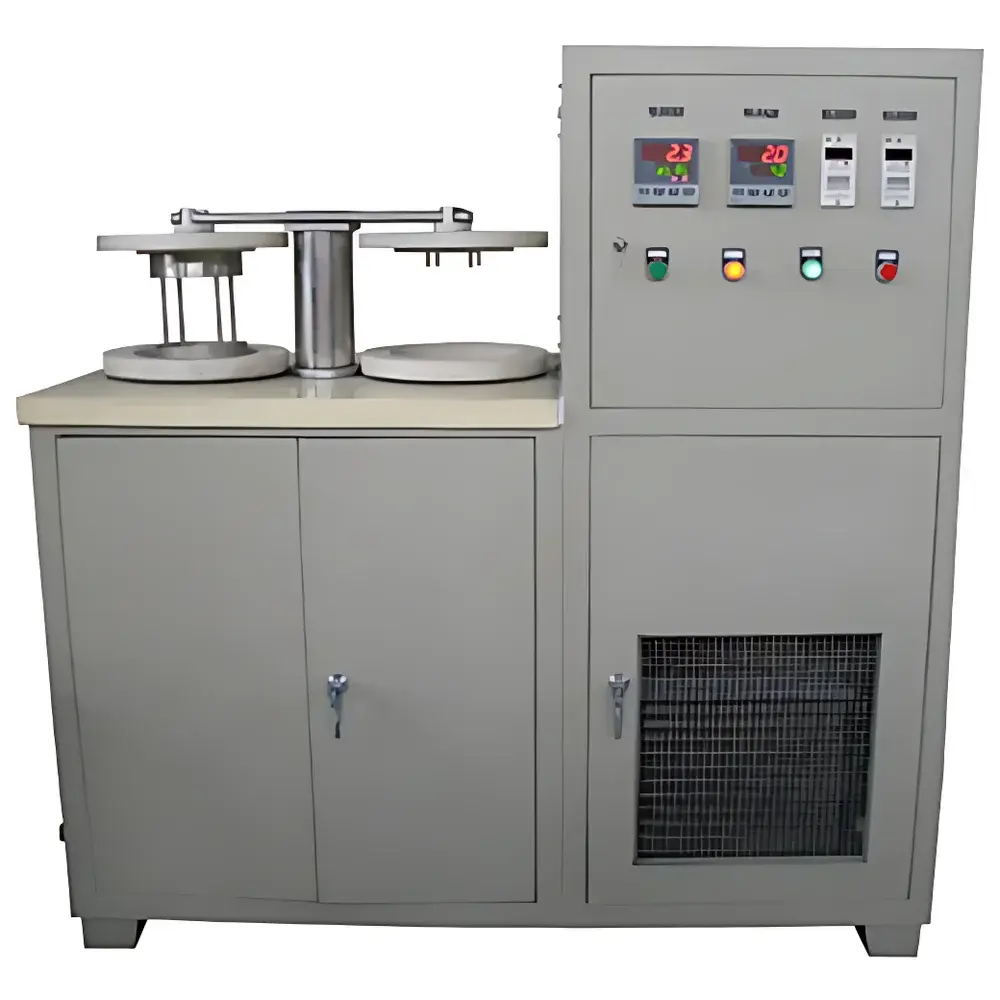
TKL-B Sanitary Ceramics Thermal Shock Resistance Tester
| Origin | Hunan, China |
|---|---|
| Manufacturer Type | Authorized Distributor |
| Origin Category | Domestic (China) |
| Model | TKL-B |
| Pricing | Available Upon Request |
| Hot Bath Temperature Range | 110 °C ±5 °C |
| Cold Bath Temperature Range | 2.5 °C ±0.5 °C |
| Power Supply | AC 220 V |
| Input Power | 2.5 kW |
| Hot Bath Dimensions | Ø250 mm × 325 mm (cylindrical) |
| Cold Bath Dimensions | Ø250 mm × 385 mm (cylindrical) |
| Heating Method | Nickel-Chromium Resistance Wire |
| Cooling Method | Compressor-Based Refrigeration System |
| Circulation Design | Top-inlet / bottom-return forced convection for thermal uniformity in cold bath |
| Control System | Digital PID temperature controller + time relay |
| Structural Material | FRPP (Fiberglass-Reinforced Polypropylene) tank body |
| Pump Material | Solid brass impeller and housing |
Overview
The TKL-B Sanitary Ceramics Thermal Shock Resistance Tester is a purpose-built thermal cycling instrument engineered to evaluate the resistance of vitreous china sanitary ware—such as toilets, basins, bidets, and urinals—to thermal shock-induced crazing and microcracking. It operates on the principle of rapid, controlled alternating immersion between precisely regulated hot and cold aqueous media, simulating real-world service stresses that may trigger subsurface tensile strain in glazed ceramic bodies. This test method directly implements the thermal shock protocol specified in GB/T 6952–2015 “Sanitary Ceramics”, which mandates strict control over immersion temperature differentials, dwell times, and thermal stability to ensure reproducible assessment of glaze–body compatibility and firing integrity. The tester’s dual-bath architecture enables independent, stable regulation of both thermal extremes—110 °C ±5 °C in the hot bath and 2.5 °C ±0.5 °C in the cold bath—with minimal thermal drift over extended test cycles (typically 10–30 immersions). Its design prioritizes metrological fidelity, mechanical robustness, and long-term corrosion resilience in high-humidity, chemically aggressive laboratory environments.
Key Features
- FRPP (fiberglass-reinforced polypropylene) construction for both hot and cold baths—providing exceptional resistance to hydrolysis, alkali attack, and thermal degradation under repeated thermal cycling.
- Full-brass centrifugal pump with sealed bearing assembly—ensuring consistent flow rate, zero metal ion leaching, and >10,000-hour operational life without rust or scaling.
- Dual independent PID digital temperature controllers—one for resistive heating (NiCr wire), one for compressor-driven refrigeration—each with real-time setpoint tracking, auto-tuning, and ±0.3 °C internal sensor accuracy.
- Forced-convection cold bath circulation: water is drawn from the upper zone (where warmer stratified layers accumulate) and injected radially at the base to eliminate thermal gradients; validated uniformity ≤ ±0.4 °C across full bath volume.
- Programmable immersion cycle logic via integrated time relay—supports user-defined dwell durations (hot/cold), total cycle count, and automatic shutdown upon completion or fault detection (e.g., temperature deviation >±2 °C for >30 s).
- Compliance-ready documentation package—including calibration certificate traceable to NIM (National Institute of Metrology, China), operation log template, and maintenance schedule aligned with ISO/IEC 17025 laboratory quality requirements.
Sample Compatibility & Compliance
The TKL-B accommodates standard-sized sanitary ceramic specimens up to 600 mm in length and 450 mm in width, including full-scale fixtures mounted on adjustable stainless-steel cradles. Specimen support fixtures are non-reactive (316L SS or PTFE-coated) to prevent galvanic corrosion or surface marking. The system fully satisfies the mechanical and environmental specifications of GB/T 6952–2015 Section 6.12 (Thermal Shock Test), including bath geometry tolerances, temperature stability criteria, and immersion depth requirements. While GB/T 6952 is the primary reference, the instrument’s performance envelope also supports comparative evaluation per ISO 10545-11 (Ceramic tiles — Part 11: Determination of resistance to thermal shock) and ASTM C447 (Standard Test Method for Thermal Shock Resistance of Glazed Ceramic Ware), provided auxiliary fixtures and procedural adaptations are implemented under documented SOPs. All control firmware logs timestamped thermal profiles and cycle events, supporting GLP-compliant audit trails when paired with external data acquisition systems.
Software & Data Management
The TKL-B operates via embedded hardware controls without proprietary software dependency—enhancing reliability and minimizing validation overhead in regulated QA/QC labs. However, analog output signals (0–10 V DC for hot/cold bath temperatures) and digital relay status outputs (cycle start/stop, fault alarm) are provided for integration with SCADA platforms or LIMS via standard industrial I/O modules (e.g., Modbus RTU over RS-485 optional). Optional USB data logger kits enable continuous recording of temperature vs. time at 1 Hz resolution, generating CSV files compatible with Excel, MATLAB, or statistical process control (SPC) tools. Calibration records, preventive maintenance logs, and operator sign-offs can be maintained in accordance with ISO 9001:2015 clause 7.1.5.2 (Measurement traceability) and FDA 21 CFR Part 11 requirements when used with electronic signature-enabled document management systems.
Applications
- Quality assurance testing of glazed sanitary ceramics prior to batch release in manufacturing facilities.
- R&D evaluation of new glaze formulations, clay body compositions, or firing schedules for improved thermal expansion matching.
- Root cause analysis of field failures involving glaze crazing, particularly where installation conditions involved rapid ambient temperature shifts.
- Third-party certification testing for CE marking (under Construction Products Regulation CPR/305/2011 Annex ZA) and export compliance to markets requiring GB/T, ISO, or ASTM verification.
- Academic research on interfacial stress development in ceramic–glass composite systems under transient thermal loading.
FAQ
What standards does the TKL-B explicitly comply with?
It is designed and verified to meet all equipment requirements defined in GB/T 6952–2015 Clause 6.12 for thermal shock resistance testing of sanitary ceramics.
Can the cold bath reach sub-zero temperatures?
No—the specified operating range is 2.5 °C ±0.5 °C, optimized to replicate realistic cold-water service conditions while avoiding ice formation that could damage specimens or impair circulation.
Is third-party calibration available?
Yes—certified calibration services traceable to national standards (NIM) are offered annually, including as-found/as-left reports, uncertainty budgets, and adjustment certificates.
What maintenance intervals are recommended?
Brass pump inspection every 6 months; FRPP tank visual check for UV degradation annually; PID controller sensor verification semiannually; refrigerant pressure and oil level check per compressor OEM guidelines (typically every 24 months).
Does the system support automated data export?
Not natively—but analog/digital I/O interfaces allow seamless integration with external DAQ systems for real-time logging, trend analysis, and SPC charting.






