
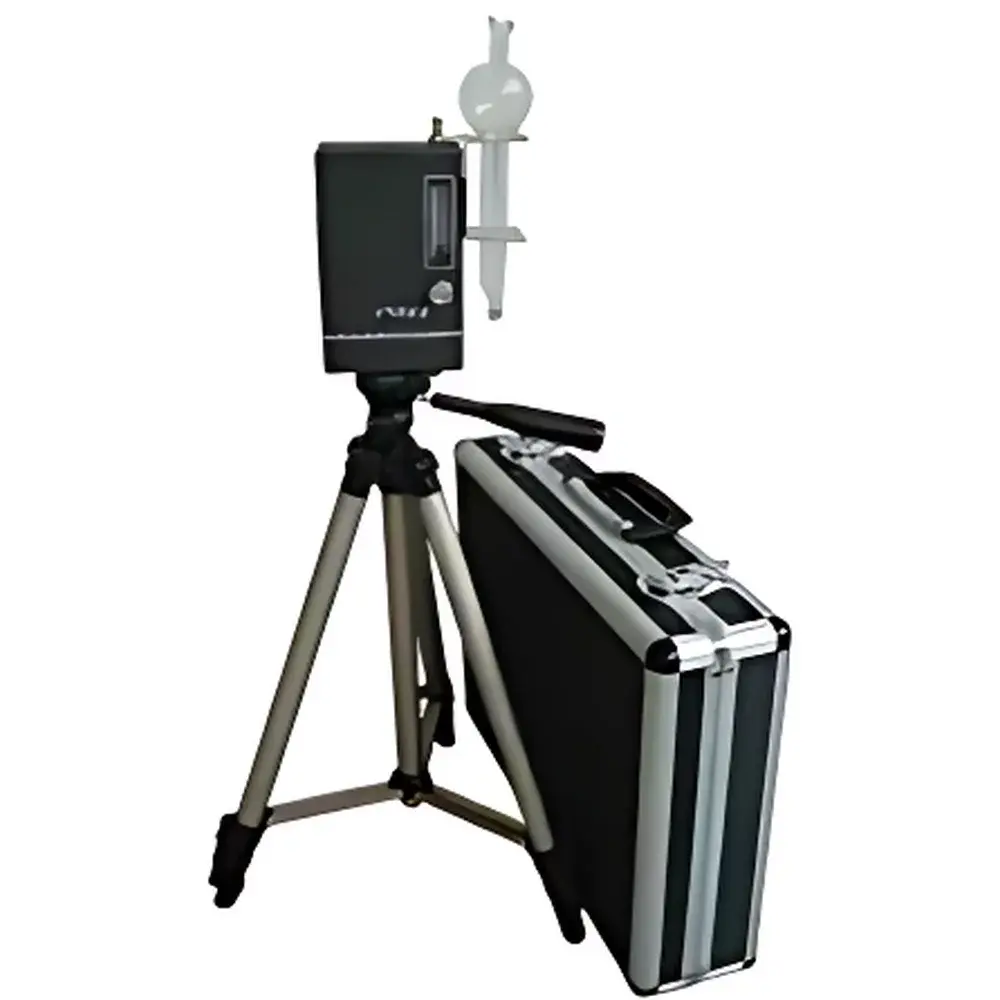
TMP-1500 Portable Atmospheric Air Sampler
| Origin | Jiangsu, China |
|---|---|
| Manufacturer Type | Authorized Distributor |
| Origin Category | Domestic (PRC) |
| Model | TMP-1500 |
| Pricing | Available Upon Request |
Overview
The TMP-1500 Portable Atmospheric Air Sampler is a precision-engineered, battery-operated active sampling device designed for quantitative collection of airborne contaminants—including toxic gases, vapors, particulate matter (PM), and adsorbed analytes on sorbent media such as activated carbon tubes. It operates on the principle of controlled volumetric aspiration using a high-efficiency diaphragm pump, enabling reliable, low-flow sampling across regulatory-compliant exposure assessment protocols. Engineered for field-deployable environmental monitoring, occupational hygiene surveys, and industrial hygiene compliance testing, the TMP-1500 meets the functional requirements of ISO 16000-2, OSHA Method 02, NIOSH Methods 1501/1600/7300 series, and EPA Compendium Method TO-17 for integrated air sampling. Its compact architecture, stable flow performance under variable backpressure, and dual-power flexibility (rechargeable Ni-Cd or alkaline batteries) make it suitable for both personal (individual) and area (fixed-location) sampling applications in ambient air, workplace environments, and emergency response scenarios.
Key Features
- High-stability diaphragm pump with acid/alkali-resistant valve membranes and electronic speed regulation—maintains consistent flow (±5% stability) across load variations up to 100 mmHg (≈13.3 kPa)
- Eight-position mechanical timer with fixed-duration settings (5, 10, 15, 30, 40, 50, 60 min) plus manual override mode for flexible sampling duration control
- Dual power system: integrated 8 V DC regulated output for continuous operation; dedicated charging circuit for Ni-Cd battery packs with auto-cutoff at full charge
- Real-time operational feedback via red LED status indicator; automatic undervoltage detection (deactivation at ≤6 V) to prevent battery damage and ensure data integrity
- Compact form factor (137 × 88 × 45 mm³) and lightweight design (<0.5 kg including batteries) optimized for belt-mounting, tripod deployment, or handheld use
- Modular inlet configuration supporting interchangeable sampling media: glass impingers, polyurethane foam (PUF) plugs, quartz fiber filters, and standard 3.5–4.0 cm activated carbon tubes
- Integrated protective filtration system with swellable barrier material to prevent liquid backflow damage to pump assembly during accidental solution aspiration
Sample Compatibility & Compliance
The TMP-1500 supports sampling configurations aligned with internationally recognized occupational and environmental standards. It is routinely deployed in conjunction with NIOSH-certified sorbent tubes (e.g., coconut-shell charcoal, Tenax TA), PM10/PM2.5 cyclones, and impinger-based methods for aldehydes, sulfur dioxide, and hydrogen sulfide. Its flow range (0.1–1.5 L/min) and pressure capability (≥25 kPa max vacuum) accommodate gravimetric dust sampling per ISO 7708 and EN 481, as well as vapor-phase collection per ASTM D5466. While not intrinsically certified for hazardous locations, optional explosion-proof accessories are available through authorized partners for ATEX Zone 2 / Class I, Division 2 deployments. All electrical components comply with IEC 61010-1 safety requirements for portable measurement equipment.
Software & Data Management
As a hardware-only sampling platform, the TMP-1500 does not incorporate embedded firmware or digital connectivity. Sample metadata—including start time, duration, flow rate setting, and battery status—is manually recorded in field logs compliant with GLP documentation practices. When used with calibrated rotameters or electronic flow calibrators (e.g., DryCal® DC Series), traceable flow verification records satisfy audit requirements under ISO/IEC 17025 and OSHA 29 CFR 1910.1200. Optional external data loggers (sold separately) can be interfaced via analog voltage output (0–5 V proportional to flow) for automated timestamped calibration tracking. Full audit trails, chain-of-custody documentation, and raw sample volume calculations remain the responsibility of the laboratory’s LIMS or paper-based QA/QC system.
Applications
- Workplace exposure assessment for VOCs, metals, and respirable crystalline silica in manufacturing, mining, and construction sectors
- Ambient air quality monitoring networks for baseline VOC profiling and fugitive emission screening
- Indoor air quality investigations in schools, hospitals, and office buildings per ASHRAE Standard 62.1
- Emergency response sampling during chemical spills or industrial accidents requiring rapid vapor-phase identification
- Method validation studies supporting EPA SW-846, ISO 16017-1, and EN 13649-1 analytical workflows
- Educational and research applications in environmental science and industrial hygiene training programs
FAQ
What is the recommended calibration frequency for the TMP-1500?
Calibration should be performed before each sampling campaign using a NIST-traceable primary standard (e.g., bubble meter or electronic calibrator), especially after filter or tube changes that alter system resistance.
Can the TMP-1500 be used for respirable dust sampling?
Yes—when paired with a size-selective cyclone (e.g., GK2.69 or IOM sampler) and gravimetric filter cassette, it delivers stable flow within the ISO 7708 respirable fraction curve requirements.
Is the instrument compatible with USP or ISO 14644 cleanroom monitoring?
No—the TMP-1500 is not rated for sterile or laminar-flow environments; it lacks HEPA filtration and positive-pressure housing required for pharmaceutical-grade air sampling.
Does the device support 21 CFR Part 11-compliant electronic records?
No—it is an analog-timed, non-networked instrument; full Part 11 compliance requires integration with validated third-party data acquisition systems.
What maintenance intervals are advised for the diaphragm pump?
Pump membranes should be inspected every 200 operating hours and replaced after 500 hours or upon visible cracking, swelling, or flow deviation exceeding ±5%.







