
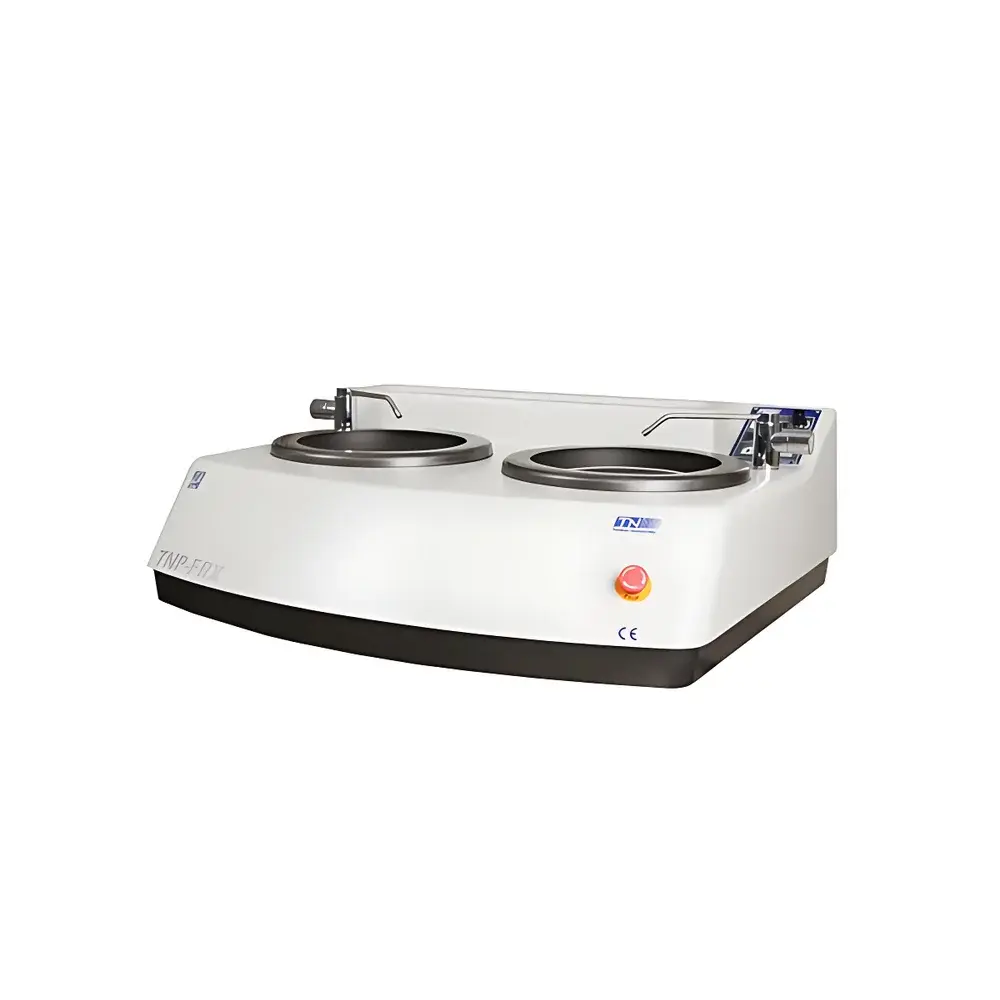
TN Testing TNP-2020FRX Manual Dual-Disc Metallographic Grinding and Polishing System
| Brand | TN Testing |
|---|---|
| Origin | Taiwan |
| Model | TNP-2020FRX |
| Dimensions (L×W×D) | 796 × 727 × 568 mm |
| Number of Grinding/Polishing Discs | 2 |
| Disc Diameter | 200 mm |
| Rotational Speed | 800 rpm |
| Construction | Cast Aluminum Base with FRP Enclosure |
| Cooling System | Stainless Steel–Ceramic Adjustable Spray Nozzle |
| Control Interface | Waterproof Membrane Keypad with 9-Step Program Memory |
| Water Pathway Design | Anti-Clogging Triangular Flow Channel |
| Optional Accessory | Removable Stain-Resistant Liner |
Overview
The TN Testing TNP-2020FRX is a manually operated, dual-disc metallographic grinding and polishing system engineered for precision sample preparation in metallurgical, materials science, and failure analysis laboratories. It employs conventional abrasive-based planar grinding and polishing mechanics—utilizing rotational shear force between specimen surface and bonded or coated abrasive media—to achieve flat, scratch-free, deformation-free cross-sections suitable for optical microscopy, SEM imaging, and quantitative microstructural analysis. Designed for reproducible, operator-controlled workflows, the TNP-2020FRX integrates mechanical stability, ergonomic usability, and contamination-aware engineering to support ISO 14971 risk management principles and ASTM E3–22 standard practices for metallographic specimen preparation.
Key Features
- Cast aluminum structural base: Provides superior vibration damping compared to cast iron alternatives, ensuring consistent disc parallelism and minimizing edge rounding or uneven material removal during prolonged operation.
- Dual 200 mm grinding/polishing stations: Independently operable discs allow simultaneous use of coarse grinding and fine polishing media, reducing turnaround time between preparation steps.
- 800 rpm fixed-speed drive: Optimized for compatibility with silicon carbide papers, diamond suspension pads, and colloidal silica cloths across grit ranges from P80 to 0.02 µm.
- Quick-change disc interface: Integrated magnetic adapter plates enable tool-free attachment of consumable-backed discs—including electroplated diamond, resin-bonded, and non-woven polishing pads—without requiring torque wrenches or alignment fixtures.
- Anti-clogging triangular water pathway: Minimizes sediment accumulation by shortening flow distance, optimizing spray angle, and employing corrosion-resistant tubing—reducing maintenance frequency and downtime associated with traditional spiral or straight-channel systems.
- Stainless steel–ceramic adjustable spray nozzle: Co-developed with industrial fluid control specialists to deliver laminar, low-turbulence coolant flow at variable incidence angles; ensures uniform lubrication and thermal management without splashing or localized drying.
Sample Compatibility & Compliance
The TNP-2020FRX accommodates specimens up to 40 mm in diameter (standard holder) and supports mounting in thermosetting resins (epoxy, acrylic), cold-mounting compounds, and conductive carbon-based media. Its mechanical architecture complies with CE machinery directive 2006/42/EC safety requirements, and its sealed FRP enclosure meets IP54 ingress protection standards for dust and water resistance. The system supports documentation traceability per GLP and ISO/IEC 17025:2017 Annex A.2 guidelines when paired with external logbooks or LIMS-integrated reporting tools.
Software & Data Management
As a manual, non-motorized system, the TNP-2020FRX does not incorporate embedded firmware or network connectivity. However, its waterproof membrane keypad stores nine user-defined grinding/polishing protocols—including disc rotation speed (fixed at 800 rpm), dwell time per step, and coolant activation sequence—enabling repeatable parameter recall without reliance on external PCs. All settings are retained after power cycling. Audit trails require manual entry into laboratory notebooks or digital SOP platforms compliant with FDA 21 CFR Part 11 when electronic records are mandated.
Applications
- Preparation of ferrous and non-ferrous alloys (e.g., stainless steels, aluminum 6061-T6, titanium Grade 5) for grain size evaluation per ASTM E112.
- Sectioning and polishing of ceramic matrix composites and sintered carbides prior to porosity quantification (ISO 4527).
- Routine QC/QA of weld joints, heat-affected zones, and coating interfaces in aerospace and power generation components.
- Failure analysis labs requiring high-fidelity cross-sections for void detection, inclusion mapping, and intergranular corrosion assessment (ASTM G153, ISO 11844).
- Academic research environments where hands-on training in standardized metallographic technique is emphasized over automation.
FAQ
Is the TNP-2020FRX compatible with automated force application modules?
No—the system is strictly manual and does not accept motorized load arms or programmable downforce units. It is intended for operators applying consistent hand pressure per ASTM E3–22 Section 7.2 recommendations.
Can the unit be integrated into a fume hood or wet bench setup?
Yes—its compact footprint (796 × 727 × 568 mm), drip-resistant FRP housing, and rear-mounted drainage channel support installation in ventilated enclosures with standard lab utility connections.
What consumables are certified for use with the magnetic disc adapter?
All commercially available 200 mm-diameter backing plates with N52-grade neodymium magnet arrays (≥1.2 T surface field) and ISO 9001-certified abrasive media meet mechanical and safety interoperability requirements.
Does TN Testing provide calibration documentation for rotational speed verification?
A factory-verified tachometer report is included with each unit, traceable to NIST-calibrated reference instruments. Annual verification using handheld laser tachometers is recommended per ISO/IEC 17025 Clause 6.5.2.
Is the optional removable liner chemically resistant to common polishing lubricants?
Yes—the liner material is polytetrafluoroethylene (PTFE)-coated fiberglass-reinforced polymer, rated for continuous exposure to pH 2–12 aqueous suspensions, ethanol-based cleaners, and mineral oil-based lubricants.



