
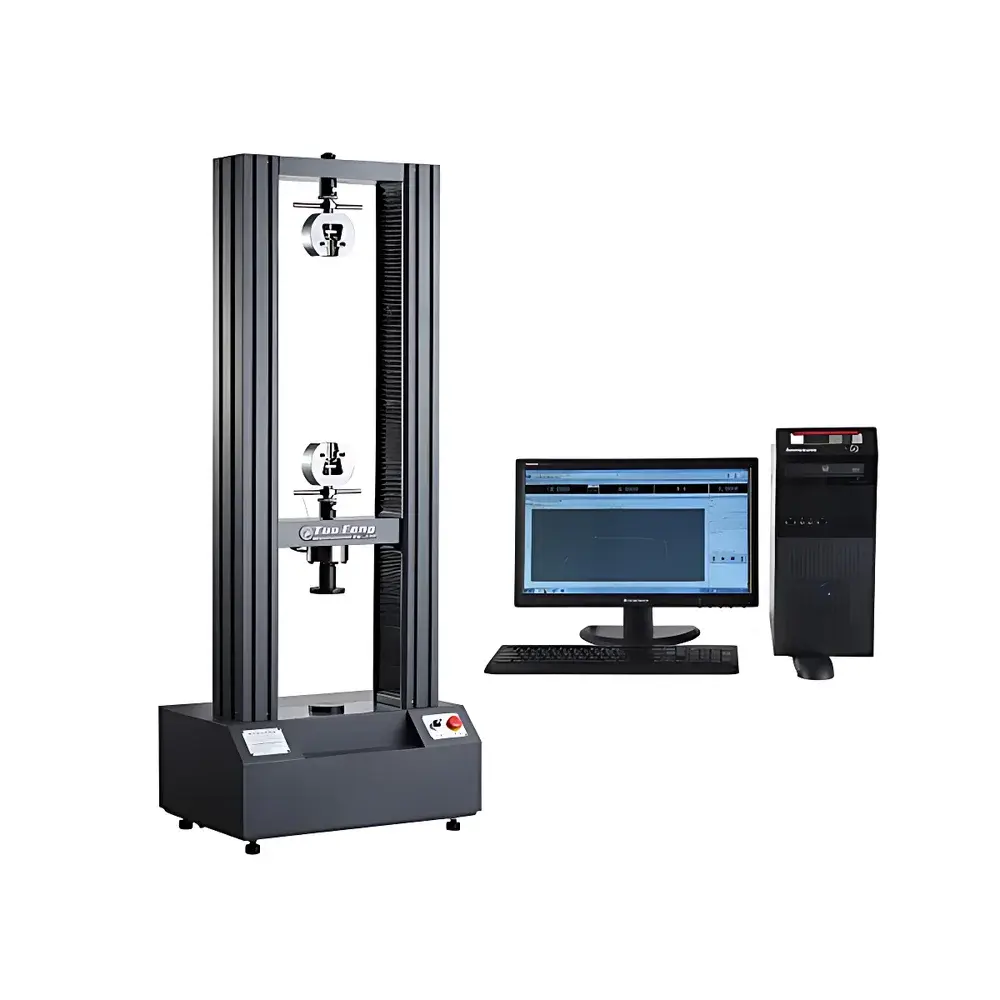
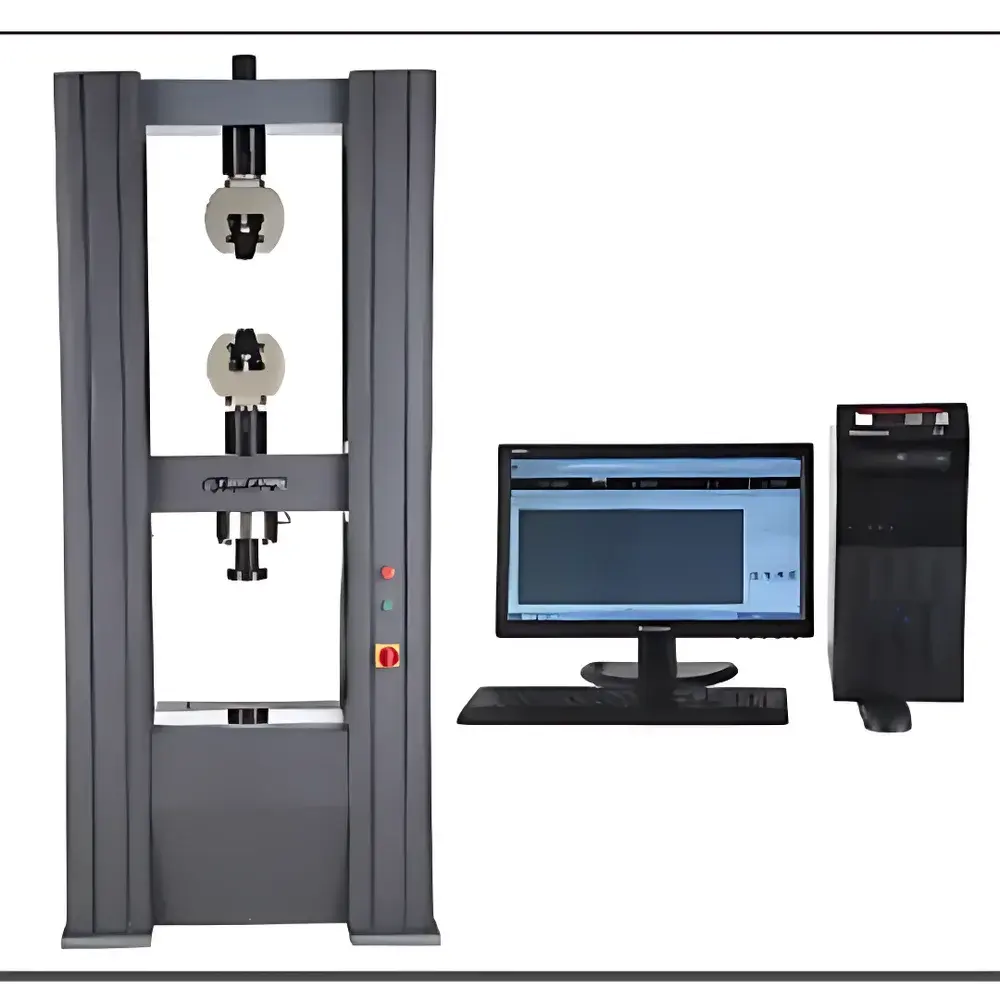
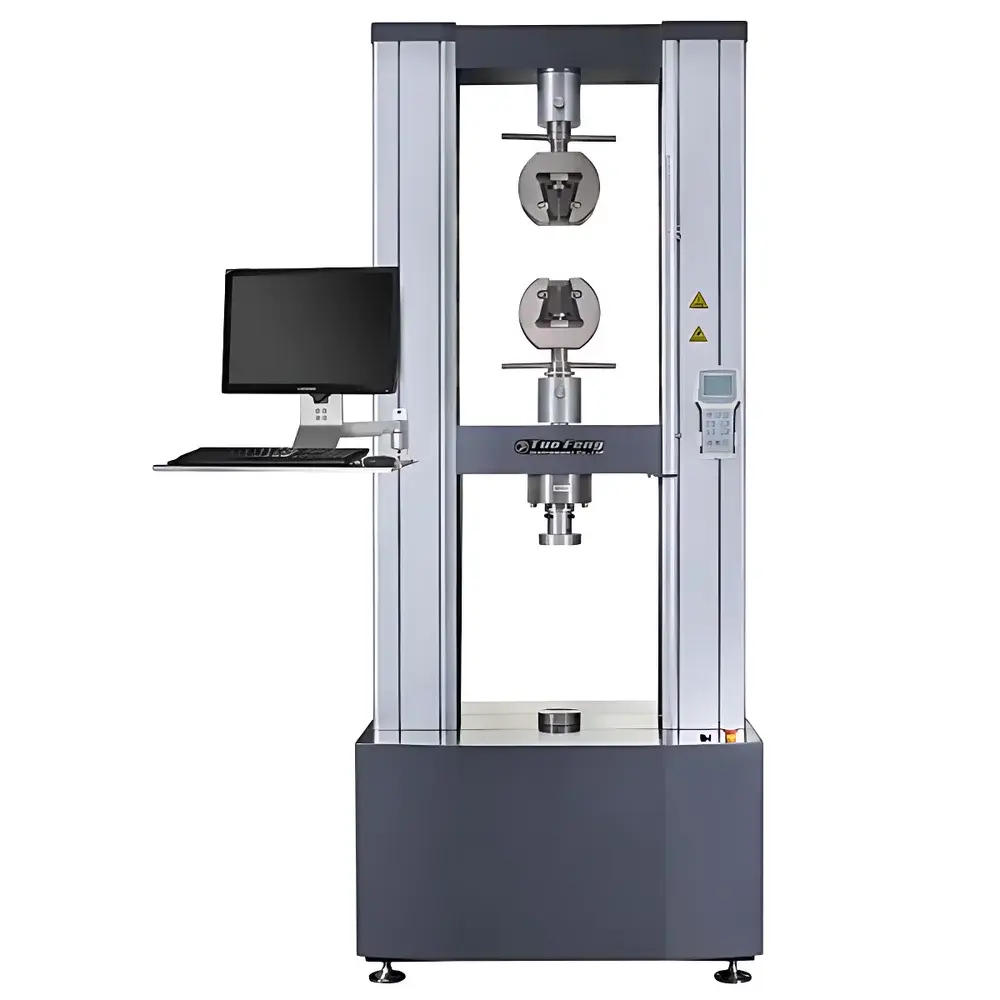
TOFENG TFW-10S Microcomputer-Controlled Electromechanical Universal Testing Machine
| [Brand | TOFENG |
|---|---|
| Origin | Shanghai, China |
| Manufacturer Type | Direct Manufacturer |
| Product Category | Domestic |
| Model | TFW-10S |
| Instrument Type | Electromechanical Universal Testing Machine |
| Maximum Test Load | 10 kN (1000 kgf) |
| Accuracy Class | 0.5 |
| Effective Force Measurement Range | 0.2%–100% of Full Scale |
| Force Measurement Accuracy | ±0.005% of Reading |
| Force Resolution | 1/±300,000 counts (full-scale, no range switching, constant resolution) |
| Drive System | Servo Motor + Worm Gear Reducer |
| Lead Screw | High-Precision Ball Screw |
| Effective Test Width | 400 mm (customizable) |
| Max. Tensile Stroke | 800 mm (customizable) |
| Speed Range | 0.01–500 mm/min (optional extended range) |
| Displacement Measurement | Optical Encoder |
| Displacement Accuracy | ±0.005% of Reading |
| Strain Measurement | Optional Extensometer or Large-Deformation Clip-on Gauge |
| Strain Accuracy | ±0.005% of Reading |
| Safety Protection | Electronic Limit Switches, Emergency Stop Button |
| Crosshead Adjustment | Dual-Speed Motorized (Fast/Slow), Jog Control |
| Return Function | Automatic or Manual High-Speed Return to Initial Position |
| Overload Protection | Auto-shutdown at >110% of Rated Load |
| Fixture Customization | Application-Specific |
| Dimensions (W×D×H) | 800 × 550 × 1780 mm |
| Power Supply | 220 V AC, 750 W |
| Net Weight | ~380 kg] |
Overview
The TOFENG TFW-10S Microcomputer-Controlled Electromechanical Universal Testing Machine is a precision-engineered static mechanical testing system designed for quantitative evaluation of tensile, compressive, flexural, shear, peel, tear, and adhesion properties of metallic, non-metallic, polymeric, composite, and elastomeric materials. Based on the principle of controlled displacement and load feedback via closed-loop servo actuation, the TFW-10S complies with international mechanical testing standards including GB/T 16491–2008, ISO 6892-1, ASTM E4, ASTM D638, ASTM D790, ASTM D1708, ISO 527, ISO 178, and JIS Z2241. Its rigid C-frame architecture, high-stiffness ball-screw transmission, and zero-backlash gear reduction ensure minimal compliance error and high reproducibility across repeated test cycles—critical for QC laboratories operating under GLP or pre-production validation protocols.
Key Features
- High-accuracy force measurement system with 0.5-class metrological certification and ±0.005% reading accuracy over a dynamic range from 0.2% to 100% of full scale (10 kN)
- Constant-resolution force transduction at 1 part in ±300,000 counts—no auto-ranging required, eliminating step-change artifacts during low-load or high-strain-rate transitions
- Dual-speed motorized crosshead control enabling rapid positioning (fast mode) and fine-load application (slow mode), with jog capability for precise specimen alignment
- Optical encoder-based displacement sensing with ±0.005% reading accuracy; compatible with optional clip-on extensometers (for strain-controlled tests) or large-deformation gauges (for rubber/elastomer characterization)
- Integrated electronic limit switches and emergency stop circuitry compliant with IEC 60204-1 safety standards; overload shutdown triggered at 110% of rated capacity
- Modular fixture interface supporting standardized wedge-action, pneumatic, hydraulic, or custom-designed grips for metals, plastics, textiles, films, and biomedical specimens
Sample Compatibility & Compliance
The TFW-10S accommodates specimens up to 400 mm wide and 800 mm in active gauge length, making it suitable for standard ASTM/ISO tensile bars, compression cylinders, three-point bending beams, peel substrates, and laminated composites. It supports both ambient and conditioned environmental testing when integrated with external temperature chambers (not included). All mechanical and software functions are validated per GB/T 16491–2008 and aligned with ISO/IEC 17025 requirements for testing laboratory competence. Force calibration traceability is maintained to national standards (e.g., CNAS-accredited reference load cells), and system verification reports include repeatability, linearity, and hysteresis data per ISO 7500-1.
Software & Data Management
The Windows-based testing software (compatible with Windows XP through Windows 10/11) provides multi-mode control—including constant-rate-of-traverse (CRT), constant-rate-of-load (CRL), constant-strain-rate (CSR), and hold-to-target protocols. Real-time plotting supports simultaneous display of up to four parameter axes: load vs. time, load vs. displacement, stress vs. strain, displacement vs. time, and load vs. extension. Units are fully configurable (N/kN/kgf/lbf, mm/in, MPa/psi), with automatic calculation of ultimate tensile strength, yield strength (with offset method), modulus of elasticity, elongation at break, compressive yield stress, flexural modulus, peel strength, and tear resistance. All test data are stored in structured binary format with embedded metadata (operator ID, timestamp, standard ID, calibration date); export options include CSV, PDF, and XML. Audit trails, user-level permissions, and electronic signature support align with FDA 21 CFR Part 11 readiness when configured with optional validation packages.
Applications
- Quality assurance of structural alloys, stainless steels, aluminum extrusions, and cold-rolled sheets in automotive and aerospace supply chains
- Mechanical validation of thermoplastics (PP, PE, ABS), engineering resins (PC, PEEK), and fiber-reinforced composites per ISO 527 and ASTM D3039
- Characterization of elastomers, foams, and medical-grade silicones using large-deformation protocols and hysteresis loop analysis
- Adhesion performance testing of pressure-sensitive adhesives, laminates, and coated films per ASTM D3330 and ISO 8510
- R&D support for additive manufacturing material qualification, including tensile anisotropy mapping and layer-bond strength assessment
- Teaching laboratories requiring ISO/ASTM-compliant instruction in solid mechanics, materials science, and mechanical engineering curricula
FAQ
Is the TFW-10S compliant with ISO/IEC 17025 for accredited testing laboratories?
Yes—the machine’s force measurement system, displacement encoder, and software verification procedures meet the technical requirements of ISO/IEC 17025:2017 Clause 6.4 (Equipment) and Clause 7.7 (Ensuring Validity of Results), provided periodic calibration and intermediate checks are performed per documented SOPs.
Can the system be upgraded to support high-temperature testing?
The base TFW-10S does not include thermal enclosures; however, its frame design and control interface are mechanically and electrically compatible with third-party environmental chambers (e.g., −70°C to +300°C models) via analog I/O and digital trigger synchronization.
Does the software support automated report generation for regulatory submissions?
Yes—test reports include customizable headers, pass/fail criteria overlays, statistical summaries (n, mean, SD, CV%), and digital signatures. When deployed with Part 11-compliant configuration (user authentication, audit trail logging, electronic records retention), it supports FDA, EMA, and MHLW submission workflows.
What is the recommended calibration interval for the load cell?
Annual calibration is recommended under normal usage; however, laboratories operating under strict quality systems (e.g., IATF 16949, AS9100) may require semi-annual or post-maintenance verification per internal calibration management plans.
Are replacement parts and technical support available outside China?
TOFENG maintains authorized service partners in North America, Europe, and Southeast Asia. Firmware updates, software patches, and remote diagnostics are provided globally via secure customer portal access, with hardware spares shipped within 5 business days from regional distribution hubs.



