
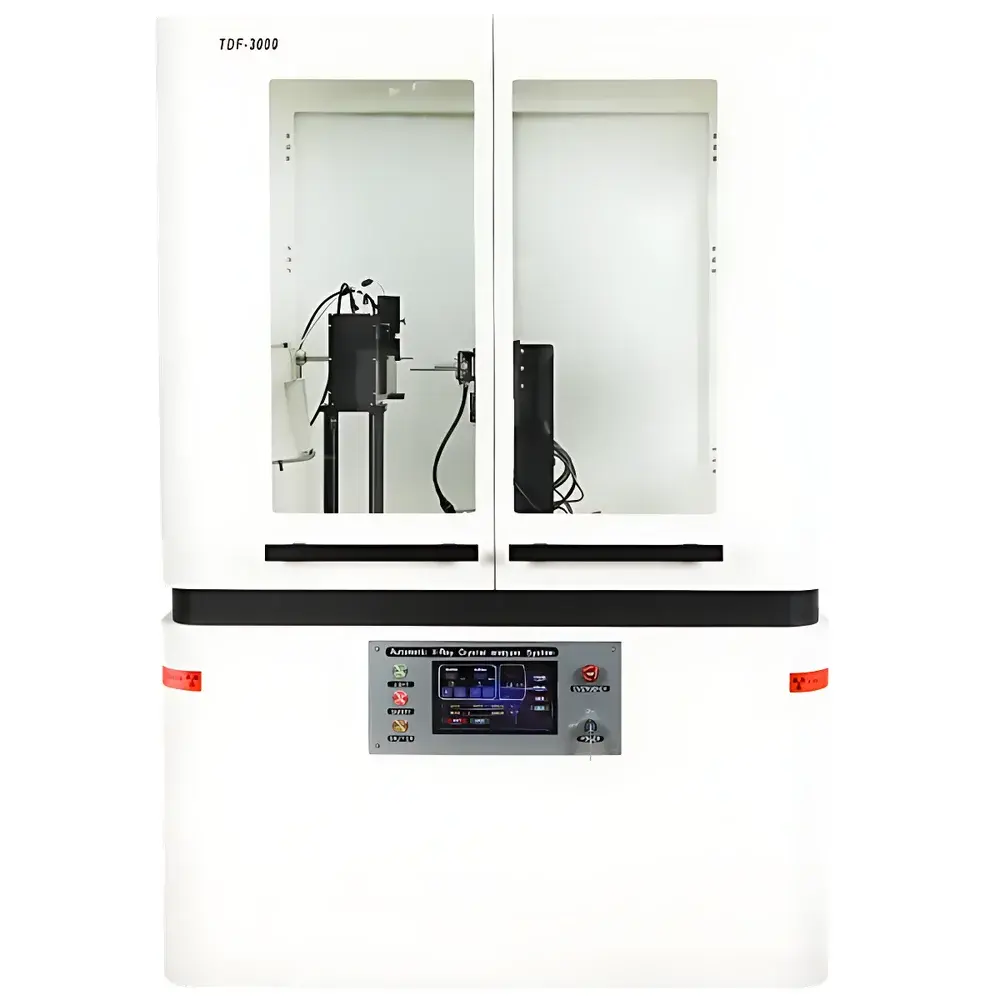
Tongda TDF-3000 X-Ray Single-Crystal Diffractometer
| Brand | Tongda |
|---|---|
| Origin | Liaoning, China |
| Manufacturer Type | Authorized Distributor |
| Origin Category | Domestic (PRC) |
| Model | TDF-3000 |
| Price Range | USD 35,000 – 49,000 |
| Tube Voltage | 10–60 kV |
| Tube Current | 2–60 mA |
| Voltage/Current Stability | ≤ ±0.005% |
| Rated High-Voltage Generator Output Power | 3 kW |
| X-Ray Tube Rated Power | 2.4 kW |
| Focal Spot Size | Point Focus (1 × 1 mm²), Line Focus (1 × 10 mm²) |
| Anode Target Materials | Cu, Co, Fe, Cr, Mo, W |
| HV Cable Dielectric Strength | ≥ 100 kV |
| HV Cable Length | 2 m |
| Radiation Leakage | ≤ 0.1 µSv/h (at 5 cm from shield surface) |
Overview
The Tongda TDF-3000 X-Ray Single-Crystal Diffractometer is a precision-engineered instrument designed for structural characterization of crystalline materials via Bragg diffraction geometry. It operates on the fundamental principle of X-ray crystallography—where monochromatic X-rays interact with periodic atomic lattices to produce characteristic diffraction patterns governed by Bragg’s law (nλ = 2d sinθ). The system supports both Laue and rotating-crystal methods, enabling quantitative determination of unit cell parameters, crystal orientation, lattice strain, dislocation density, and residual stress distribution in bulk single crystals and epitaxial films. Its vertical tube housing accommodates four independent beam ports, facilitating simultaneous configuration of multiple detection geometries—including point-collimated Laue photography, powder Debye–Scherrer imaging, and multiwire area detection—without mechanical realignment.
Key Features
- Vertical high-vacuum X-ray tube assembly with dual focal spot options (1 × 1 mm² point focus for high-resolution angular definition; 1 × 10 mm² line focus for enhanced intensity in texture or stress mapping)
- Imported programmable logic controller (PLC)-based high-voltage generator with active feedback regulation—ensuring voltage and current stability better than ±0.005% over extended operational cycles
- Automated X-ray tube conditioning protocol integrated into the control firmware, reducing thermal shock during startup and extending tube service life beyond 5,000 operating hours under nominal load
- Modular detector interface supporting interchangeable configurations: standard Laue camera (for back-reflection and transmission geometry), flat-plate film holder (for powder and polycrystalline analysis), and optional Multiwire proportional counter (U.S.-sourced, 2D position-sensitive detection with < 200 µm spatial resolution)
- Lead-glass radiation shielding (≥ 2.5 mm Pb equivalence) certified to IEC 61000-4-3 and GBZ 138–2019 standards, limiting ambient dose rate to ≤ 0.1 µSv/h at 5 cm from all accessible surfaces
- Three-axis motorized goniometer (ω, χ, φ) with optical encoder feedback (resolution: 0.001°), compatible with crystal alignment routines per ASTM E975 and ISO 11171
Sample Compatibility & Compliance
The TDF-3000 accepts single-crystal specimens ranging from 0.5 mm to 50 mm in maximum dimension, including but not limited to semiconductor wafers (Si, GaAs, SiC), oxide ceramics (Al₂O₃, YAG), metallic alloys (Ti-6Al-4V, Inconel 718), and organic molecular crystals. Sample mounting utilizes kinematic three-point chucks with vacuum clamping, ensuring repeatable positioning without plastic deformation. All electrical and radiation safety functions comply with national mandatory standards GB 18871–2002 (Basic Standards for Protection Against Ionizing Radiation) and GB/T 18268.1–2010 (EMC requirements for laboratory equipment). The system architecture supports audit-ready operation under GLP and GMP environments, with optional timestamped log export for traceability.
Software & Data Management
Control and data acquisition are managed through Tongda’s proprietary TDF-Studio v4.2 software suite, running on Windows 10 IoT Enterprise. The application provides real-time diffraction image preview, automatic peak indexing using the NIST Crystal Data Library (version 2023), and lattice parameter refinement via least-squares minimization (Rietveld-compatible output format). Raw frame data is stored in vendor-neutral TIFF-64 with embedded EXIF metadata (tube kV/mA, exposure time, goniometer angles, collimation status). Export modules support CIF, .hkl, .xye, and ASCII formats for downstream analysis in GSAS-II, TOPAS, or Mercury. Software validation documentation—including IQ/OQ protocols and 21 CFR Part 11-compliant electronic signature templates—is available upon request for regulated laboratories.
Applications
- Determination of crystallographic orientation in turbine blade superalloys for aerospace quality assurance
- Quantitative assessment of mosaic spread and domain size in synthetic quartz resonators
- In-situ thermal expansion coefficient measurement across phase transitions (e.g., α↔β quartz, martensitic TiNi)
- Residual stress profiling in cold-rolled stainless steel sheets using sin²ψ methodology (ASTM E915)
- Defect mapping in Czochralski-grown silicon ingots via white-beam topography
- Structural solution of small-molecule pharmaceutical intermediates when coupled with low-temperature cryostream accessories
FAQ
Does the TDF-3000 support automated crystal centering?
Yes—the system includes a laser-assisted optical alignment subsystem and iterative centroid-finding algorithms that converge within ±0.02° of true Bragg condition.
Can third-party detectors be interfaced?
The detector port implements IEEE 1394b (FireWire) and USB 3.2 Gen 2 physical layers with documented SDK APIs; compatibility with Dectris EIGER2 R 500K and Rigaku R-AXIS IV+ has been verified.
Is remote diagnostics supported?
TDF-Studio includes secure TLS 1.3-enabled remote maintenance mode, allowing authorized engineers to monitor HV performance logs, thermal sensor readings, and vacuum integrity in real time.
What is the typical warm-up time before stable diffraction data collection?
After cold start, full thermal equilibrium is achieved in ≤ 18 minutes; tube training completes automatically within the first 5 minutes of operation.
Are calibration standards supplied with the instrument?
A NIST-traceable Si (111) reference wafer and certified LaB₆ powder standard (SRM 660c) are included in the delivery package, along with certificate of conformance and uncertainty budgets.






