
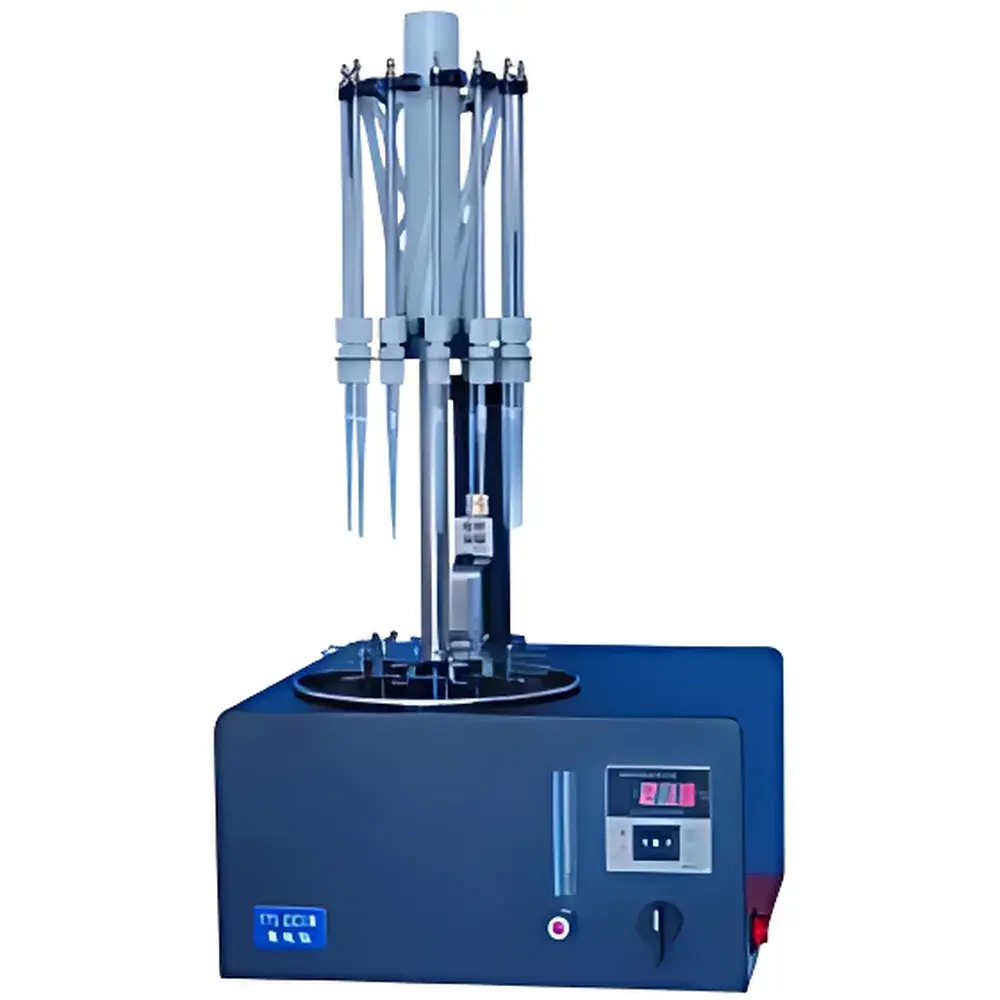
Tongtailian TTL-DCI Series Nitrogen Evaporator
| Brand | Tongtailian (TTL) |
|---|---|
| Origin | Beijing, China |
| Manufacturer Type | Direct Manufacturer |
| Product Origin | Domestic (China) |
| Model | TTL-DCI |
| Price Range | USD 1,400 – 4,200 |
| Heating Method | Water Bath |
| Temperature Range | Ambient to 99.9 °C |
| Temperature Stability | ±1 °C |
| Sample Tube Diameter Compatibility | 10–29 mm |
| Gas Flow Rate | 0–10 L/min |
| Sample Positions | 12 |
| Heating Power | 600 W |
| Display | Digital LED |
| Temperature Accuracy | ±2 °C |
| Nitrogen Consumption per Position | 330 mL/min |
| Material Construction | Stainless Steel Frame with PTFE-Coated Components |
| Gas Control | Individual Needle Valve per Channel + Master Flow Meter with Digital Readout |
| Sample Holder | Motorized Vertical Lift |
| Sample Holder Rotation | 360° Adjustable Orientation |
Overview
The Tongtailian TTL-DCI Series Nitrogen Evaporator is an engineered solution for controlled, parallel sample concentration in analytical laboratories. It operates on the principle of inert gas-assisted solvent evaporation—introducing a gentle, laminar stream of nitrogen or compressed air directly above the liquid surface of heated samples to lower the partial pressure of volatile solvents and accelerate phase transition without thermal degradation. Unlike dry-block or infrared-based concentrators, the TTL-DCI employs a precision-regulated water bath system to deliver uniform thermal energy across all 12 positions, minimizing temperature gradients and ensuring reproducible evaporation kinetics. This architecture is especially critical for thermolabile analytes encountered in LC-MS, GC-MS, and HPLC sample preparation workflows where over-concentration or localized overheating may compromise recovery or induce artifact formation.
Key Features
- Twelve independently controllable sample positions accommodating tubes from 10 mm to 29 mm in outer diameter—including standard culture tubes, conical centrifuge vials, and low-volume glass inserts.
- Motor-driven vertical lift mechanism enables precise, repeatable positioning of the gas delivery manifold relative to sample meniscus height—critical for optimizing mass transfer efficiency and preventing splashing or cross-contamination.
- Each of the 12 gas delivery needles features individual needle valve control and height adjustment, allowing fine-tuned optimization per sample based on solvent volatility, volume, and container geometry.
- Integrated digital flow meter with master control valve provides real-time monitoring and regulation of total gas consumption (0–10 L/min), while calibrated per-channel flow rates remain stable at 330 mL/min per position under nominal operating conditions.
- Water bath heating system maintains temperature uniformity within ±1 °C across the entire heating block; digital PID controller ensures rapid stabilization and minimal overshoot during ramping.
- Corrosion-resistant construction: stainless steel chassis, PTFE-coated heating well, and chemically inert gas pathways ensure long-term reliability when handling acidic, basic, or halogenated solvents.
- Modular needle assembly supports both reusable stainless-steel nozzles and disposable PTFE-tipped consumables—enabling strict segregation between sample batches and simplifying cleaning validation for regulated environments.
Sample Compatibility & Compliance
The TTL-DCI accommodates a broad range of vessel formats without adapter modification: round-bottom test tubes, 15 mL and 50 mL conical centrifuge tubes, 4–10 mL autosampler vials, and custom micro-volume inserts. Its open-bath design allows direct visual monitoring of sample volume reduction and facilitates manual intervention if required. From a regulatory perspective, the instrument’s traceable temperature control, independent gas flow calibration capability, and documented material compatibility support compliance with GLP and GMP-aligned laboratory practices. While not certified to IEC 61000 or UL 61010 by default, its electrical safety architecture meets GB 4793.1–2007 (equivalent to IEC 61010-1:2010), and its temperature logging interface (via optional RS-232/USB module) permits integration into 21 CFR Part 11–compliant data acquisition systems when paired with validated software.
Software & Data Management
The TTL-DCI operates as a standalone benchtop unit with local digital control; no proprietary software is required for basic operation. However, optional communication modules (RS-232 or USB-to-serial) enable remote parameter setting, real-time temperature and flow telemetry, and time-stamped event logging via third-party SCADA or LIMS platforms. All temperature setpoints, dwell times, and gas flow configurations can be exported in CSV format for audit trail generation. The embedded firmware retains up to 10 user-defined method profiles, each storing target temperature, ramp rate, hold duration, and gas flow setpoint—supporting method reproducibility across shifts and operators.
Applications
This evaporator is routinely deployed in environmental testing labs for concentrating pesticide residues from aqueous extracts prior to GC-ECD analysis; in clinical toxicology for preparing urine specimens for LC-MS/MS quantification of opioids and benzodiazepines; and in pharmaceutical R&D for high-throughput cleanup of reaction mixtures following solid-phase extraction. Its balanced combination of thermal uniformity, gas flow precision, and mechanical flexibility makes it particularly suitable for applications requiring intermediate throughput (12–24 samples/batch) with stringent recovery consistency—such as EPA Method 525.3 (drinking water), ISO 18856 (water quality), and USP dissolution sample workup.
FAQ
Is the TTL-DCI compatible with compressed air instead of nitrogen?
Yes—the gas inlet accepts any clean, oil-free, dry compressed gas up to 100 psi; air is commonly used for non-sensitive applications to reduce operational cost.
Can the water bath be filled with alternative heat-transfer fluids?
Only deionized water or glycerol–water mixtures (≤30% v/v) are recommended; silicone oils or organic solvents are incompatible with the PTFE-coated bath and may damage seals.
What maintenance intervals are recommended for long-term accuracy?
Calibration of the temperature sensor and flow meter should be performed annually using NIST-traceable references; routine cleaning of needle orifices and bath descaling is advised every 200 operational hours.
Does the instrument support external temperature probe input for sample-specific monitoring?
No—the system relies on bath temperature feedback only; however, optional PT100 probe ports can be factory-installed upon request for auxiliary monitoring.
Are replacement parts such as PTFE-coated needles and O-rings available separately?
Yes—Tongtailian supplies full OEM spare kits including valves, seals, and consumable nozzles with documented lot traceability for quality assurance purposes.



