
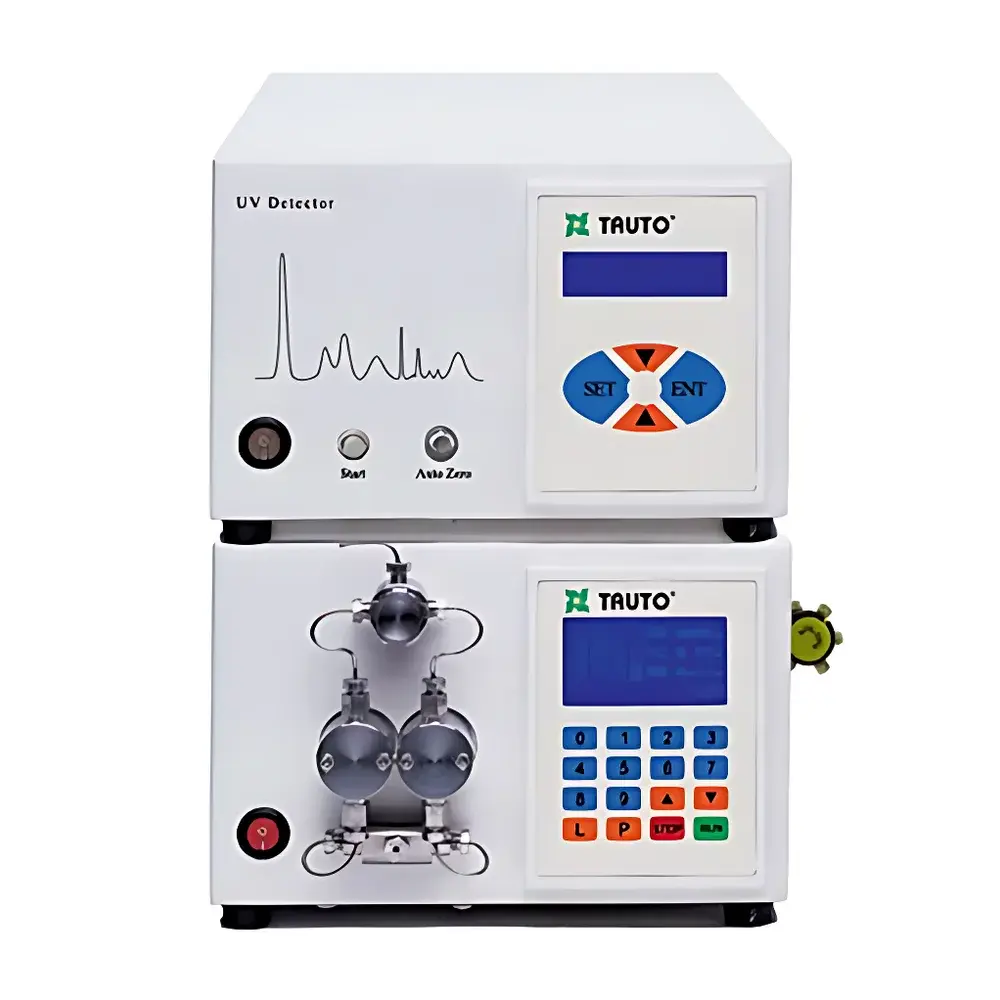
Tongtian S2000 Six-Wavelength Medium-Pressure Preparative Liquid Chromatography System
| Brand | Tongtian |
|---|---|
| Origin | Shanghai, China |
| Model | S2000 |
| Application Level | Laboratory Grade |
| Instrument Type | Medium-Low Pressure Preparative LC System |
| Flow Rate Range | 1–200 mL/min |
| Flow Accuracy | ≤ ±2% |
| Flow RSD | ≤ 1% |
| Max Operating Pressure | 20 MPa |
| Wavelength Range | ±1 nm |
| Wavelength Repeatability | 0.2 nm |
| Baseline Noise | 1 × 10⁻⁵ AU |
| Data Acquisition Frequency | 20 Hz |
Overview
The Tongtian S2000 Six-Wavelength Medium-Pressure Preparative Liquid Chromatography System is an engineered solution for scalable purification of natural products, peptides, oligonucleotides, and other labile biomolecules under controlled medium-pressure conditions (up to 20 MPa). Built upon a dual-piston constant-flow pump architecture and integrated multi-wavelength UV detection, the system operates on the principle of gradient or isocratic liquid chromatography—where differential partitioning of analytes between a stationary phase (e.g., silica, C18, or specialized bio-inert resins) and a mobile phase enables high-resolution fractionation. Unlike analytical HPLC systems optimized for sensitivity, the S2000 prioritizes robustness, sample loading capacity, and reproducible column hydrodynamics—making it suitable for gram-scale isolation in academic labs, biotech process development, and early-stage pharmaceutical purification workflows.
Key Features
- Dual-head positive-displacement plunger pump delivering stable flow across 1–200 mL/min with ≤1% RSD and ≤±2% accuracy—critical for maintaining consistent retention times and peak shape during extended runs.
- Six independently selectable UV wavelengths (254 nm, 280 nm, 313 nm, 365 nm, plus two additional user-configurable channels) enabled by deuterium lamp source and precision monochromator; wavelength repeatability of ±0.2 nm ensures inter-run comparability for multi-component tracking.
- Bio-inert fluidic path constructed from PEEK, sapphire, and ceramic components—minimizing metal ion leaching and surface adsorption, especially for acidic/basic or thiol-containing compounds.
- Integrated medium-pressure injection valve (V-541 type) with optional 10/20/50 mL sample loops—supporting both loop- and direct-injection modes for flexible loading strategies without manual column disassembly.
- Real-time digital flow control interface with tactile feedback and password-protected parameter locking—designed to meet GLP documentation requirements for method traceability.
- Modular column interface accommodating standard 10–50 mm ID preparative columns with Swagelok-compatible conversion fittings—enabling rapid column swaps and pressure-tolerant packing validation up to 20 MPa.
Sample Compatibility & Compliance
The S2000 is validated for use with common reversed-phase (C4, C8, C18), ion-exchange (SP, DEAE), size-exclusion (SEC), and affinity-based media—including polymer-coated silica and macroporous resins. Its low baseline noise (1 × 10⁻⁵ AU at 254 nm) and 20 Hz acquisition rate support reliable integration of broad, low-intensity peaks typical of crude extract separations. The system conforms to ISO 9001 manufacturing standards and supports audit-ready operation through configurable electronic logs. While not pre-certified for FDA 21 CFR Part 11, its software architecture permits implementation of user-defined electronic signatures, audit trails, and data integrity controls aligned with GMP/GLP expectations for non-clinical research environments.
Software & Data Management
The embedded chromatography workstation provides real-time chromatogram display, peak integration (with customizable slope/threshold settings), fraction collection triggering (time-, peak-, or threshold-based), and method archiving with version control. Raw data files are saved in vendor-neutral ASCII format (.csv) and proprietary binary (.tdf) for backward compatibility. Export modules support direct transfer to third-party analysis platforms including OpenChrom and Chromeleon (via CSV import). All acquisition parameters—including flow profile, gradient table, wavelength schedule, and detector gain—are stored within each run file, enabling full experimental reconstruction. Optional network licensing allows centralized method deployment across multiple instruments in core facilities.
Applications
- Purification of plant-derived alkaloids, flavonoids, and terpenoids from crude extracts using step-gradient elution on C18 or diol columns.
- Desalting and buffer exchange of synthetic peptides prior to lyophilization or structural characterization.
- Removal of endotoxins and host-cell proteins from monoclonal antibody intermediates via multimodal chromatography.
- Isolation of nucleotide analogs and modified oligos under mild pH and low-UV-exposure conditions.
- Method scouting for downstream analytical HPLC or MS analysis—leveraging identical chemistries and retention behavior at preparative scale.
FAQ
What is the maximum column internal diameter supported by the S2000 system?
The system is mechanically and hydraulically optimized for columns ranging from 10 mm to 50 mm internal diameter, with recommended linear velocities maintained via adjustable flow rates per column cross-section.
Can the six-wavelength detection be used simultaneously for real-time spectral deconvolution?
No—the six wavelengths are sequentially scanned at 20 Hz total acquisition rate; simultaneous multi-wavelength monitoring is not implemented. However, rapid switching (<50 ms per channel) enables quasi-simultaneous tracking of co-eluting species with distinct absorbance maxima.
Is the pump compatible with aggressive solvents such as THF or chloroform?
Yes—standard wetted materials (PEEK, sapphire, ceramic) resist degradation in THF, DCM, and acetonitrile; however, prolonged exposure to chloroform requires optional fluoropolymer seals and solvent compatibility verification per ASTM D471 guidelines.
Does the system include compliance features for regulated laboratories?
It provides foundational capabilities—including electronic logbooks, method versioning, and raw data immutability—but formal 21 CFR Part 11 compliance requires site-specific validation protocols and supplementary access controls implemented by the end user.
What maintenance intervals are recommended for the plunger seals and UV lamp?
Plunger seals should be inspected every 500 operational hours and replaced every 1,000 hours under typical usage; the D₂ lamp has a rated lifetime of 1,500 hours and is monitored via intensity calibration routines embedded in the software.





