
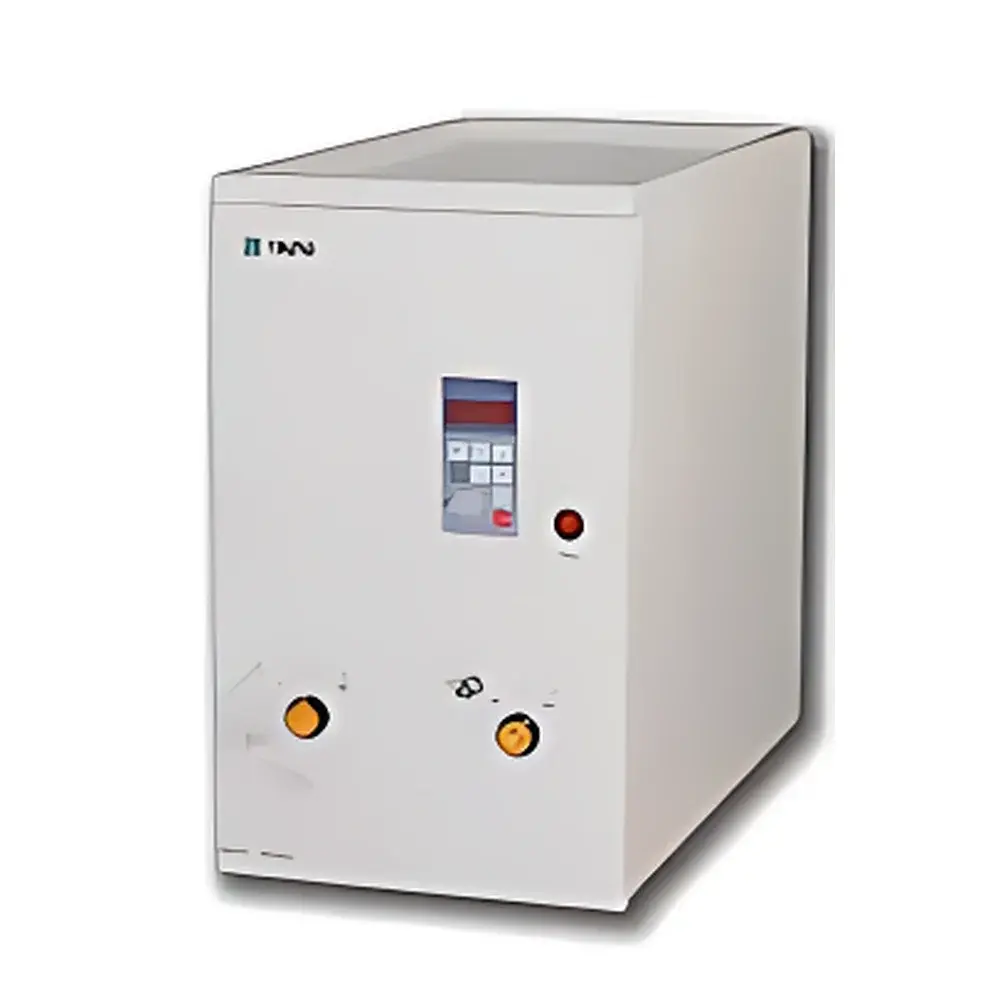
Tongtian TBE-200V High-Speed Counter-Current Chromatograph
| Brand | Tongtian |
|---|---|
| Origin | Shanghai, China |
| Model | TBE-200V |
| Column Capacity | 200 mL |
| Sample Injection Volume | 20 mL |
| Dimensions (W×D×H) | 330 × 600 × 550 mm |
| Rotation Speed Range | 0–1000 rpm |
| Separation Speed | 700–900 rpm (stepless frequency-controlled) |
| Flow Rate Range | 0.1–30 mL/min |
| Separation Flow Rate | 1.5–2.0 mL/min |
| Maximum System Pressure | 2 MPa |
| UV Detector Wavelengths | 254 nm & 280 nm (dual fixed-wavelength) |
| Temperature Control Range | 15–40 °C (±0.5 °C accuracy) |
| Circulating Cooling Fluid Flow | 1–10 L/min |
| Column Configuration | Three serially connected helical separation columns |
| Valve System | Dual six-port switching valves |
| Detection Mode | Real-time online UV detection |
| Instrument Orientation | Vertical architecture |
Overview
The Tongtian TBE-200V High-Speed Counter-Current Chromatograph (HSCCC) is a liquid–liquid partition chromatographic system engineered for high-resolution, non-destructive separation of thermally labile and structurally complex biomolecules without solid stationary-phase interactions. Unlike conventional column chromatography, HSCCC relies on the differential partitioning of analytes between two immiscible liquid phases—one serving as the stationary phase (retained by centrifugal force in a coiled column) and the other as the mobile phase (pumped through the system). The TBE-200V implements a vertically oriented, triple-helical column assembly rotating at precisely controlled speeds (700–900 rpm), generating stable hydrodynamic equilibrium to retain >95% of the stationary phase under continuous elution. This design eliminates irreversible adsorption, minimizes sample degradation, and ensures quantitative recovery—critical for isolating sensitive natural products such as polysaccharides, peptides, glycoproteins, alkaloids, and flavonoid aglycones.
Key Features
- Triple-helical column configuration with serial interconnection—optimized for enhanced retention of stationary phase and improved peak resolution across extended run times.
- Vertical instrument architecture—reduces footprint, improves mechanical stability during high-speed rotation, and facilitates ergonomic access to fluidic connections and detector ports.
- Dual six-port switching valves—enabling flexible solvent system selection, automated fraction collection, and seamless transition between equilibration, separation, and cleaning cycles.
- Stepless frequency-controlled motor drive—provides precise, repeatable rotational control from 0 to 1000 rpm with <±1 rpm stability at setpoint, essential for method transfer and regulatory reproducibility.
- Integrated dual-wavelength UV detector (254 nm and 280 nm)—supports real-time monitoring of aromatic and peptide-bond absorbance, with analog output for synchronized data acquisition.
- Active temperature regulation via external recirculating chiller interface—maintains column thermal environment within ±0.5 °C over 15–40 °C range, critical for controlling partition coefficient (K) drift in temperature-sensitive systems.
Sample Compatibility & Compliance
The TBE-200V is routinely applied to crude extracts, fermentation broths, and partially purified fractions containing macromolecular or amphiphilic compounds unsuitable for silica-based HPLC. Its solvent flexibility supports common biphasic systems including n-hexane–ethyl acetate–methanol–water (HEMWAT), chloroform–methanol–water, and tert-butyl methyl ether–acetonitrile–water. As a non-adsorptive technique, it complies with ICH Q5A and USP guidelines for characterization of biologics, and supports GLP-compliant workflows when paired with audit-trail-capable data systems. While not inherently 21 CFR Part 11 compliant, its analog UV output and discrete valve timing signals are compatible with validated third-party acquisition platforms meeting FDA requirements.
Software & Data Management
The TBE-200V operates as a hardware-controlled standalone system with manual parameter setting via front-panel interface. It outputs analog voltage signals (0–1 V DC) from the UV detector and TTL-compatible status pulses from valve actuation and rotation encoder feedback. These signals integrate seamlessly with industry-standard chromatography data systems (CDS), including Empower™, Chromeleon™, and LabSolutions™, enabling time-stamped chromatogram generation, fraction trigger logic, and post-run peak integration. Raw signal logging, method parameter archiving, and electronic lab notebook (ELN) export are supported through CDS-level configurations—ensuring traceability per ISO/IEC 17025:2017 clause 7.7.
Applications
- Purification of plant-derived polysaccharides (e.g., arabinogalactans, fucoidans) with preserved glycosidic linkage integrity.
- Isolation of bioactive peptides from enzymatic digests without denaturation or surface adsorption losses.
- Separation of enantiomeric alkaloids using chiral aqueous–organic solvent systems.
- Preparative-scale isolation of marine natural products (e.g., brominated indoles, meroterpenoids) from complex lipid-rich matrices.
- Downstream processing support for monoclonal antibody fragments where residual host-cell proteins must be removed without ion-exchange or affinity resin contact.
FAQ
Does the TBE-200V require column packing or conditioning before use?
No—its separation mechanism relies entirely on liquid-phase retention; no column packing, silanization, or equilibration beyond solvent system priming is required.
Can the system accommodate gradient elution?
Not natively—the TBE-200V uses isocratic biphasic solvent delivery; however, multi-step isocratic runs with pre-programmed valve switching can simulate step gradients.
What maintenance is required for long-term rotational stability?
Annual calibration of speed encoder and bearing lubrication per manufacturer’s service protocol; no consumable column replacements are needed.
Is the UV detector compliant with pharmacopeial wavelength accuracy standards?
The fixed 254 nm and 280 nm LEDs meet USP tolerance limits (±2 nm) when verified with NIST-traceable holmium oxide reference filters.
How is system suitability assessed for QC applications?
Via stationary phase retention ratio (Sf) measurement, peak symmetry (As), and resolution (Rs) between reference standards—protocols align with ASTM D7811-15 for CCC performance verification.




