
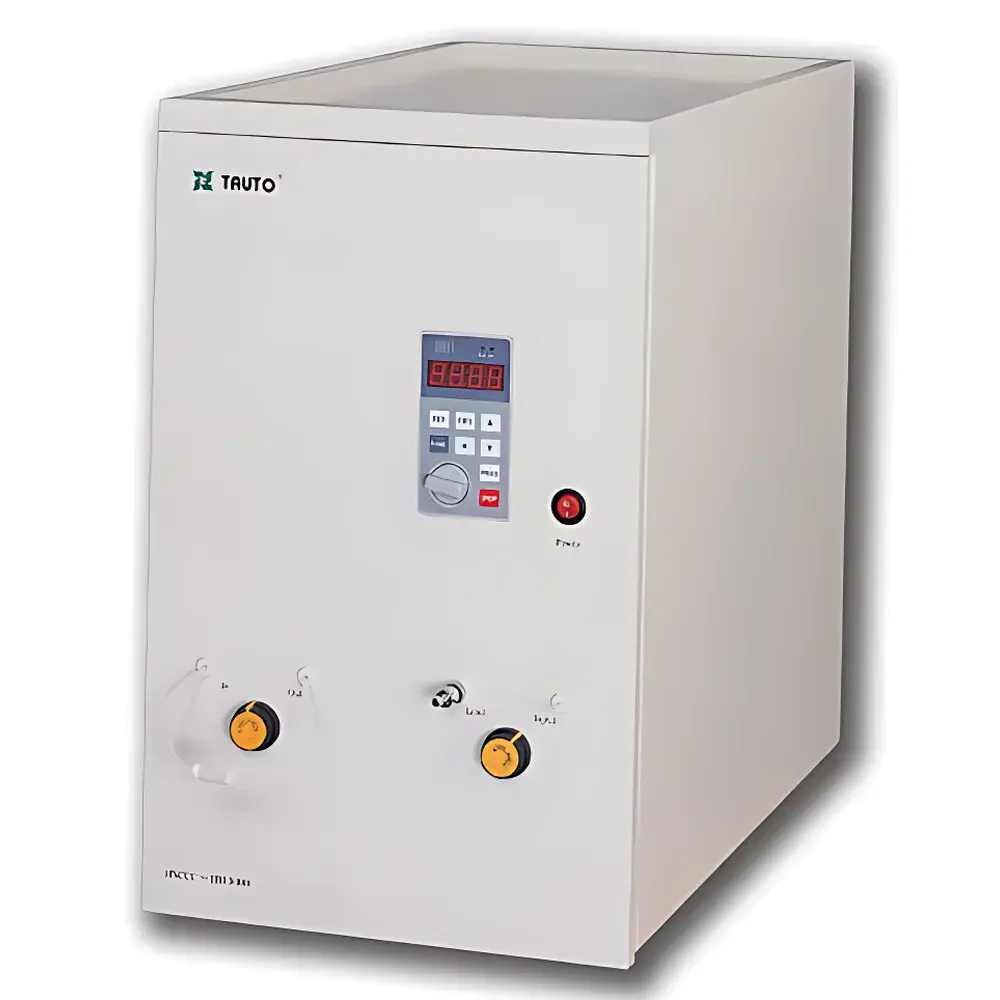
Tongtian TBE-300B High-Speed Counter-Current Chromatography (HSCCC) System
| Brand | Tongtian |
|---|---|
| Origin | Shanghai, China |
| Model | TBE-300B |
| Configuration | Vertical triple-column HSCCC system with dual six-port valves |
| Separation Capacity | mg–g scale |
| Column Volume | 280 mL |
| Sample Loop | 20 mL |
| Rotation Speed Range | 0–1000 rpm (stepless frequency-controlled) |
| Optimal Separation Speed | 700–1000 rpm |
| Flow Rate Range | 0.1–30 mL/min |
| Recommended Separation Flow Rate | 2.0–4.0 mL/min |
| Temperature Control | 15–40 °C (±0.5 °C), external water bath interface, circulation flow 1–10 L/min |
| Power Supply | 220 V ±20 V, 50 Hz ±0.5 Hz |
| Max Operating Pressure | 2 MPa |
| Dimensions (W×D×H) | 330 × 600 × 550 mm |
| Power Consumption | 300 W |
Overview
The Tongtian TBE-300B High-Speed Counter-Current Chromatography (HSCCC) System is a vertically oriented, preparative-scale liquid–liquid partition chromatograph engineered for high-resolution, solvent-based separation of thermally labile and non-volatile compounds without solid stationary-phase adsorption. Unlike conventional column chromatography, HSCCC operates on the principle of partition equilibrium between two immiscible liquid phases—one serving as the stationary phase (retained by centrifugal force in coiled or helical columns) and the other as the mobile phase (pumped through the system). The TBE-300B implements a patented triple-separation-column architecture with dual six-port switching valves, enabling sequential or parallel elution modes, enhanced peak capacity, and improved reproducibility across multi-step fractionation protocols. Designed specifically for natural product isolation, pharmaceutical intermediate purification, and metabolite enrichment, this instrument supports rigorous method development under GLP-compliant workflows and aligns with ASTM D7967 (standard guide for liquid–liquid extraction techniques) and ISO/IEC 17025 requirements for analytical instrumentation validation.
Key Features
- Triple-coil column assembly (total volume: 280 mL) with optimized geometry for high stationary-phase retention (>85% at 900 rpm) and minimal band broadening
- Dual six-port valve configuration supporting automated fraction collection, solvent recycling, and multi-step gradient partitioning
- Stepless frequency-controlled motor delivering precise rotational control from 0 to 1000 rpm (±1 rpm stability at setpoint)
- Integrated temperature management interface compatible with external recirculating chillers or water baths (15–40 °C, ±0.5 °C accuracy)
- High-pressure fluidic path rated to 2 MPa, accommodating viscous solvent systems including chloroform/methanol/water and ethyl acetate/n-butanol/water mixtures
- Modular design permitting seamless integration with UV-Vis online detectors (e.g., 254/280 nm), fraction collectors, and mass-directed triggering systems
Sample Compatibility & Compliance
The TBE-300B is validated for the isolation of low-to-medium molecular weight organic compounds (MW 99% purity in single-run preparations. The system conforms to ISO 9001:2000 quality management standards (certified by DNV) and carries CE marking per EU Directive 2014/30/EU (EMC) and 2014/35/EU (LVD). All electronic control modules support audit trail logging and user-access-level permissions, facilitating alignment with FDA 21 CFR Part 11 requirements when paired with compliant third-party data acquisition software.
Software & Data Management
While the TBE-300B operates via hardware-integrated digital panel controls, it features analog/digital I/O ports (RS-232, 0–5 V TTL) for synchronization with external chromatography data systems (CDS), such as Chromeleon™, Empower™, or open-source platforms like OpenChrom. Real-time monitoring of rotation speed, flow rate, column backpressure, and bath temperature is enabled through optional analog signal output. For full traceability, users may configure external PCs to record timestamps, valve actuation events, and fraction trigger signals—supporting GMP-aligned documentation practices including electronic signatures, version-controlled method storage, and secure raw data archiving.
Applications
- Purification of bioactive natural products from plant extracts (e.g., Huperzia serrata, Ginkgo biloba, Glycine max)
- Isolation of antibiotic intermediates and chiral metabolites for structure–activity relationship (SAR) studies
- Preparative-scale separation of synthetic oligomers and peptide fragments prior to NMR or X-ray crystallography
- Reference standard preparation for USP/NIST-certified material qualification
- Process development for continuous counter-current extraction (CCE) scale-up in API manufacturing
FAQ
What types of solvent systems are compatible with the TBE-300B?
The system supports biphasic solvent systems with partition coefficients (K) between 0.2 and 5. Common examples include hexane/ethyl acetate/methanol/water (HEMWat), chloroform/methanol/water (CMW), and tert-butyl methyl ether/acetonitrile/water (TAME/ACN/H₂O).
Can the TBE-300B be used for method transfer from analytical to preparative scale?
Yes—its triple-column design allows direct scaling from analytical HSCCC methods (e.g., using 1–5 mL columns) by maintaining identical phase ratio, flow-to-speed ratio (F/S), and settling time parameters.
Is remote operation or network connectivity supported?
Native Ethernet or Wi-Fi is not embedded; however, the RS-232 port enables integration with LabView™, Python-based automation scripts, or SCADA environments via serial-to-Ethernet converters.
What maintenance is required for long-term operational stability?
Routine checks include rotor bearing lubrication every 12 months, O-ring replacement in high-pressure manifolds annually, and calibration verification of tachometer and flowmeter against NIST-traceable references per ISO/IEC 17025 Clause 6.5.
Related Products






