
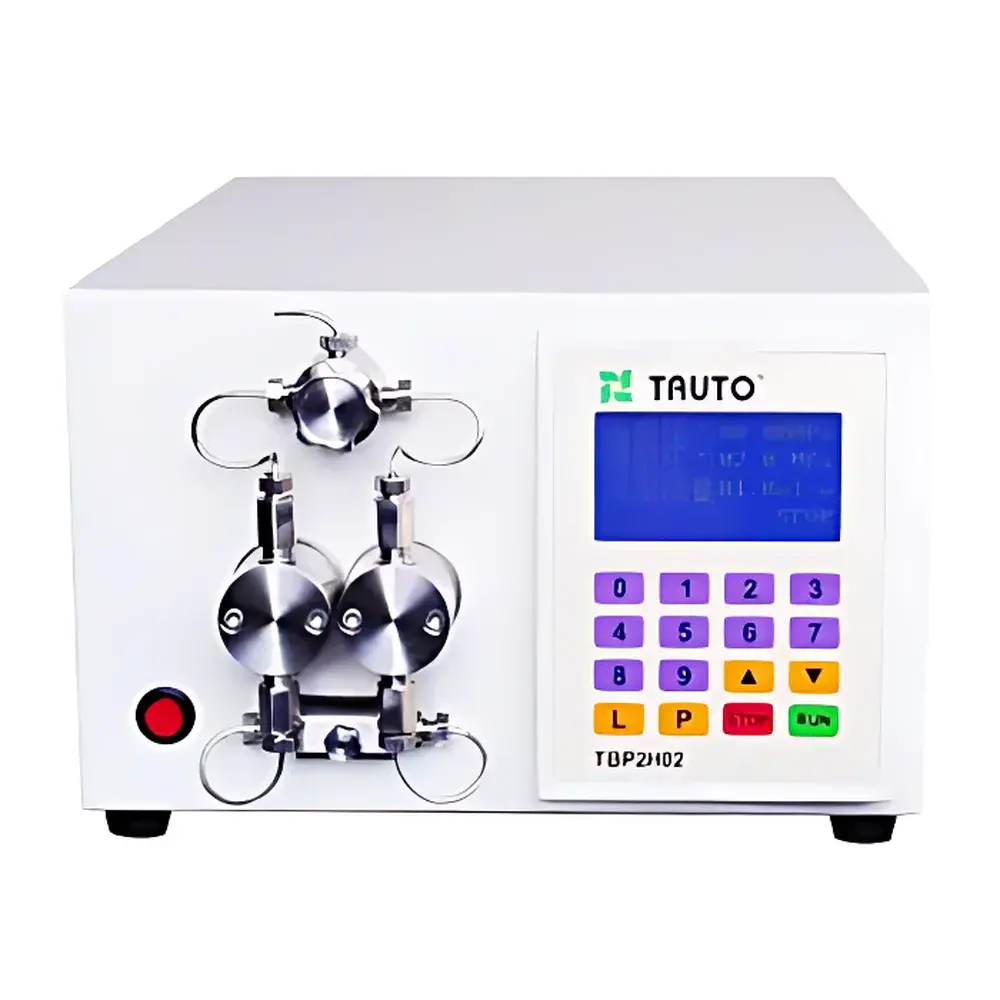
Tongtian TBP-1002 Dual-Piston Constant Flow Pump for Medium-Pressure Chromatography
| Brand | Tongtian |
|---|---|
| Origin | Shanghai, China |
| Model | TBP-1002 |
| Pressure Range | 0–2.0 MPa |
| Flow Rate Range | 0.1–10.0 mL/min |
| Pressure Pulsation | ≤ 0.08 MPa |
| Pressure Accuracy | ≤ ±0.05 MPa |
| Flow Setting Error | ≤ ±1% |
| Flow Precision (RSD) | ≤ 1% |
| Wetted Materials | Sapphire, 316L Stainless Steel, Zirconia Ceramic |
| Interface | RS232 |
| Power Supply | 220 V ±10%, 50/60 Hz |
| Power Consumption | 75 W |
| Dimensions | 360 × 255 × 160 mm |
| Weight | 12 kg |
Overview
The Tongtian TBP-1002 is a dual-piston constant flow pump engineered for medium-pressure liquid delivery in analytical and preparative chromatographic applications. It operates on positive displacement principle using synchronized dual reciprocating pistons to deliver highly stable volumetric flow with minimal pulsation—critical for baseline stability in UV detection and reproducible retention time alignment in HPLC, flash chromatography, and process-scale purification workflows. Unlike single-piston designs, the dual-piston architecture ensures continuous fluid displacement, reducing pressure ripple to ≤ 0.08 MPa while maintaining flow precision (RSD ≤ 1%) across its full operating range of 0.1–10.0 mL/min. The pump is rated for maximum system pressure up to 2.0 MPa (20 bar), positioning it between low-pressure peristaltic systems and high-pressure UHPLC instrumentation—making it ideal for silica-based flash columns, ion exchange resins, and size-exclusion media requiring controlled eluent delivery without excessive backpressure.
Key Features
- Dual-piston hydraulic design with phase-shifted actuation to minimize flow pulsation and extend sapphire ball and plunger service life
- Chemically inert wetted path comprising sapphire check valves, 316L stainless steel pump head and tubing, and zirconia ceramic seals—validated for compatibility with acetonitrile, methanol, THF, dichloromethane, and aqueous buffers containing up to 0.1% TFA or formic acid
- Integrated over-pressure protection circuitry that automatically halts operation if system pressure exceeds user-defined threshold (adjustable from 0.5–2.0 MPa)
- Real-time digital display of actual pressure, set pressure, and programmed flow rate; graphical pressure trend curve with adjustable time scale
- RS232 serial interface compliant with standard SCPI command syntax for integration into LabVIEW, MATLAB, or custom LIMS environments
- Onboard timer function enabling scheduled start/stop sequences for unattended overnight runs
- Manual air purge valve and self-venting check valve geometry to eliminate entrained gas prior to column equilibration
Sample Compatibility & Compliance
The TBP-1002 is designed for use with non-particulate, low-viscosity (< 5 cP) liquids compatible with its wetted materials. It meets mechanical safety requirements per IEC 61010-1 for laboratory equipment and incorporates electrical isolation conforming to EN 61326-1 (EMC for measurement and control equipment). While not certified to ISO/IEC 17025 or FDA 21 CFR Part 11 out-of-the-box, its RS232 interface supports audit-trail-capable software implementations when paired with validated host applications. The pump’s flow accuracy (≤ ±1% setting error) and repeatability (RSD ≤ 1%) align with ASTM D5292 (standard test method for flow rate verification of liquid chromatographic pumps) and are suitable for GLP-compliant method development where traceability of calibration records is maintained externally.
Software & Data Management
The TBP-1002 communicates via ASCII-based SCPI commands over RS232 at 9600 baud, 8N1. Host software must provide terminal emulation or structured command scripting to configure parameters including flow rate (0.1–10.0 mL/min in 0.01 mL/min increments), pressure limit (0.5–2.0 MPa), run duration, and data logging interval. Raw pressure and flow data can be timestamped and exported as CSV for post-acquisition analysis in Excel or Python pandas. Optional OEM firmware updates may introduce USB-to-serial bridging or Ethernet connectivity—subject to separate validation under site-specific IT policies.
Applications
- Preparative flash chromatography (0.5–5 g scale) using 15–40 µm silica or C18-bonded phases
- Mobile phase delivery in gradient-capable medium-pressure LC systems (e.g., binary mixing with external proportioning valves)
- Continuous solvent delivery for membrane filtration feed streams in pilot-scale bioprocessing
- Controlled reagent addition in automated synthesis reactors requiring stoichiometric precision
- Calibration fluid delivery in viscometer or densitometer verification protocols
- Long-term leaching studies in environmental geochemistry where steady-state eluent flux must be sustained over 72+ hours
FAQ
What solvents are compatible with the TBP-1002’s fluid path?
The sapphire/316L/zirconia construction supports common HPLC-grade organic solvents (acetonitrile, methanol, isopropanol, ethyl acetate), halogenated solvents (DCM, chloroform), and aqueous acids/bases (pH 1–12) at ambient temperature. Avoid hydrofluoric acid, molten alkali metals, or oxidizing agents above 50% w/w concentration.
Can the TBP-1002 be used in GMP-regulated environments?
Yes—as a component within a validated system. Its hardware does not include electronic signature or audit trail functionality, but when integrated with 21 CFR Part 11-compliant host software and operated under documented SOPs, it satisfies equipment qualification requirements for Installation Qualification (IQ) and Operational Qualification (OQ).
Is flow calibration traceable to NIST standards?
The factory calibration uses gravimetric flow verification against NIST-traceable mass standards. End users may perform in-house recalibration using certified flow meters (e.g., Bronkhorst EL-FLOW Select) per ASTM D5292 procedures.
How often should the sapphire check valves be replaced?
Under typical usage (8 h/day, 5 days/week, methanol/water mobile phase), sapphire components exhibit >12 months service life. Replacement frequency increases with abrasive slurries or high-salinity buffers; visual inspection every 200 operational hours is recommended.
Does the pump support pulseless flow for UV-sensitive detection?
Yes—the dual-piston synchronization and internal dampening reduce pressure transients to ≤ 0.08 MPa, resulting in baseline noise < 2 mAU in 1 cm pathlength UV cells when coupled with appropriate detector dwell volume management.



