
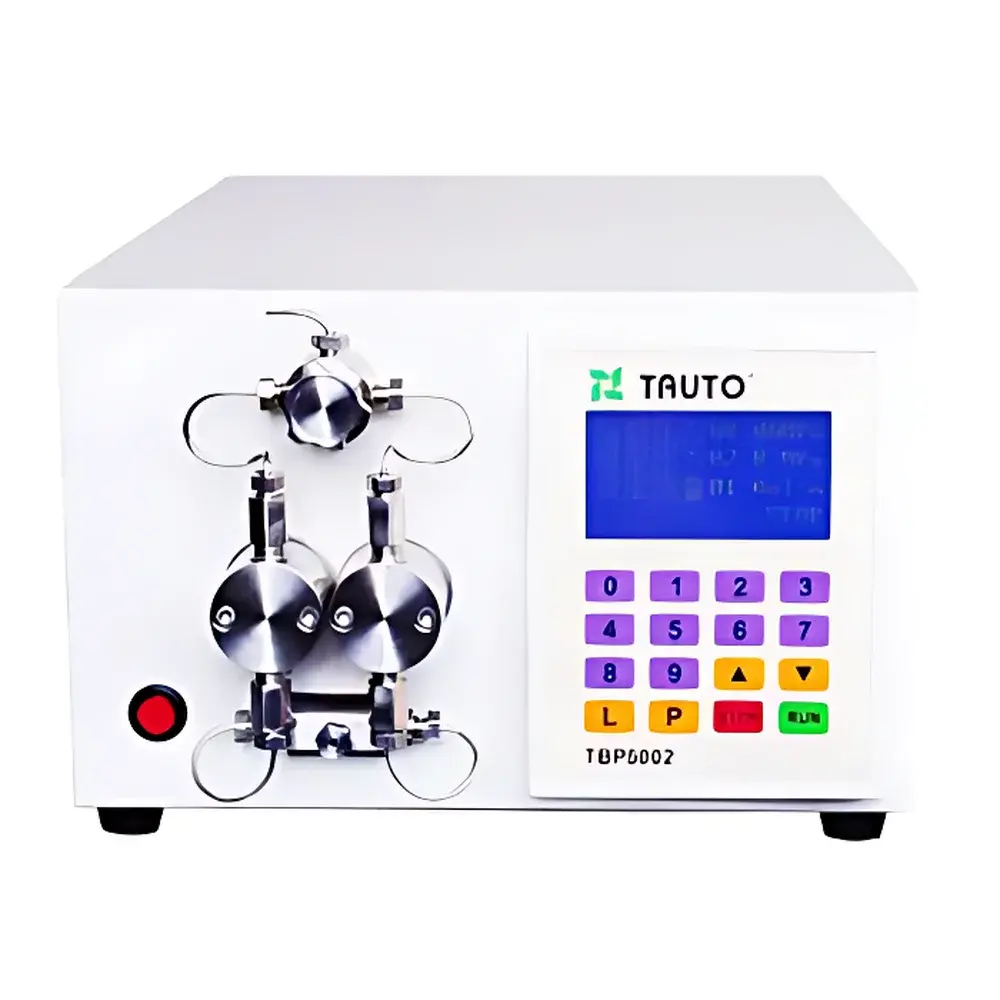
Tongtian TBP-5002 Dual-Piston Constant Flow Pump
| Brand | Tongtian |
|---|---|
| Origin | Shanghai, China |
| Model | TBP-5002 |
| Pressure Range | 0–2.0 MPa |
| Flow Rate Range | 0.1–50.0 mL/min |
| Pressure Pulsation | ≤0.10 MPa |
| Pressure Accuracy | ≤±0.05 MPa |
| Flow Setting Error | ≤1% (0.1–10 mL/min), ≤2% (10–50 mL/min) |
| Flow Precision (RSD) | ≤1% |
| Wetted Materials | Sapphire, 316L Stainless Steel, Zirconia Ceramic |
| Power Supply | 220 V ±10%, 50/60 Hz |
| Power Consumption | 75 W |
| Dimensions | 360 × 255 × 160 mm |
| Weight | 12 kg |
| Communication Interface | RS232 |
Overview
The Tongtian TBP-5002 Dual-Piston Constant Flow Pump is an engineered solution for precise, continuous liquid delivery in analytical, preparative, and process-critical laboratory applications. Based on positive displacement dual-piston architecture, it operates on the principle of reciprocating displacement with active phase synchronization to minimize flow pulsation—ensuring stable hydrodynamic conditions essential for chromatographic elution, reaction feeding, and long-duration infusion studies. Unlike peristaltic or diaphragm-based systems, this pump delivers true constant flow across its operational range without reliance on feedback correction loops, making it suitable for applications demanding high reproducibility under variable backpressure (up to 2.0 MPa). Its microprocessor-controlled drive system enables real-time pressure monitoring, flow calibration, and programmable timing—all accessible via front-panel LCD or external PC interface.
Key Features
- Dual-piston design with synchronized stroke control reduces pressure pulsation to ≤0.10 MPa, supporting baseline stability in HPLC-compatible workflows and sensitive spectroscopic detection.
- Chemically inert wetted path constructed from sapphire pistons/balls, 316L stainless steel fluidic manifolds, and zirconia ceramic seals—validated for compatibility with organic solvents (e.g., acetonitrile, THF, chloroform), aqueous acids/bases (pH 1–13), and aggressive reagents used in synthesis and extraction.
- RS232 serial interface enables bidirectional communication with host computers for remote operation, script-based method sequencing, and integration into automated lab platforms compliant with ASTM E1384 and ISO/IEC 17025 data integrity requirements.
- Integrated over-pressure protection circuitry halts operation if system pressure exceeds user-defined thresholds, preventing column damage or seal failure during blockage events.
- Onboard flow calibration routine allows traceable adjustment using certified volumetric standards—supporting GLP/GMP documentation needs where flow accuracy must be verified per USP <621> or ISO 8573-1.
- Optimized degassing manifold with manual venting valve facilitates rapid removal of entrained air prior to priming—critical for minimizing bubble-induced flow disruption in low-viscosity mobile phases or biological buffers.
Sample Compatibility & Compliance
The TBP-5002 accommodates a broad spectrum of sample matrices including organic solvent mixtures, aqueous buffers, viscous polymer solutions (up to 50 cP), and particulate-laden suspensions (with optional inline filtration). Its material construction meets FDA-relevant biocompatibility criteria per ISO 10993-5 for non-cytotoxicity and complies with RoHS Directive 2011/65/EU for hazardous substance restriction. For regulated environments, audit trails generated via PC software satisfy 21 CFR Part 11 requirements when paired with electronic signature-enabled acquisition systems. The pump’s mechanical design conforms to IEC 61010-1 safety standards for laboratory equipment, and its electromagnetic compatibility is certified to EN 61326-1.
Software & Data Management
The included Windows-based control software provides intuitive graphical configuration of flow rate, pressure limits, run duration, and start/stop triggers. Real-time plotting displays both instantaneous pressure and cumulative volume delivered, with timestamped data export to CSV or Excel formats for post-acquisition analysis. All parameter changes are logged with operator ID, date/time stamp, and reason-for-change fields—enabling full traceability required under ISO/IEC 17025 Clause 7.7 and pharmaceutical QA protocols. Optional API support allows integration with LabVantage, Thermo Fisher SampleManager, or custom LIMS deployments via TCP/IP or OPC UA adapters.
Applications
- Preparative and analytical liquid chromatography (flash, MPLC, and entry-level HPLC) requiring stable gradient formation and low pulse amplitude.
- Controlled reagent addition in catalytic reaction monitoring, crystallization studies, and continuous-flow synthesis reactors.
- Calibration fluid delivery in viscometry, particle size analysis (e.g., dynamic light scattering), and electrochemical cell conditioning.
- Environmental water analysis workflows involving automated solid-phase extraction (SPE) and ion chromatography sample loading.
- Pharmaceutical dissolution testing per USP <711>, where consistent flow across varying tablet matrix resistance is critical for release profile fidelity.
- Bioprocessing applications including buffer exchange, column equilibration, and affinity capture steps in protein purification pipelines.
FAQ
What is the maximum operating temperature for the wetted components?
The sapphire and zirconia components maintain structural integrity up to 80 °C; prolonged exposure above this threshold may affect seal longevity in 316L stainless steel housings.
Can the TBP-5002 be operated in parallel mode with another pump for binary gradient delivery?
No—it is a single-channel constant flow unit. For gradient applications, Tongtian’s Grad series dual-pump systems are recommended, which support independent control and mid-pressure mixing.
Is flow calibration traceable to NIST standards?
Yes; calibration procedures include reference to gravimetrically verified volumetric flasks (Class A, ISO 648) and certified stopwatch timers (traceable to NIST SP 250-94), with certificate generation available upon request.
Does the pump support analog input/output for PLC integration?
Not natively; only RS232 digital communication is provided. Analog I/O requires third-party signal converters compatible with Modbus RTU protocol.
How often should the sapphire pistons be inspected for wear?
Under typical use (≤10 mL/min, 1–2 MPa, clean solvents), inspection is recommended every 6 months or after 2000 hours of cumulative runtime—documented in the maintenance log per ISO 13485 Annex C guidelines.



