
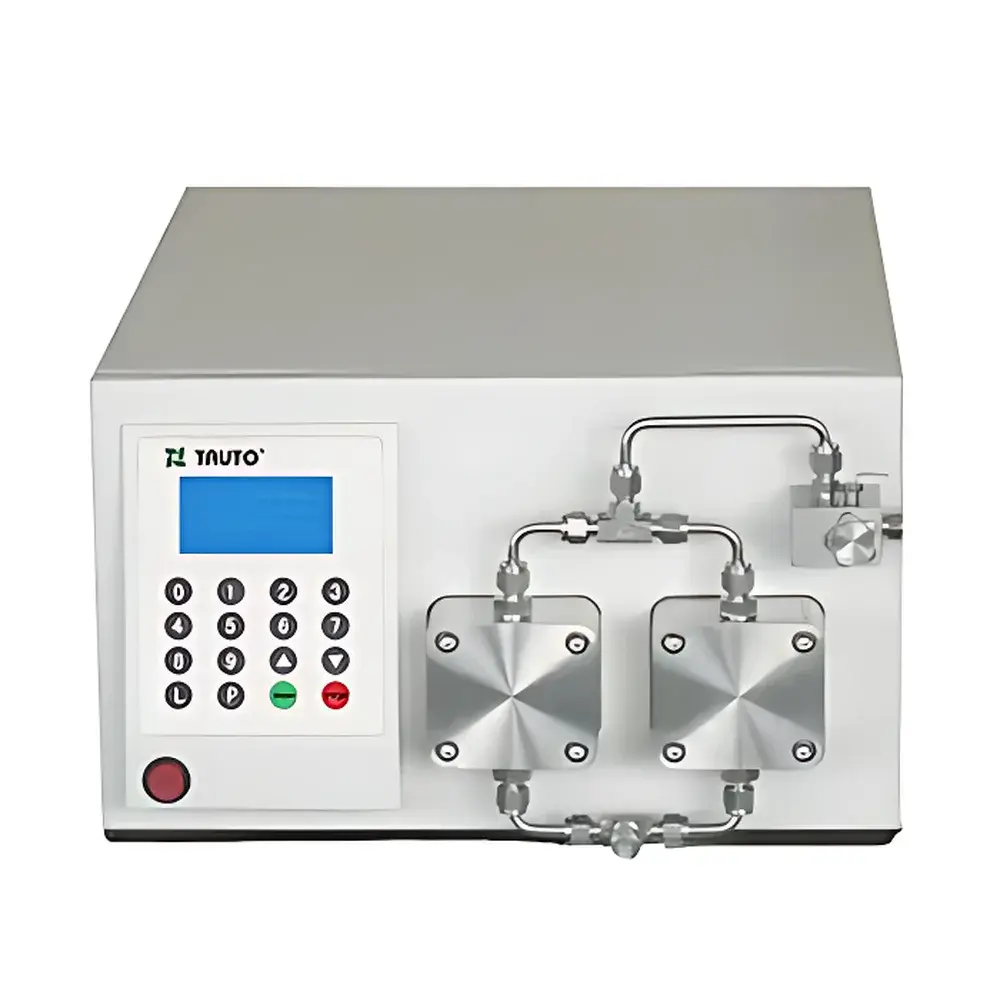
Tongtian TBP1H10S High-Pressure Dual-Piston Constant Flow Pump
| Brand | Tongtian |
|---|---|
| Origin | Shanghai, China |
| Model | TBP1H10S |
| Flow Range | 1–100 mL/min |
| Pressure Range | 0–10.0 MPa |
| Pressure Pulsation | ≤0.05 MPa |
| Flow Accuracy | ≤2% (1–50 mL/min), ≤1.5% (50–100 mL/min) |
| Flow Repeatability | ≤1.5% (1–50 mL/min), ≤1% (50–100 mL/min) |
| Pressure Accuracy | ≤0.20 MPa |
| Wetted Materials | Sapphire ball valves, ceramic plungers, 316L stainless steel or pure titanium pump head & flow path |
| Communication Interface | RS232 |
| Power Supply | 220 V ±10%, 50/60 Hz |
| Power Consumption | 75 W |
| Dimensions | 270 × 400 × 190 mm |
| Weight | 17 kg |
Overview
The Tongtian TBP1H10S is a high-precision dual-piston constant flow pump engineered for stable, pulse-free liquid delivery across mid-pressure analytical and preparative applications. Based on positive displacement reciprocating piston technology with active pressure compensation and microprocessor-driven closed-loop flow control, the TBP1H10S delivers consistent volumetric output under variable backpressure conditions—critical for HPLC, SFC, reaction feeding, continuous extraction, and automated synthesis workflows. Its robust architecture supports sustained operation at up to 10.0 MPa (1450 psi), with flow stability optimized via dual-sapphire check valves, ceramic plunger rods, and modular sealing design. Unlike conventional low-cost peristaltic or single-piston systems, the TBP1H10S eliminates reliance on mechanical feedback alone; instead, it integrates real-time pressure monitoring and adaptive stroke calibration to maintain accuracy across its full 1–100 mL/min range.
Key Features
- Dual-sapphire ball check valve assembly—ensures long-term flow integrity, minimal wear, and resistance to particulate-induced failure
- Ceramic plunger rods combined with chemically inert wetted-path options: 316L stainless steel (L-series) or grade 2 pure titanium (T-series) for aggressive solvents including halogenated organics, strong acids, and alkaline media
- Low-pressure pulsation design (≤0.05 MPa) achieved through synchronized dual-piston phasing and optimized fluidic damping geometry
- Modular pump housing enables in-situ maintenance—valve replacement, seal inspection, or plunger cleaning without system shutdown or disassembly of tubing connections
- Integrated overpressure protection circuitry automatically halts operation if preset pressure threshold is exceeded, safeguarding downstream instrumentation and columns
- Factory-calibrated flow correction algorithm compensates for viscosity-dependent slippage and thermal expansion effects, supporting traceable reproducibility per ISO 5725-2
- Large-bore flow path (standard 2/3/6 mm ID tubing compatibility, plus 1/8″ NPT/BSPP custom ports) minimizes clogging risk in crude feed streams, suspensions, or viscous formulations
Sample Compatibility & Compliance
The TBP1H10S accommodates a broad spectrum of process liquids—from aqueous buffers and organic eluents (acetonitrile, THF, DCM) to corrosive reagents (conc. HCl, HNO₃, NaOH) and high-viscosity solutions (polymer melts <500 cP). Its titanium-wetted configuration complies with ASTM B348 Grade 2 requirements for corrosion resistance. All electronic subsystems meet IEC 61000-6-3 EMC emission standards and IEC 61000-6-2 immunity criteria. While not certified for use in Class I Div 1 hazardous locations, the pump conforms to general-purpose laboratory safety guidelines per EN 61010-1. For regulated environments, audit trails for flow/pressure setpoints, runtime logs, and calibration events can be exported via RS232 for GLP/GMP documentation alignment.
Software & Data Management
The native Windows-based control software provides real-time visualization of pressure (setpoint vs. actual), flow rate, elapsed time, and operational status. Users may define multi-step protocols—including ramped pressure profiles, timed start/stop sequences, and conditional triggers based on pressure thresholds. All parameters—including flow, pressure, and timer settings—are non-volatile and retained after power cycling. Data export supports CSV format for integration into LIMS or statistical process control platforms. The RS232 interface supports SCPI-like command syntax (e.g., “FLOW:SET 25.0”, “PRESS:SET 7.5”) enabling seamless integration with LabVIEW, Python (pySerial), or MATLAB automation scripts. No proprietary drivers required—standard COM port enumeration suffices.
Applications
- HPLC and preparative chromatography systems requiring precise gradient formation and column equilibration
- Continuous-flow chemical synthesis reactors where stoichiometric reagent dosing must remain invariant across temperature and backpressure fluctuations
- Environmental sample extraction (e.g., ASE, PLE) using pressurized solvent delivery at elevated temperatures
- Pharmaceutical dissolution testing per USP , where constant flow rate is mandated for sink condition maintenance
- Biochemical assay platforms involving enzyme kinetics or cell perfusion, where shear-sensitive samples demand laminar, pulse-free transport
- Materials science applications such as slurry delivery for battery electrode coating or ceramic tape casting
FAQ
What is the maximum allowable inlet pressure for the TBP1H10S?
The pump is designed for atmospheric or slightly pressurized inlet conditions (0–0.2 MPa); positive inlet pressure exceeding 0.3 MPa may compromise check valve sealing integrity.
Can the TBP1H10S operate continuously for 24/7 duty cycles?
Yes—rated for continuous operation at ≤70% of max pressure and flow capacity; thermal management is ensured by passive convection cooling and duty-cycle-aware firmware throttling.
Is firmware upgrade supported via RS232?
Firmware updates are performed offline using dedicated utility software and require physical connection to a Windows host; version history and checksum validation are provided in release notes.
Does the pump support analog input for external flow modulation?
No—control is digital-only via RS232; however, external PLCs may emulate serial commands using TTL-to-RS232 converters.
How often does the flow calibration need verification?
We recommend quarterly verification using gravimetric measurement per ISO 4064-2; factory calibration certificate includes uncertainty budget referenced to NIST-traceable mass standards.



