
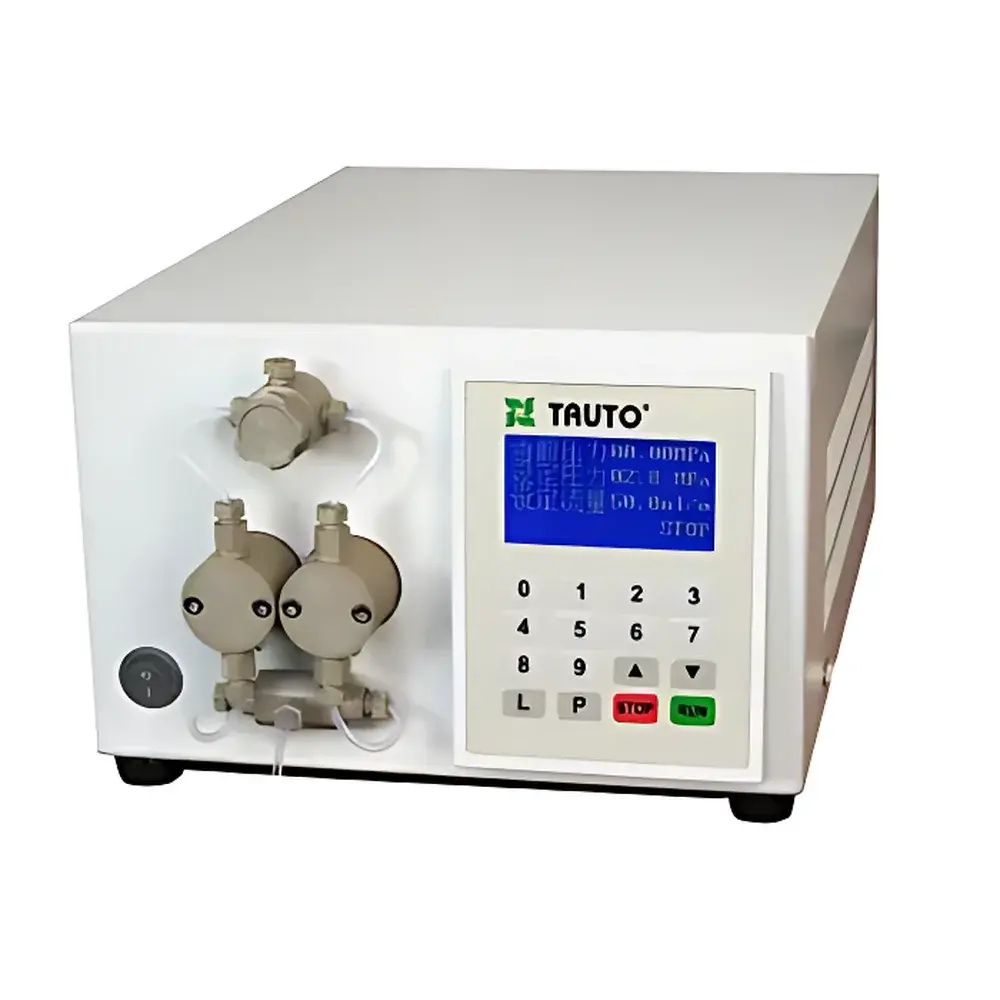
Tongtian TBP5002K PEEK-Body Medium-Pressure Dual-Piston Constant Flow Pump
| Brand | Tongtian |
|---|---|
| Origin | Shanghai, China |
| Model | TBP5002K |
| Pressure Range | 0–2.0 MPa |
| Flow Rate Range | 0.1–50.0 mL/min |
| Pressure Pulsation | ≤ 0.08 MPa |
| Pressure Accuracy | ≤ ±0.05 MPa |
| Flow Setting Error | ≤ ±1% |
| Flow Precision (RSD) | ≤ 1% |
| Wetted Materials | PEEK, Sapphire, Zirconia Ceramic |
| Interface | RS232 |
| Power Supply | 220 V ±10%, 50/60 Hz |
| Power Consumption | 75 W |
| Dimensions | 360 × 255 × 160 mm |
| Weight | 12 kg |
Overview
The Tongtian TBP5002K is a medium-pressure, dual-piston constant flow pump engineered for precision liquid delivery in analytical, preparative, and process-critical laboratory applications. It operates on positive displacement principle using two synchronized sapphire-tipped pistons driven by a microprocessor-controlled stepper motor system. This architecture ensures minimal flow pulsation (< 0.08 MPa pressure ripple), high volumetric reproducibility (RSD ≤ 1%), and long-term stability under continuous operation. Designed specifically for chemically aggressive environments, the TBP5002K features a fully PEEK-wetted fluid path—including pump head, tubing, check valves, and seals—complemented by sapphire balls and zirconia ceramic components. Its maximum operating pressure of 2.0 MPa (290 psi) and adjustable flow range of 0.1–50.0 mL/min make it suitable for HPLC pre-column injection, solvent delivery in flash chromatography systems, reagent dosing in automated synthesis platforms, and continuous feed in membrane filtration or electrochemical cell studies.
Key Features
- Dual-piston architecture with phase-shifted actuation to suppress pressure pulsation and extend sapphire ball service life
- PEEK-based fluidic pathway offering exceptional resistance to organic solvents, strong acids (e.g., concentrated HCl, HNO₃), strong bases (e.g., 50% NaOH), and hydrolytic degradation—even at elevated temperatures up to 260°C continuously
- High-precision flow control with ≤ ±1% setting error and ≤ 1% RSD across full flow range, validated per ISO 5725-2:2019 guidelines for repeatability
- Integrated overpressure protection circuitry and real-time pressure monitoring with automatic shutdown at user-defined thresholds
- RS232 serial interface compliant with standard SCPI command syntax, enabling seamless integration into LabVIEW, Python (pySerial), or custom PLC-based control environments
- Backlit LCD display showing real-time pressure, setpoint values, elapsed runtime, and system status; supports parameter memory recall for up to 10 user-defined protocols
- Optimized degassing manifold with integrated vent valve and low-volume dead space design to minimize bubble entrainment in low-surface-tension solvents
Sample Compatibility & Compliance
The TBP5002K is compatible with a broad spectrum of liquids including acetonitrile, methanol, THF, DMF, DMSO, chlorinated hydrocarbons, aqueous buffers (pH 0–14), and biological media containing proteins or nucleic acids. Its PEEK/sapphire/zirconia construction meets USP Class VI biocompatibility requirements and conforms to ISO 10993-5 cytotoxicity standards. While not certified for GMP manufacturing use out-of-the-box, the pump’s deterministic flow behavior, audit-trail-capable firmware (via optional RS232 logging), and mechanical robustness support qualification under FDA 21 CFR Part 11 when deployed within validated workflows. It complies with IEC 61000-6-3 (EMC emissions) and IEC 61010-1 (safety for laboratory equipment).
Software & Data Management
The pump operates autonomously via front-panel controls but supports external command-driven operation through ASCII-based SCPI protocol over RS232. Standard firmware enables time-based start/stop scheduling, ramped flow profiles, and pressure-triggered pause/resume functions. Logged data—including timestamped pressure, flow setpoint, and actual flow (derived from motor step count calibration)—can be exported as CSV via terminal emulation software. For regulated environments, third-party middleware (e.g., LabArchives ELN integrations or custom C#/.NET drivers) may be configured to capture digital signatures and enforce electronic record retention policies aligned with ALCOA+ principles.
Applications
- Preparative HPLC and flash chromatography solvent delivery where pulse-free flow improves fraction homogeneity and column lifetime
- Controlled reagent addition in flow chemistry reactors requiring stoichiometric accuracy and inert wetted surfaces
- Continuous perfusion in ex vivo tissue culture systems demanding biocompatible, non-leaching fluid paths
- Calibration fluid supply for gravimetric flowmeter validation in metrology labs
- Mobile phase delivery in field-deployable portable GC or IC systems requiring low power draw (75 W) and compact footprint
- Feedstock pumping in small-scale membrane separation trials involving aggressive cleaning-in-place (CIP) solutions
FAQ
What solvents are compatible with the TBP5002K’s PEEK fluid path?
PEEK exhibits excellent compatibility with aliphatic/aromatic hydrocarbons, halogenated solvents, esters, ketones, alcohols, and most mineral acids and bases. Exceptions include concentrated sulfuric acid (>95%), trifluoroacetic acid (TFA) at elevated temperatures, and molten alkali metals.
Can the pump be integrated into a GLP-compliant workflow?
Yes—when paired with timestamped RS232 logging, electronic signature-enabled control software, and documented installation/operational qualification (IQ/OQ), the TBP5002K supports GLP-aligned usage for method development and stability testing.
Is flow calibration traceable to NIST standards?
Factory calibration uses gravimetric verification against NIST-traceable mass standards (OIML R111 Class E2 weights); users may perform in-house recalibration using certified flowmeters meeting ISO 4064-2 Class 0.2 requirements.
Does the pump support gradient formation?
No—the TBP5002K is a single-channel constant-flow device. Gradient capability requires pairing with a second TBP5002K unit and external mixing tees, or upgrading to Tongtian’s Grad series dual-pump systems.
What maintenance intervals are recommended for sapphire components?
Under typical lab use (≤ 8 h/day, 5 days/week), sapphire balls and seats require inspection every 6 months; replacement is advised after 10,000 operational hours or upon observed flow deviation >2% RSD.
Related Products



