
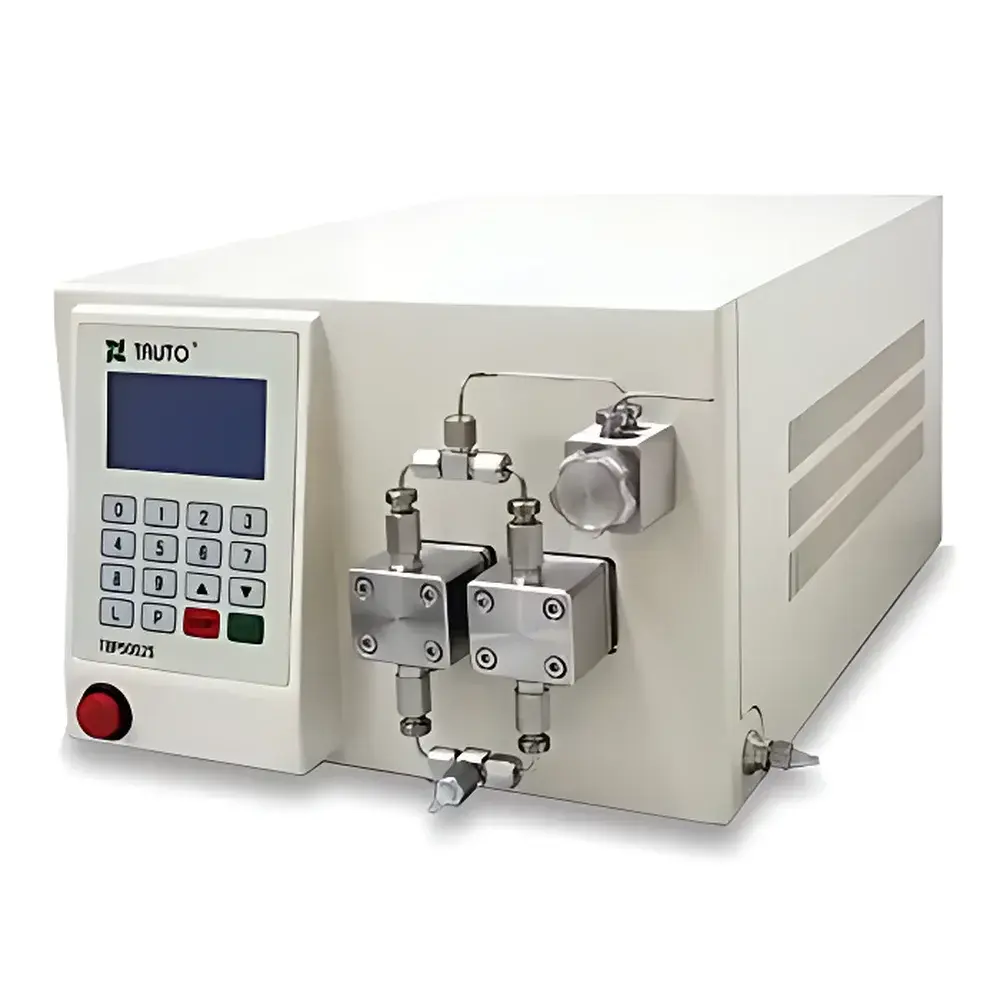
Tongtian TBP5010S Precision Constant-Flow Parallel Piston Pump
| Brand | Tongtian |
|---|---|
| Origin | Shanghai, China |
| Model | TBP5010S |
| Flow Rate | 0.1–50.0 mL/min |
| Maximum Pressure | 0–10.0 MPa |
| Pressure Pulsation | ≤ 0.02 MPa |
| Flow Accuracy | ≤ ±0.5% |
| Flow Repeatability | ≤ ±0.5% |
| Pressure Accuracy | ≤ ±0.20 MPa |
| Wetted Materials Options | 316L SS / Titanium / PEEK / PTFE |
| Drive System | Sealed Dual-Piston Mechanism with Microprocessor Control |
| Power Supply | 220 V ±10%, 50/60 Hz |
| Power Consumption | 75 W |
| Dimensions (W×D×H) | 270 × 400 × 190 mm |
| Weight | 17 kg |
Overview
The Tongtian TBP5010S Precision Constant-Flow Parallel Piston Pump is an engineered solution for high-stability, low-pulsation fluid delivery in demanding analytical, preparative, and process-scale applications. Unlike conventional reciprocating piston pumps that generate inherent pressure and flow fluctuations due to cyclic displacement, the TBP5010S employs a parallel dual-piston architecture synchronized via microprocessor-controlled cam timing. This design ensures continuous volumetric displacement—effectively eliminating dead volume transitions and minimizing flow discontinuity. The pump operates on the principle of positive displacement with active pulsation suppression, delivering true constant-flow performance across its full operating range (0.1–50.0 mL/min) at pressures up to 10.0 MPa. Its mechanical architecture is optimized for long-term stability under continuous operation, making it suitable for integration into GMP-compliant purification systems, automated reaction platforms, and regulated chromatographic workflows.
Key Features
- Parallel dual-piston mechanism with phase-shifted actuation reduces pressure pulsation to ≤ 0.02 MPa—critical for sensitive detection systems and microfluidic interfaces.
- Selectively configurable wetted path materials: 316L stainless steel (L), commercially pure titanium (T), PEEK (K), or PTFE (F)—enabling compatibility with aggressive solvents, halogenated reagents, strong acids/bases, and high-purity pharmaceutical streams.
- High-precision sapphire ball valves and ceramic plunger rods ensure wear resistance, chemical inertness, and dimensional stability over extended service life.
- Fully sealed drive train prevents lubricant contamination and eliminates maintenance intervals associated with external gearboxes or belt drives.
- Integrated microprocessor control supports real-time monitoring of actual pressure, setpoint pressure, and flow rate; displays dynamic pressure curves for system diagnostics.
- RS232/USB interface enables bidirectional communication with host PCs or PLCs for remote parameter setting, event logging, and synchronization with auxiliary modules (e.g., fraction collectors, UV detectors).
Sample Compatibility & Compliance
The TBP5010S accommodates a broad spectrum of liquid-phase samples—from aqueous buffers and organic eluents (acetonitrile, methanol, THF) to corrosive media including concentrated HCl, HF, and oxidizing agents (e.g., nitric acid, hydrogen peroxide). Its modular flow-path configuration allows rapid adaptation to application-specific chemistries without hardware modification. From a regulatory standpoint, the pump meets mechanical safety requirements per IEC 61010-1 and electromagnetic compatibility standards (EN 61326-1). When deployed in validated environments—such as USP HPLC method transfers or FDA 21 CFR Part 11–compliant purification suites—the device supports audit-trail-enabled software operation (via optional Tongtian PumpControl v3.x), including user-access controls, electronic signatures, and immutable parameter-change logs.
Software & Data Management
The standard firmware provides local touchscreen operation with intuitive menu navigation, while the optional PC-based PumpControl software extends functionality significantly. Users can define multi-step gradient profiles, schedule timed start/stop sequences, trigger external events via TTL outputs, and export timestamped pressure/flow datasets in CSV format. All operational parameters—including calibration coefficients, error codes, and runtime statistics—are stored in non-volatile memory. Software updates are delivered via signed firmware packages to maintain integrity in regulated settings. Data export complies with ALCOA+ principles (Attributable, Legible, Contemporaneous, Original, Accurate, Complete, Consistent, Enduring, Available), facilitating traceability during internal audits or regulatory inspections.
Applications
- Preparative and medium-pressure chromatography: compatible with flash, MPLC, and semi-prep HPLC systems requiring stable flow under variable backpressure (e.g., column packing, gradient elution).
- Modular continuous-flow chemistry: integrated into microreactor arrays, tube reactors, and jacketed batch reactors for stoichiometric reagent dosing and residence-time-controlled synthesis.
- Automated sample introduction: used in ICP-MS, AAS, and ion chromatography systems where pulse-free delivery prevents baseline noise and detector saturation.
- Process validation support: employed in cleaning-in-place (CIP) verification studies and extractables/leachables testing where precise, repeatable solvent delivery is mandated by ISO 10993 or USP .
- Environmental analysis: delivers consistent flow rates in EPA Method 8081B (PCB analysis) and ASTM D7087 (diesel fuel oxidation stability testing) sample preparation protocols.
FAQ
What certifications does the TBP5010S hold for use in regulated laboratories?
The pump complies with IEC 61010-1 (Safety Requirements for Electrical Equipment for Measurement, Control, and Laboratory Use) and EN 61326-1 (EMC for Laboratory Instruments). While not inherently 21 CFR Part 11–certified, its software-enabled audit trail functionality satisfies key technical controls required for compliance when implemented within a validated system.
Can the TBP5010S be operated in parallel mode with another unit for higher flow capacity?
No—this model is designed as a single-channel, constant-flow source. Parallel operation is not supported mechanically or electronically; however, multiple units may be synchronized via external PLC control using TTL triggers.
Is calibration traceable to national standards?
Yes—factory calibration uses NIST-traceable flow meters (±0.1% reading) and pressure transducers (±0.05% FS). Certificate of Calibration is provided with each unit and includes uncertainty budgets per ISO/IEC 17025 guidelines.
What maintenance intervals are recommended for routine operation?
Under typical lab conditions (8 hrs/day, aqueous/organic solvents), sapphire valves and ceramic plungers require inspection every 6,000 hours; seals should be replaced every 12 months or after 500 bar·L total solvent throughput—whichever occurs first.
Does the pump support gradient programming natively?
Gradient capability requires the PumpControl software package; the onboard controller supports only fixed flow/pressure setpoints and timed on/off cycles.
Related Products



