
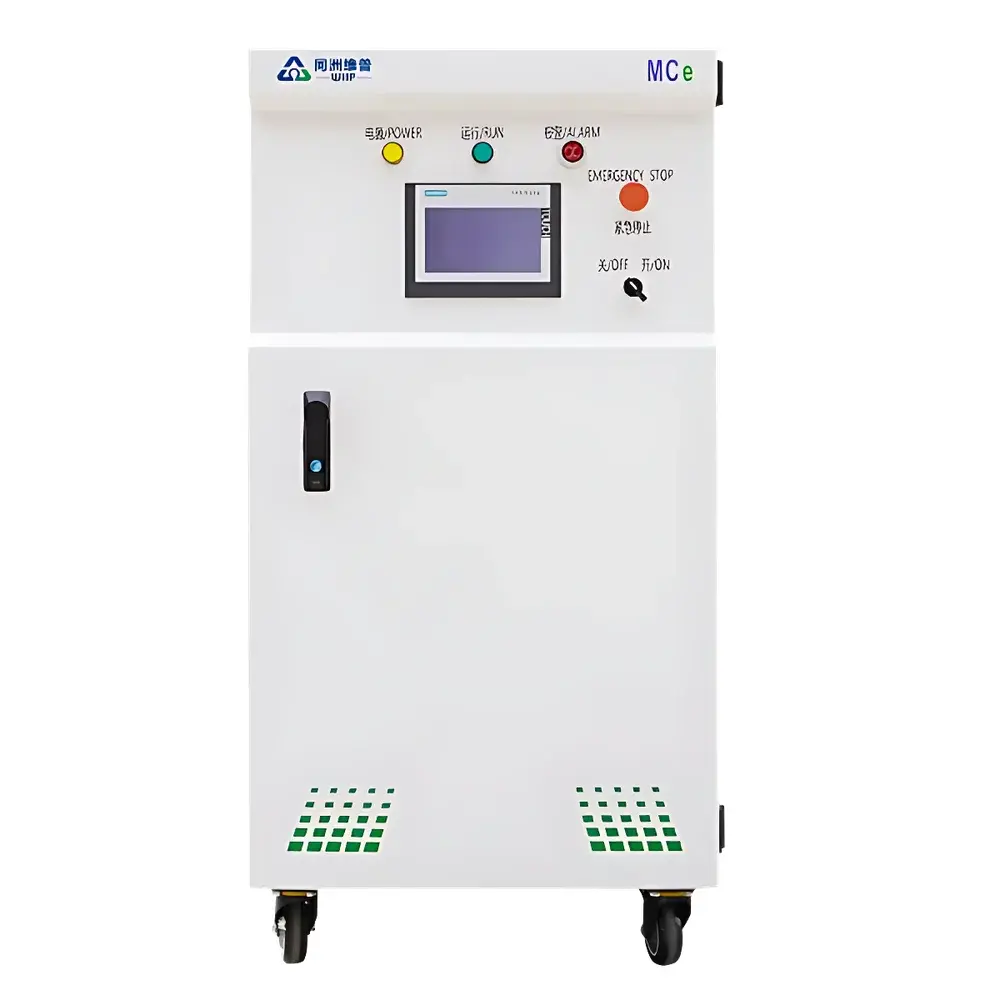
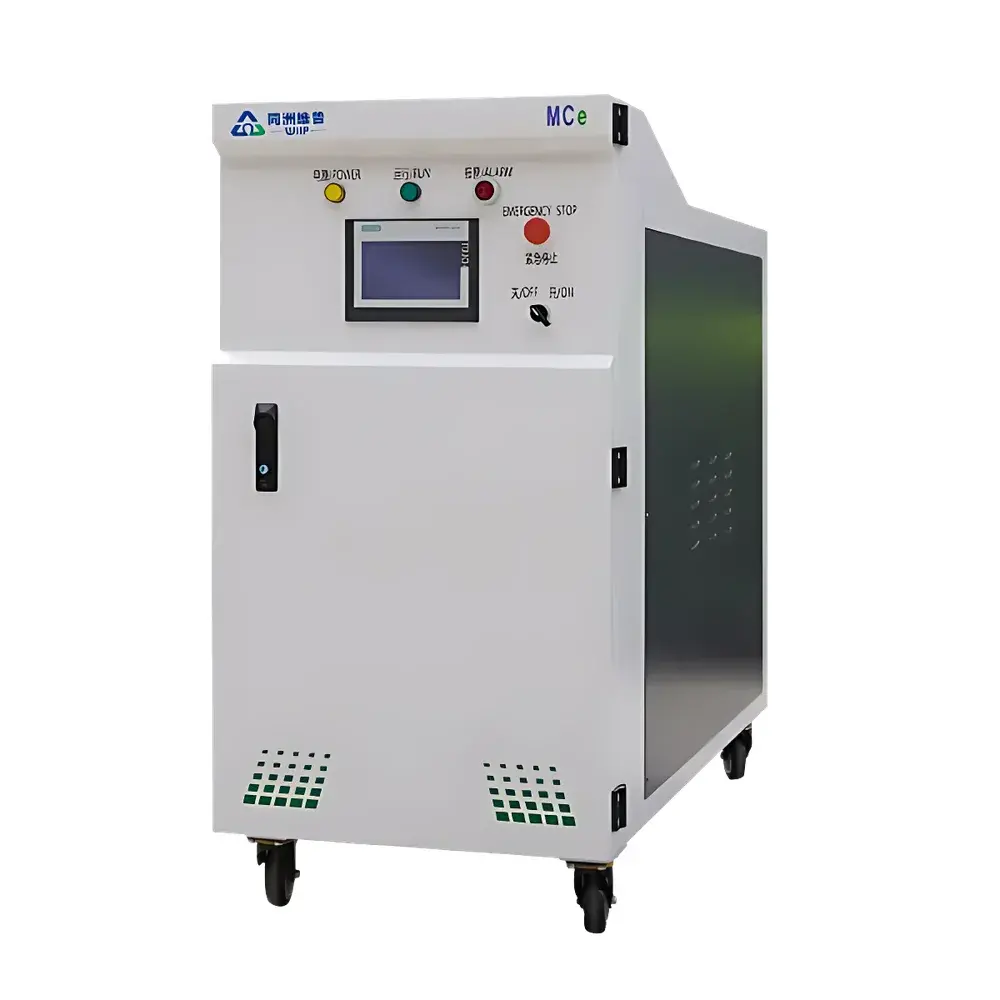
Tongzhou Weipu MCe Integrated Circulating Chiller for High-Temperature Performance Testing of Power Electronics Controllers
| Brand | Tongzhou Weipu |
|---|---|
| Origin | Beijing, China |
| Manufacturer Type | Direct Manufacturer |
| Instrument Type | Integrated Circulating Chiller |
| Temperature Control Range | +10 °C to +95 °C |
| Temperature Stability | ±1 °C |
| Cooling Capacity | 20 kW to 300 kW |
| Circulating Pump Flow Rates | 2–20 L/min |
Overview
The Tongzhou Weipu MCe Integrated Circulating Chiller is an engineered thermal management solution designed specifically for high-temperature performance validation of power electronics systems under controlled, repeatable conditions. Unlike conventional vapor-compression chillers, the MCe operates via direct heat exchange with externally supplied cooling water or chilled water—eliminating onboard refrigerant circuits, compressors, and associated energy losses. This design enables operation across a wide temperature range (+10 °C to +95 °C) while maintaining ±1 °C thermal stability, critical for evaluating thermal derating, junction temperature rise, and long-term reliability of electric vehicle (EV) traction inverters, motor controllers, battery management systems (BMS), and integrated power modules. Its architecture supports both steady-state thermal soak testing and dynamic thermal cycling protocols aligned with ISO 16750-4, SAE J1739, and IEC 60068-2-14 test standards.
Key Features
- Direct water-to-water heat exchange architecture—no internal refrigeration cycle, resulting in >30% lower power consumption versus compressor-based chillers of equivalent capacity.
- Five selectable pump flow configurations (2–20 L/min up to 10–150 L/min) to match varying system pressure drop requirements and thermal mass characteristics of DUTs (Devices Under Test).
- Integrated PID-controlled heater and precision flow-regulated bypass valve ensure stable setpoint maintenance across full operating range, even during rapid load transients.
- Stainless steel fluid path and corrosion-resistant heat exchanger materials compatible with deionized water, glycol-water mixtures (up to 35%), and inhibited coolant formulations per ASTM D1384.
- IP54-rated enclosure with vibration-damped mounting and low-noise pump assemblies (<62 dB(A) at 1 m), suitable for integration into EMC-shielded test bays and adjacent to sensitive instrumentation.
- Modular control interface supporting analog 0–10 V / 4–20 mA setpoint input and digital RS485 Modbus RTU communication for seamless integration into automated test stands.
Sample Compatibility & Compliance
The MCe chiller is validated for thermal conditioning of high-power electronic assemblies including IGBT-based motor controllers (up to 350 kW nominal), liquid-cooled battery packs (cell-to-pack and module-level), and onboard chargers subjected to accelerated life testing. It complies with CE marking requirements (2014/30/EU EMC Directive, 2014/35/EU LVD Directive) and meets essential safety provisions of UL 61010-1 (3rd Ed.) for laboratory equipment. All fluid-contact components conform to RoHS 2011/65/EU and REACH SVHC regulations. Optional documentation packages support GLP/GMP audit readiness, including factory calibration certificates traceable to NIM (National Institute of Metrology, China) and IQ/OQ protocol templates.
Software & Data Management
The MCe includes embedded firmware with real-time logging of inlet/outlet temperatures, flow rate, heater power, and system status flags at user-configurable intervals (1 s to 10 min). Data export is supported via USB mass storage or Ethernet TCP/IP socket connection in CSV format. For enterprise-scale deployment, optional Tongzhou Weipu TCS-Link software provides centralized monitoring of multiple MCe units, alarm escalation via SMTP/SNMP traps, and time-synchronized data aggregation with external DAQ systems. Audit trail functionality records all parameter changes, user logins, and firmware updates—fully compliant with FDA 21 CFR Part 11 requirements when deployed with electronic signature and role-based access controls.
Applications
- High-temperature endurance testing of automotive-grade power converters per ISO 20653 and AEC-Q100 stress profiles.
- Thermal validation of bidirectional DC-DC converters during regenerative braking simulation.
- Controlled thermal ramping for solder joint fatigue analysis in power module packaging (JEDEC JESD22-B103, -B110).
- Support of MIL-STD-810H Method 501.7 (High Temperature) and Method 502.7 (Temperature Shock) test sequences using external environmental chambers.
- Integration into HIL (Hardware-in-the-Loop) test benches for real-time thermal coupling with model-based controller emulation.
FAQ
Does the MCe chiller require refrigerant charging or periodic compressor maintenance?
No. The MCe uses only external cooling water or chilled water as its heat sink—there is no refrigerant circuit, compressor, or oil lubrication system.
Can the MCe operate continuously at 95 °C outlet temperature with full flow capacity?
Yes, provided the incoming cooling water temperature remains ≤25 °C and flow rate meets minimum specification for the selected pump configuration.
Is the fluid path compatible with propylene glycol solutions for sub-zero ambient protection?
The standard configuration supports up to 35% glycol by volume; higher concentrations require optional EPDM-free seals and verification of viscosity impact on pump head curve.
What level of temperature uniformity can be expected across multiple parallel DUT cooling loops?
When configured with balanced manifold distribution and flow meters, thermal deviation between branches remains within ±0.8 °C under steady-state conditions.
How is calibration traceability documented for quality assurance purposes?
Each unit ships with a NIM-traceable calibration report covering temperature sensors (Pt100 Class A), flow meters (±1.5% FS), and heater power measurement (±0.5% RDG).



