
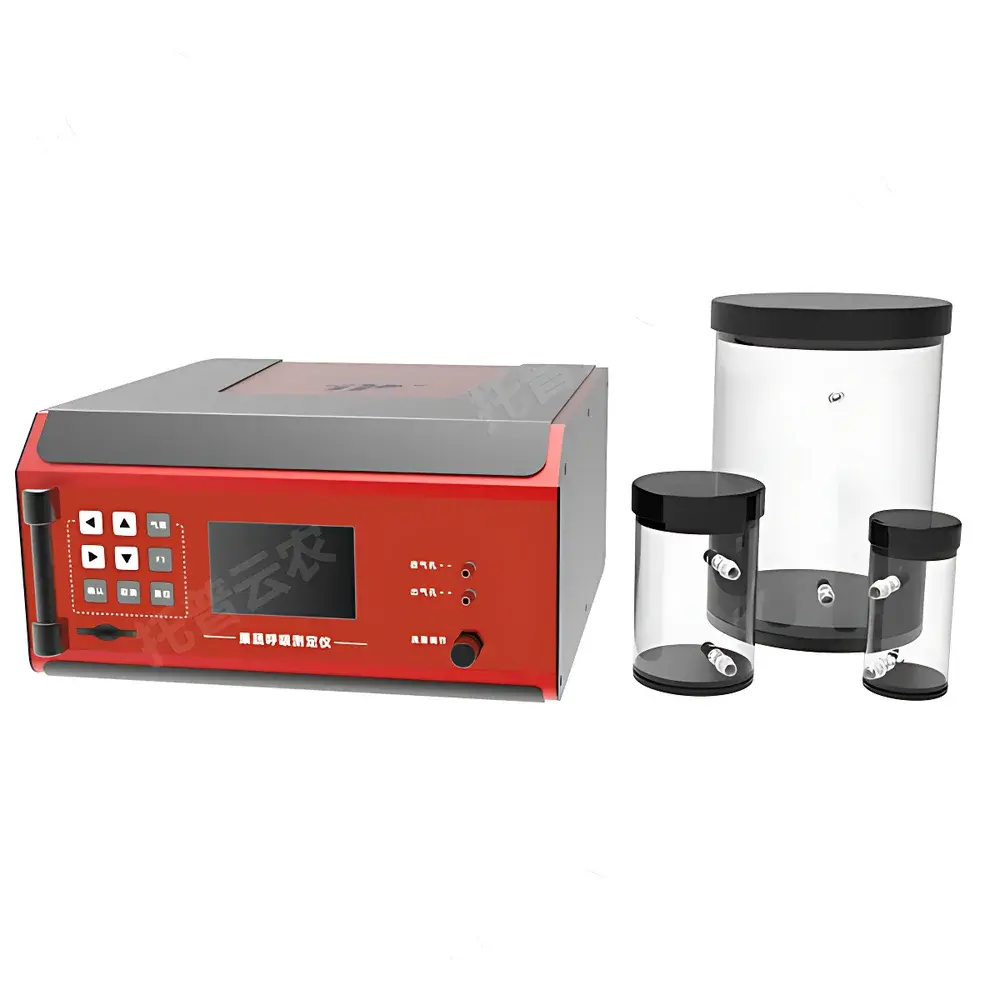
Top Cloud-agri 3051H Fruit & Vegetable Respiration Rate Analyzer
| Brand | Top Cloud-agri |
|---|---|
| Origin | Zhejiang, China |
| Manufacturer Type | Direct Manufacturer |
| Country of Origin | China |
| Model | 3051H |
| CO₂ Range | 0–1000/2000 ppm & 0–100% |
| O₂ Range | 0–25% (electrochemical) |
| Temp Range | 0–50 °C (±0.2 °C) |
| RH Range | 0–100% (±0.2% F.S.) |
| Display | 256×160 LCD |
| Response Time | ≤15 s (CO₂), ≤30 s (O₂) |
| Linearity | ≤±2% F.S. |
| Repeatability | ≤±1% |
| Zero/End Drift | ≤±2% F.S./24 h |
| Chamber Options | Φ120×170 mm, Φ60×90 mm, Φ40×80 mm |
| Power | AC, with thermostatic control |
| Flow Control | Brass needle valve |
| Dimensions | 320×483×133 mm |
| Warm-up Time | 2 h |
Overview
The Top Cloud-agri 3051H Fruit & Vegetable Respiration Rate Analyzer is a dedicated, non-destructive gas exchange measurement system engineered for quantitative assessment of respiratory metabolism in horticultural produce under controlled storage environments. It operates on the principle of real-time, dual-gas differential analysis—simultaneously monitoring dynamic changes in CO₂ evolution and O₂ consumption within sealed, temperature- and humidity-regulated respiration chambers. This enables precise calculation of respiration rate (µmol CO₂·kg⁻¹·h⁻¹ or µmol O₂·kg⁻¹·h⁻¹), a critical physiological indicator of postharvest quality, shelf-life potential, and metabolic stress response. Designed for operational use in ambient storage rooms, refrigerated warehouses, controlled-atmosphere (CA) facilities, modified-atmosphere packaging (MAP) validation labs, and retail cold-chain monitoring stations, the 3051H supports both research-grade characterization and routine quality assurance protocols across the fresh produce value chain.
Key Features
- Simultaneous real-time display of CO₂ concentration (ppm/%), O₂ concentration (%), chamber temperature (°C), and relative humidity (%RH) on a high-contrast 256×160 monochrome LCD interface.
- Modular respiration chamber system with three standardized volumes (Φ120×170 mm, Φ60×90 mm, Φ40×80 mm) to accommodate diverse sample sizes—from whole melons and cabbages to cut leafy greens and berry clusters—minimizing headspace-to-biomass ratio and accelerating gas equilibrium.
- Dual-respiratory expression capability: users may select either CO₂ production rate or O₂ consumption rate as the primary metric, facilitating cross-study comparability and alignment with ISO 8602 (1987) and ASTM D4713-22 guidelines for respiration-based shelf-life modeling.
- High-stability electrochemical O₂ sensor and NDIR-based CO₂ sensor, each calibrated against traceable gas standards; integrated temperature-compensated signal processing ensures metrological integrity across 0–50 °C operating range.
- Brass precision needle valve for fine-grained, reproducible flow regulation (typically 100–500 mL/min), critical for maintaining laminar flow conditions and avoiding pressure-induced artifacts in low-mass fruit samples.
- Onboard thermostatic control and environmental monitoring eliminate external incubator dependency; all measured parameters are displayed with 0.1-unit resolution and certified accuracy (±0.2 °C, ±0.2% RH, ≤±2% F.S. for gases).
Sample Compatibility & Compliance
The 3051H accommodates intact, minimally processed, or excised plant tissues—including apples, citrus, tomatoes, lettuce, broccoli, strawberries, and root vegetables—without requiring destructive sampling or chemical derivatization. Its chamber design conforms to standard respirometry geometry requirements outlined in FAO Technical Paper No. 533 and aligns with methodological frameworks referenced in USDA Postharvest Recommendations and EU Regulation (EC) No. 1221/2008 on horticultural product quality monitoring. While not certified to IEC 61000-6-3 or UL 61010-1 out-of-box, the instrument’s AC-powered architecture, grounded chassis, and EMI-shielded sensor electronics support stable operation in GLP-compliant laboratories and GMP-adjacent QA environments. Data logging intervals and parameter thresholds can be configured to satisfy internal SOPs for audit readiness.
Software & Data Management
The 3051H operates as a stand-alone, embedded-system analyzer with no proprietary PC software dependency. All measurements are displayed and retained in real time on the device LCD; numeric values update at 1-second intervals and stabilize per sensor-specific response times (≤15 s for CO₂, ≤30 s for O₂). For long-term data capture, users integrate the unit into existing laboratory information management systems (LIMS) via analog voltage outputs (0–5 V DC) for CO₂, O₂, temperature, and RH—each scaled linearly and isolated for noise immunity. These analog signals comply with IEEE 11073-10201 nomenclature conventions and may be digitized using standard DAQ hardware supporting 16-bit resolution. The absence of cloud connectivity or firmware-updatable logic ensures deterministic behavior required for FDA 21 CFR Part 11–aligned environments where electronic records must demonstrate traceability, immutability, and operator accountability.
Applications
- Postharvest physiology studies evaluating the impact of storage temperature, atmospheric composition (O₂/CO₂/N₂ ratios), and humidity on respiratory quotient (RQ) and ethylene biosynthesis kinetics.
- Validation of controlled-atmosphere (CA) and dynamic-controlled-atmosphere (DCA) storage protocols for pome fruits, stone fruits, and tropical commodities.
- Quality assurance testing in packinghouses and distribution centers to establish baseline respiration signatures and detect early-stage chilling injury or microbial spoilage onset.
- Development and verification of predictive shelf-life models used in supply chain logistics optimization and food waste reduction initiatives.
- Curriculum-based teaching of plant bioenergetics in university-level plant science, food engineering, and postharvest technology programs.
FAQ
What respiration metrics does the 3051H calculate directly?
The instrument provides raw, time-synchronized readings of CO₂ concentration (ppm or %), O₂ concentration (%), temperature (°C), and relative humidity (%RH). Respiration rate (e.g., µmol CO₂·kg⁻¹·h⁻¹) must be calculated externally using chamber volume, sample mass, measurement duration, and ideal gas law assumptions.
Can the 3051H be used for soil or microbial respiration studies?
No. Its chamber geometry, flow dynamics, and calibration are optimized exclusively for solid, low-surface-area horticultural produce. Soil or liquid-phase respiration requires specialized closed-chamber or continuous-flow systems with different mass-transfer characteristics.
Is sensor recalibration required between measurements?
The CO₂ and O₂ sensors are factory-calibrated and exhibit ≤±2% F.S. zero/end drift over 24 hours. For multi-day campaigns or regulatory submissions, users should perform span calibration using certified gas mixtures (e.g., 1000 ppm CO₂ in N₂, 5% O₂ in N₂) prior to each test series.
Does the device support automated data export or USB logging?
No. Data export relies on analog outputs (0–5 V) connected to third-party DAQ systems or chart recorders. Internal memory or digital communication interfaces (USB, Bluetooth, Wi-Fi) are not implemented, preserving signal integrity and simplifying validation.
What is the recommended warm-up procedure before measurement?
A minimum 2-hour stabilization period under operating conditions is required to achieve thermal equilibrium across optical paths, electrochemical cells, and humidity sensing elements—ensuring specified accuracy and repeatability.




