
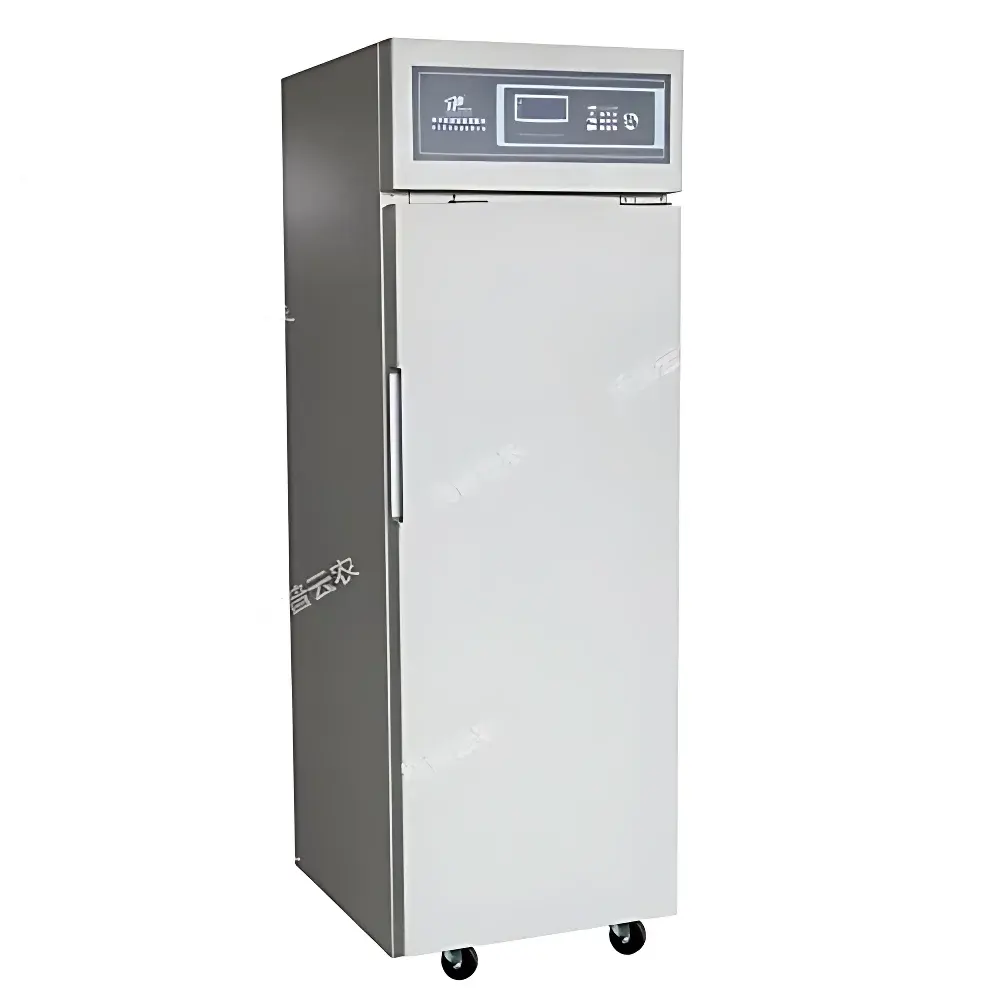
Top Cloud-agri CZ-450FC Seed Cold Storage Cabinet
| Brand | Top Cloud-agri |
|---|---|
| Origin | Zhejiang, China |
| Manufacturer Type | Direct Manufacturer |
| Product Origin | Domestic (China) |
| Model | CZ-450FC |
| Capacity | 450 L |
| Temperature Range | 0–9.9 °C |
| Temperature Control Accuracy | ±1 °C |
| Humidity Range | 30–60 %RH (adjustable) |
| Humidity Control Accuracy | ±5 %RH |
| Control System | Fully Automatic Microcomputer-Based |
| Cooling Method | Fan-Cooled, Frost-Free |
| Power Supply | 220 V, 50 Hz |
| Safety Protections | Electric Shock Protection, Leakage Current Protection, Overload & Overcurrent Protection, Compressor Delayed Start |
| Optional Connectivity | RJ45 Ethernet or Wi-Fi Module (add-on) |
| UV Sterilization Timer | Programmable Auto-Off Function |
| Display | Chinese LCD with Real-Time Temp/RH Readout |
| Compliance | Designed for GLP-aligned seed storage workflows |
Overview
The Top Cloud-agri CZ-450FC Seed Cold Storage Cabinet is a purpose-engineered environmental storage system designed to maintain strict low-temperature and low-humidity conditions essential for long-term viability of orthodox seed germplasm. Operating on a precision fan-cooled refrigeration architecture with frost-free operation, the cabinet delivers stable thermal and hygrometric control across its 450 L stainless steel chamber—engineered to meet internationally recognized standards for seed conservation in agricultural research stations, gene banks, breeding programs, and regulatory seed testing laboratories. Its microprocessor-based control system continuously regulates temperature (0–9.9 °C) and relative humidity (30–60 %RH), minimizing metabolic activity while preventing condensation, mold growth, and moisture-induced deterioration. Unlike general-purpose refrigerated cabinets, the CZ-450FC integrates dedicated humidity management, UV sterilization cycles, and multi-layer safety protocols—making it suitable for ISO/IEC 17025-compliant sample holding prior to germination assays, viability testing, or genetic analysis.
Key Features
- Fully automated microcomputer control system with real-time monitoring of temperature and relative humidity via bilingual (Chinese/English-capable) LCD interface
- Frost-free fan-cooled refrigeration circuit ensuring uniform air distribution and eliminating manual defrosting requirements
- Double-walled stainless steel construction (interior and exterior) for corrosion resistance, thermal stability, and ease of decontamination
- Programmable UV-C germicidal lamp with adjustable timer function—auto-shutoff prevents accidental overexposure and ensures operator safety
- Comprehensive electrical protection suite: leakage current detection, overload cutoff, overcurrent interruption, and compressor startup delay to extend service life
- Configurable alarm system with audible/visual alerts for temperature deviation, humidity excursion, door ajar status, and system fault conditions
- Optional network connectivity via standard RJ45 port or field-installable Wi-Fi module for remote supervision and data archival
Sample Compatibility & Compliance
The CZ-450FC accommodates standardized seed storage containers—including aluminum foil packets, laminated polyethylene bags, glass jars, and hermetically sealed canisters—without compromising internal airflow or sensor accuracy. Its chamber geometry and shelf layout support both bulk storage and discrete sample organization. The unit complies with core principles outlined in FAO’s Genebank Standards, ISTA’s International Rules for Seed Testing, and national guidelines for base collection management (e.g., China’s GB/T 3543.4–1995). When equipped with network functionality, the cabinet supports traceable, time-stamped environmental logging aligned with GLP documentation requirements—including user authentication, audit trails, and tamper-evident data export formats (CSV, PDF).
Software & Data Management
The optional cloud-connected configuration interfaces with Top Cloud-agri’s proprietary C/S architecture Instrument Management Platform. This secure web-based platform enables centralized monitoring of multiple cabinets across geographically dispersed facilities. Logged parameters—including temperature, humidity, UV activation logs, alarm events, and door-open durations—are stored redundantly with automatic backup and version-controlled retention. Users may generate time-series plots, comparative statistical reports, and compliance-ready summaries directly from the dashboard. Data exports support CSV, Excel, and printable PDF formats; historical datasets remain accessible indefinitely within allocated tenant storage. Platform firmware updates are delivered over-the-air, ensuring continuous alignment with evolving data integrity expectations under FDA 21 CFR Part 11 (when validated per site-specific SOPs).
Applications
- Long-term ex situ conservation of recalcitrant and orthodox seed accessions in national and regional gene banks
- Pre-test conditioning and stabilization of seed samples prior to germination, vigor, or purity analysis per ISTA or AOSA protocols
- Controlled environment staging for QTL mapping populations, hybrid seed multiplication trials, and varietal registration studies
- Secure interim storage of certified reference materials (CRMs) and proficiency testing samples requiring documented thermal history
- Backup cold storage for cryopreserved embryo or pollen samples where ultra-low temperatures are not required but strict RH control is critical
FAQ
What is the minimum achievable humidity level inside the cabinet?
The system is calibrated to maintain 30 %RH as the lower operational limit; sustained operation below this threshold is not supported due to risk of desiccation-induced seed damage.
Can the cabinet operate reliably in ambient environments above 35 °C?
Yes—the thermal management system includes high-ambient compensation logic and is rated for continuous operation at up to 35 °C ambient temperature with ≤60 %RH.
Is the UV sterilization cycle validated against common fungal spores found in seed storage facilities?
UV-C output (254 nm) is designed to achieve ≥3-log reduction of Aspergillus niger and Penicillium chrysogenum spores under standard exposure durations; validation must be performed onsite per ISO 15714.
Does the network-enabled version support integration with third-party LIMS platforms?
Yes—via RESTful API endpoints and Modbus TCP protocol; integration requires configuration by authorized system administrators.
What documentation is provided for IQ/OQ validation support?
Factory test reports, calibration certificates for integrated sensors, and URS-mapped functional specification documents are included; full GxP validation packages available upon request.





