
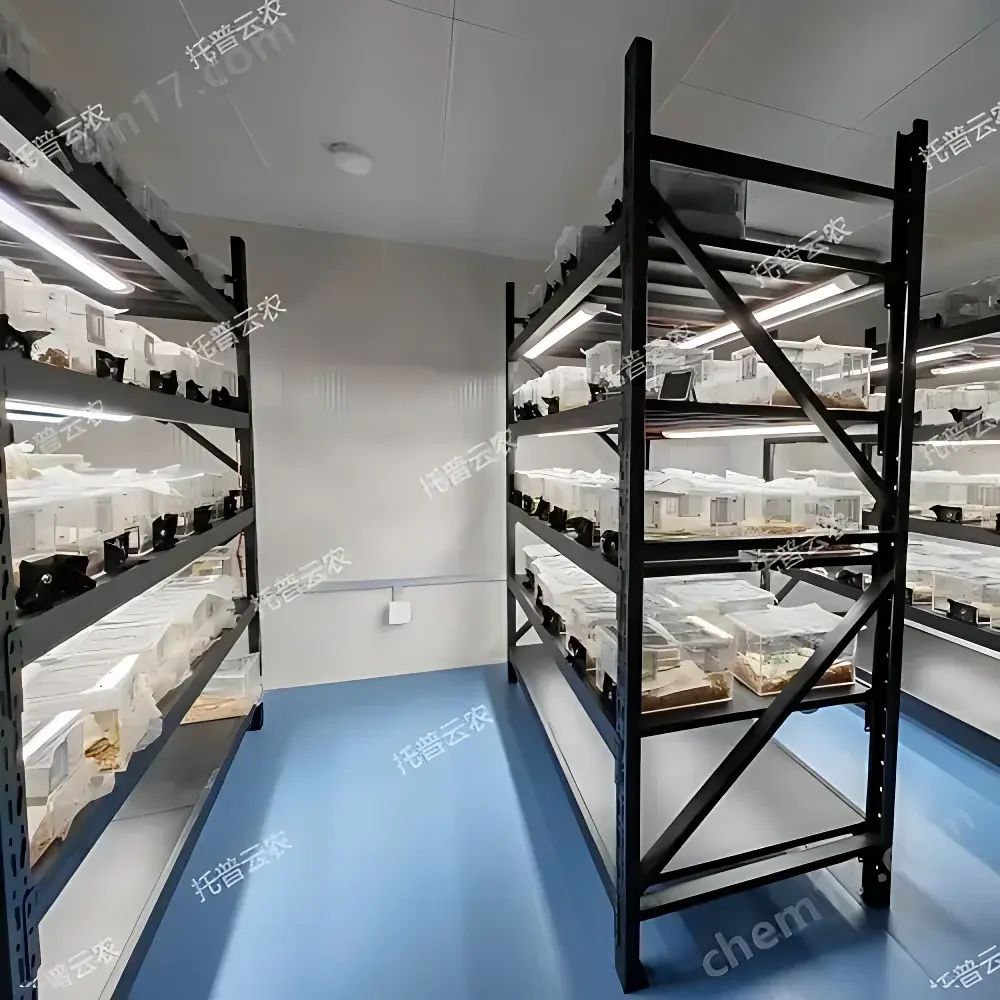
Top Cloud-agri Insect Rearing Chamber
| Brand | Top Cloud-agri |
|---|---|
| Origin | Zhejiang, China |
| Manufacturer Type | Direct Manufacturer |
| Model | Insect Rearing Chamber |
| Temperature Range | 15–30°C |
| Humidity Range | 45–85% RH |
| Illumination Range | 0–10,000 lux or 0–20,000 lux (customizable) |
| Air Circulation | Ducted forced-air system with uniform airflow distribution |
| Ventilation | Motorized fresh-air exchange module |
| Remote Control | IoT-enabled cloud platform with mobile app interface |
| Compliance | Designed for GLP-aligned entomological research environments |
Overview
The Top Cloud-agri Insect Rearing Chamber is a purpose-built environmental control system engineered for standardized, reproducible insect rearing and behavioral-physiological studies in entomology, integrated pest management (IPM), and biological control research. Unlike general-purpose plant growth chambers, this chamber integrates precision climate regulation—temperature, relative humidity, photoperiod, and spectral irradiance—with structural features optimized for arthropod containment, colony maintenance, and experimental scalability. It operates on a closed-loop environmental control architecture, utilizing PID-regulated heating/cooling modules, ultrasonic humidification or desiccant-based dehumidification (depending on configuration), and multi-channel LED lighting arrays calibrated to deliver stable, spectrally tunable illumination across PAR (400–700 nm) and UV-A (315–400 nm) ranges where relevant. The chamber’s thermal and hygric stability (±0.5°C, ±3% RH over 24 h under steady-state conditions) ensures minimal physiological stress during critical life-stage transitions—such as egg hatch synchronization, pupal eclosion timing, or adult mating assays.
Key Features
- Programmable multi-zone environmental control: Independent setpoint scheduling for temperature, humidity, and light intensity across up to four daily phases (e.g., dawn/dusk simulation).
- Ducted laminar airflow system: Low-velocity, high-uniformity air distribution prevents mechanical disturbance to delicate specimens—including larval stages on host plants or microcosm substrates—while maintaining homogeneous environmental gradients.
- Modular shelving architecture: Adjustable-height stainless steel or powder-coated steel racks with per-tier independent LED lighting control; compatible with standard insect rearing trays (e.g., 24-well plates, ventilated cages, mesh-bottom containers).
- Active fresh-air exchange: Motor-driven intake/exhaust valves with particulate filtration (HEPA-grade optional), enabling CO₂ replenishment and volatile organic compound (VOC) clearance without compromising chamber integrity.
- IoT-integrated monitoring and control: Real-time telemetry via embedded sensors (PT100, capacitive RH, silicon photodiode lux meter); remote parameter adjustment, alarm logging, and historical trend export through encrypted HTTPS API and native iOS/Android application.
- Energy-efficient design: Variable-speed compressors, adaptive lighting dimming, and thermal mass optimization reduce power consumption by ≥25% compared to legacy constant-air-volume systems.
Sample Compatibility & Compliance
The chamber accommodates a broad spectrum of terrestrial arthropods—including Diptera (Drosophila, mosquitoes), Lepidoptera (Helicoverpa, Plutella), Coleoptera (Tribolium), Hemiptera (Aphis), and beneficial species (Trichogramma wasps, predatory mites)—across all developmental stages. Its internal dimensions (standard configurations: W1200 × D700 × H1800 mm) support stacked rearing units while permitting unobstructed access for manual handling or automated imaging integration. All materials comply with ISO 10993-5 (cytotoxicity) and RoHS directives. The control firmware supports audit-ready data logging aligned with GLP principles, including user authentication, electronic signatures, and tamper-evident event timestamps—facilitating regulatory readiness for USDA APHIS, EFSA, or national biosafety authority submissions.
Software & Data Management
The embedded Linux-based controller runs proprietary firmware v3.2+ with dual-mode operation: local touchscreen interface (7″ resistive LCD) and cloud-synced web dashboard. Environmental logs are stored locally (microSD) and mirrored to encrypted AWS S3 buckets with configurable retention policies (default: 90 days). Data exports conform to CSV and NetCDF-4 standards, enabling direct ingestion into R, Python (pandas/xarray), or MATLAB for time-series analysis of development rate, fecundity, or diapause induction. Optional FDA 21 CFR Part 11 compliance package includes role-based access control, electronic audit trail, and digital certificate signing for validated workflows.
Applications
- Standardized bioassay protocols for insecticide resistance monitoring (e.g., WHO tube tests, FAO leaf-dip assays).
- Climate-change impact modeling: Quantifying thermal performance curves (TPCs), CTmax estimation, and humidity-dependent survival thresholds.
- Symbiont transmission studies requiring sterile or gnotobiotic conditions (when paired with optional UV-C sterilization cycle).
- Mass-rearing optimization for augmentative biological control programs (e.g., parasitoid production, pollinator conservation).
- Behavioral phenotyping: Phototaxis, circadian rhythm entrainment, and olfactory response assays under controlled spectral and temporal cues.
FAQ
What is the minimum achievable humidity setpoint under continuous operation?
The system maintains stable humidity down to 45% RH at 25°C; lower setpoints require optional desiccant-based dehumidification modules.
Can the lighting spectrum be customized beyond standard white LEDs?
Yes—full-spectrum RGB + UV-A + far-red (730 nm) LED arrays are available as factory-configured options for photobiological studies.
Is remote firmware update supported over the cloud platform?
Yes, over-the-air (OTA) updates are delivered via signed binary packages with rollback capability and pre-update validation checks.
Does the chamber meet electrical safety standards for laboratory use?
It complies with IEC 61010-1:2010 for measurement, control, and laboratory equipment, including protection against electric shock and fire hazards.
How is calibration traceability documented?
Each unit ships with NIST-traceable calibration certificates for temperature (PT100), humidity (capacitive sensor), and illuminance (calibrated photodiode), valid for 12 months from commissioning.
Related Products



