
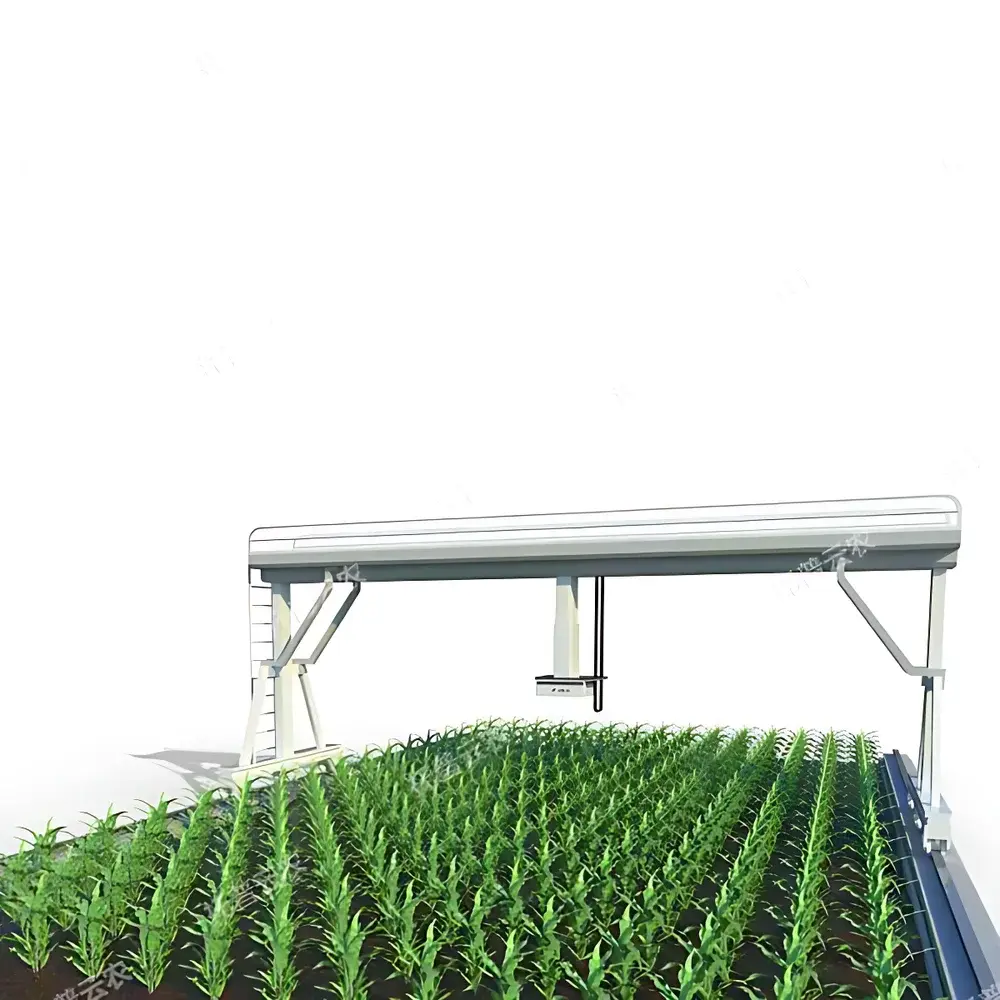
Top Cloud-agri Mobile Field-Based Plant Phenotyping Imaging System
| Brand | Top Cloud-agri |
|---|---|
| Origin | Zhejiang, China |
| Manufacturer Type | Original Equipment Manufacturer (OEM) |
| Product Category | Domestic |
| Model | Mobile Track-Mounted |
| Pricing | Available Upon Request |
Overview
The Top Cloud-agri Mobile Field-Based Plant Phenotyping Imaging System is an engineered high-throughput phenotyping platform designed for non-destructive, in situ characterization of plant traits under real-world field or large-scale greenhouse conditions. It operates on a Sensor-to-Plant principle—eliminating the need to move plants—and integrates automated imaging, multi-sensor fusion, and edge-based data processing into a single modular architecture. The system employs a gantry-style rail-mounted mobile carriage that traverses over planted experimental plots, positioning sensors precisely above individual plants or plot-level units without physical contact. This design ensures minimal disturbance to natural growth dynamics while enabling repeatable, time-series phenotypic monitoring across developmental stages. Built for scalability and environmental robustness, the platform supports deployment in variable climatic conditions and aligns with international best practices for field phenomics infrastructure.
Key Features
- Gantry-based rail-mounted mobility with sub-millimeter positional repeatability via laser barcode guidance and servo-controlled motion systems
- Modular multi-sensor payload integration: synchronized visible-light RGB cameras, hyperspectral imagers (400–1000 nm spectral range), LiDAR (time-of-flight 3D point cloud acquisition), and thermal infrared modules (7.5–14 µm)
- Three-axis (X-Y-Z) motorized sensor positioning for precise spatial targeting of individual plants, rows, or defined plot coordinates
- Onboard edge computing unit for real-time image preprocessing, geometric correction, radiometric calibration, and feature extraction prior to data transfer
- Integrated environmental stabilization subsystems including active cooling and controlled ambient light simulation for consistent illumination conditions regardless of diurnal or weather variability
- Hardware dimensions fully customizable to match existing field plot layouts, greenhouse bay widths, or soil bed configurations
Sample Compatibility & Compliance
The system accommodates a broad spectrum of plant species—from cereal crops (e.g., rice, wheat, maize) and legumes to horticultural varieties (tomato, lettuce, strawberry) and perennial woody species—across diverse growth stages, canopy architectures, and planting densities. It maintains full compatibility with standard agronomic trial designs (RCBD, alpha-lattice, augmented block) and supports both monoculture and intercropping scenarios. From a regulatory standpoint, data acquisition workflows are structured to support GLP-compliant documentation requirements. Metadata tagging includes ISO 11783-compliant georeferencing, timestamping with NTP synchronization, and audit-ready provenance logs. While not FDA-certified (as it is non-clinical research equipment), its software architecture supports traceability features aligned with 21 CFR Part 11 principles—including electronic signatures, user access controls, and immutable data archiving—when deployed in GxP-aligned breeding programs.
Software & Data Management
The integrated PhenotypeStudio software suite provides unified control of hardware movement, sensor triggering, calibration routines, and raw data ingestion. All imaging modalities are time-synchronized at the microsecond level using PTP (Precision Time Protocol) and stored in vendor-neutral HDF5 containers with embedded EXIF-like metadata. Image processing pipelines include automated plant segmentation (via U-Net trained on domain-specific datasets), trait quantification (e.g., projected leaf area, canopy height, NDVI, chlorophyll index, stomatal conductance proxies), and 3D morphological reconstruction from fused LiDAR-RGB data. Processed outputs are exported in MIAPPE-compliant JSON-LD format and can be ingested directly into BreedBase, Gramene, or BrAPI-compatible databases. The system also supports API-driven integration with LIMS and ELN platforms for end-to-end digital lab notebook linkage.
Applications
- High-throughput screening of mutant populations and mapping populations for QTL discovery
- Phenotypic validation of CRISPR/Cas9-edited lines under field-relevant stress conditions (drought, heat, salinity)
- Time-resolved analysis of disease progression and host–pathogen interaction dynamics
- Functional annotation of candidate genes through correlating imaging-derived traits with transcriptomic or metabolomic profiles
- Seedling vigor assessment and early-stage selection in hybrid breeding pipelines
- Longitudinal monitoring of root-zone water use efficiency using thermal–visible–LiDAR fusion indices
FAQ
Is this system suitable for permanent installation in open-field environments?
Yes—the gantry structure is fabricated from corrosion-resistant aluminum alloy and rated IP65 for outdoor operation; foundation mounting kits and wind-load calculations are provided for site-specific civil engineering integration.
Can third-party sensors be integrated into the imaging payload?
Yes—standard M12 and GigE Vision interfaces are supported; SDK documentation and HAL abstraction layer specifications are supplied to certified partners for custom sensor onboarding.
What is the typical data throughput and storage requirement per hectare per season?
At standard acquisition frequency (daily RGB + weekly hyperspectral/LiDAR), average uncompressed raw data volume is ~2.1 TB/ha/year; lossless compression and intelligent down-sampling reduce this to ~380 GB/ha/year without compromising trait extraction fidelity.
Does the system support remote operation and monitoring?
Yes—cloud-enabled telemetry, secure VPN tunneling, and web-based dashboard access allow off-site control, live camera preview, and alert-based anomaly detection (e.g., sensor drift, mechanical misalignment).
Are software updates and calibration services included post-deployment?
A 24-month comprehensive support package includes biannual remote calibration verification, firmware patches, and major software releases; extended service contracts cover on-site recalibration and hardware maintenance.




