
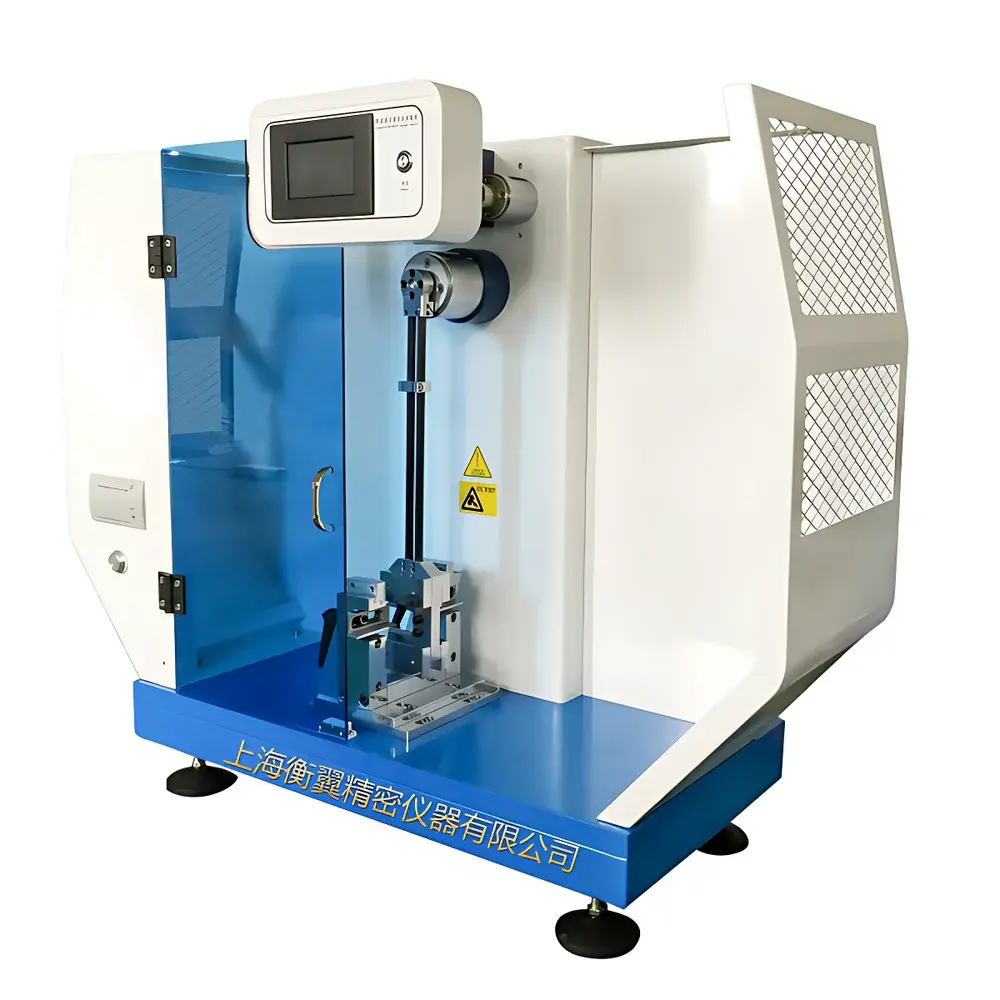
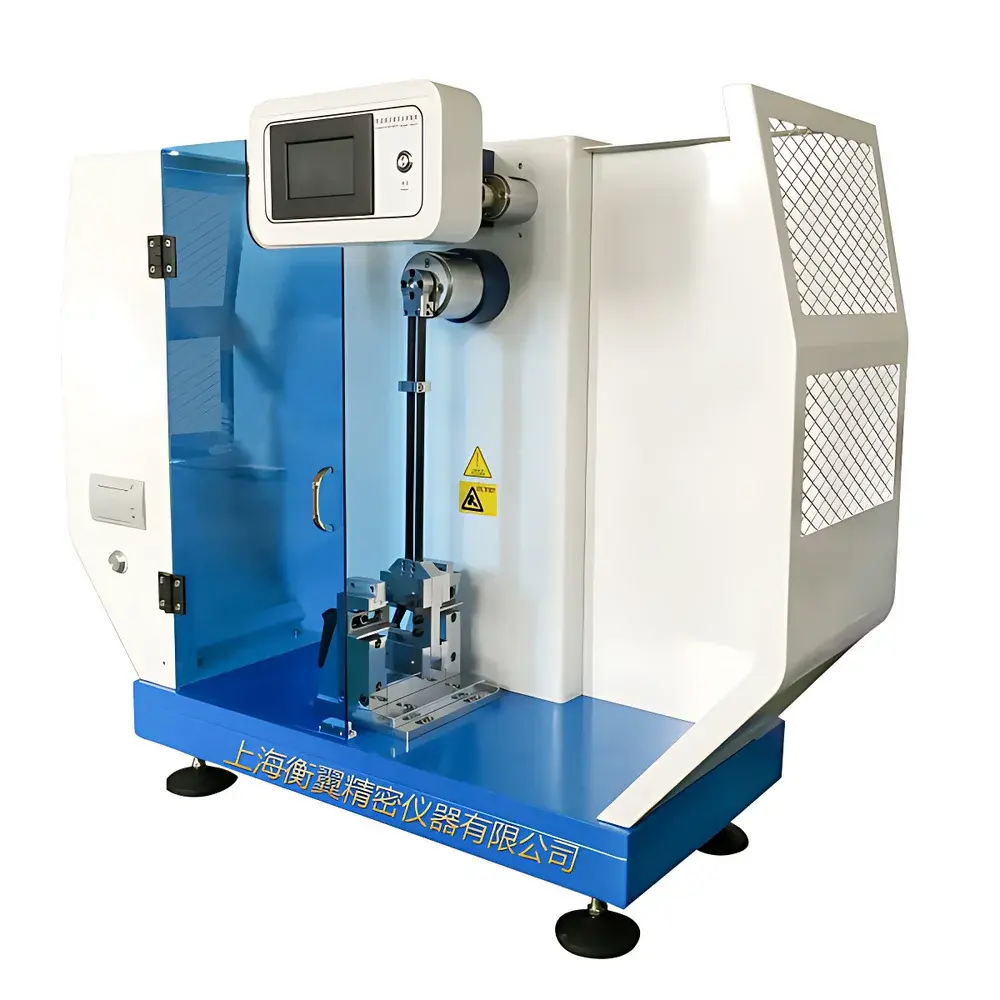
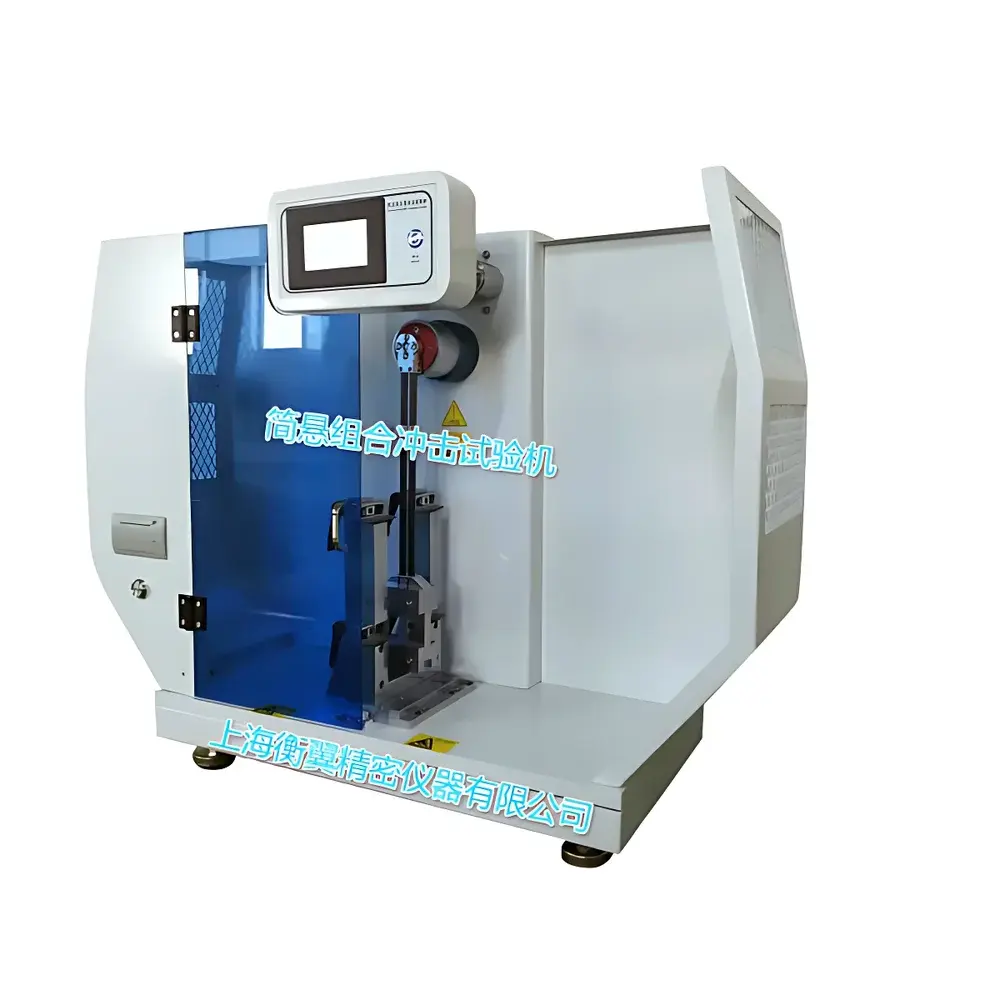
Hengyi HY(XB)-22J Cantilever Beam Impact Tester
| Brand | Hengyi |
|---|---|
| Origin | Shanghai, China |
| Manufacturer Type | Direct Manufacturer |
| Product Category | Domestic |
| Model | HY(XB)-22JUNNYHGF |
| Instrument Type | Pendulum Impact Tester |
| Nominal Impact Energy | 22 J |
| Impact Velocity | 3.5 m/s |
| Pendulum Torque (Impact Constant) | 0.001 J·deg⁻¹ |
| Load Cell Range | 22 J |
| Maximum Pendulum Lifting Height | 395 mm |
| Display | Color Touchscreen (English/Chinese) |
| Angle Sensor | Omron Encoder, ±0.01° resolution |
| Energy Resolution | 0.01 J |
| Pendulum Angle | 150° |
| Distance from Pendulum Pivot to Impact Blade | 335 mm |
| Distance from Impact Blade to Clamp Upper Surface | 22 mm |
| Blade Tip Radius | R = 0.8 ± 0.2 mm |
| Net Weight | 85 kg |
| Power Supply | AC 220 V ±10%, 50 Hz |
Overview
The Hengyi HY(XB)-22J Cantilever Beam Impact Tester is a precision-engineered pendulum impact testing system designed in strict accordance with ISO 180 and ASTM D256 standards for determining the notched and unnotched impact strength of rigid plastics and non-metallic materials. It operates on the principle of gravitational potential energy conversion: a calibrated pendulum is raised to a defined height, released, and allowed to strike a standardized specimen clamped in a cantilever configuration. The residual energy after fracture is measured via high-resolution angular displacement sensing and load cell feedback, enabling direct calculation of absorbed impact energy per unit cross-sectional area (kJ/m²). This method delivers high reproducibility for comparative material qualification, batch release verification, and failure mode analysis in polymer development, quality control, and regulatory documentation workflows.
Key Features
- Compliant dual-energy configuration: selectable nominal impact energies of 11 J and 22 J, optimized for standard 80 × 10 × 4 mm specimens per ISO 180-1 and ASTM D256 Type A/B geometries.
- High-fidelity angular measurement using an industrial-grade Omron optical encoder with ±0.01° angular resolution, ensuring traceable energy determination across the full scale.
- Integrated digital force transduction: a calibrated load cell with 22 J full-scale range provides redundant energy validation and supports real-time force–time curve acquisition (optional firmware upgrade).
- Color touchscreen HMI with bilingual (English/Chinese) interface, supporting parameter setup, real-time energy display (0.01 J resolution), automatic energy loss correction, and on-device report generation.
- Rigid cast-iron base and precision-machined pendulum arm ensure mechanical stability and minimal vibration coupling during impact—critical for repeatable fracture initiation assessment.
- Standardized impact blade geometry: radius R = 0.8 ± 0.2 mm, meeting ISO 180 Annex B and ASTM D256 Section 7.3 requirements for notch-tip radius tolerance and edge sharpness.
Sample Compatibility & Compliance
The HY(XB)-22J accommodates standardized rectangular bars (e.g., 80 × 10 × 4 mm) with or without machined U- or V-notches, enabling evaluation of materials including thermoplastics (e.g., ABS, PC, PP), fiber-reinforced composites (glass-filled nylon, CFRP), ceramics, insulating polymers, and cast stone. Specimen clamping conforms to ISO 180-2 Clause 6.2 and ASTM D256 Section 8.1, ensuring consistent support span and alignment. All mechanical dimensions—including 335 mm pivot-to-blade distance and 22 mm blade-to-clamp reference plane—are certified against national metrological verification protocols (JJG 145–2019, China). The instrument satisfies essential requirements for GLP-compliant laboratories conducting routine QC testing under ISO/IEC 17025-accredited scopes.
Software & Data Management
Data acquisition and reporting are handled through embedded firmware with local storage (SD card slot) and USB export capability. Each test record includes timestamp, specimen ID, energy absorption (J), calculated impact strength (kJ/m²), notch depth, and operator annotation. Energy loss compensation algorithms apply empirically derived friction and air resistance corrections per ISO 148-1 Annex C. Exported CSV files contain raw encoder counts, load cell mV outputs, and processed metrics—fully compatible with LIMS integration and statistical process control (SPC) platforms. Audit trail functionality logs all parameter changes and report generations, supporting compliance with FDA 21 CFR Part 11 when paired with user access controls (admin/operator roles).
Applications
- Quality assurance of injection-molded plastic components in automotive and electronics housings.
- Evaluation of toughening agent efficacy (e.g., elastomer blends, nanofillers) during polymer formulation R&D.
- Batch-to-batch consistency verification for glass-fiber reinforced polyamide (PA66-GF30) and PBT composites.
- Regulatory submission support for medical device housing materials requiring ISO 10993-1 biocompatibility documentation.
- Failure analysis of brittle fracture in ceramic substrates and epoxy-based encapsulants used in power electronics.
- Teaching laboratory use in materials science curricula for hands-on demonstration of Charpy vs. Izod vs. cantilever beam energy dissipation mechanisms.
FAQ
What standards does the HY(XB)-22J comply with for calibration and testing?
It meets the mechanical and procedural requirements of ISO 180, ASTM D256, GB/T 2611, and JJG 145–2019 for pendulum impact testers.
Can the instrument measure both notched and unnotched specimens?
Yes—standard clamp fixtures support both configurations per ISO 180-1 Clause 7 and ASTM D256 Section 7.1.
Is the energy loss correction algorithm traceable to international guidelines?
Yes—the correction follows ISO 148-1 Annex C methodology, incorporating measured bearing friction and aerodynamic drag coefficients.
Does the system support network connectivity or remote data retrieval?
No native Ethernet/Wi-Fi; data export is via USB 2.0 or SD card in CSV format for offline analysis.
What maintenance is required to maintain measurement validity?
Annual verification of pendulum moment of inertia, blade radius, and encoder linearity is recommended per ISO/IEC 17025 Clause 6.4.3.



