
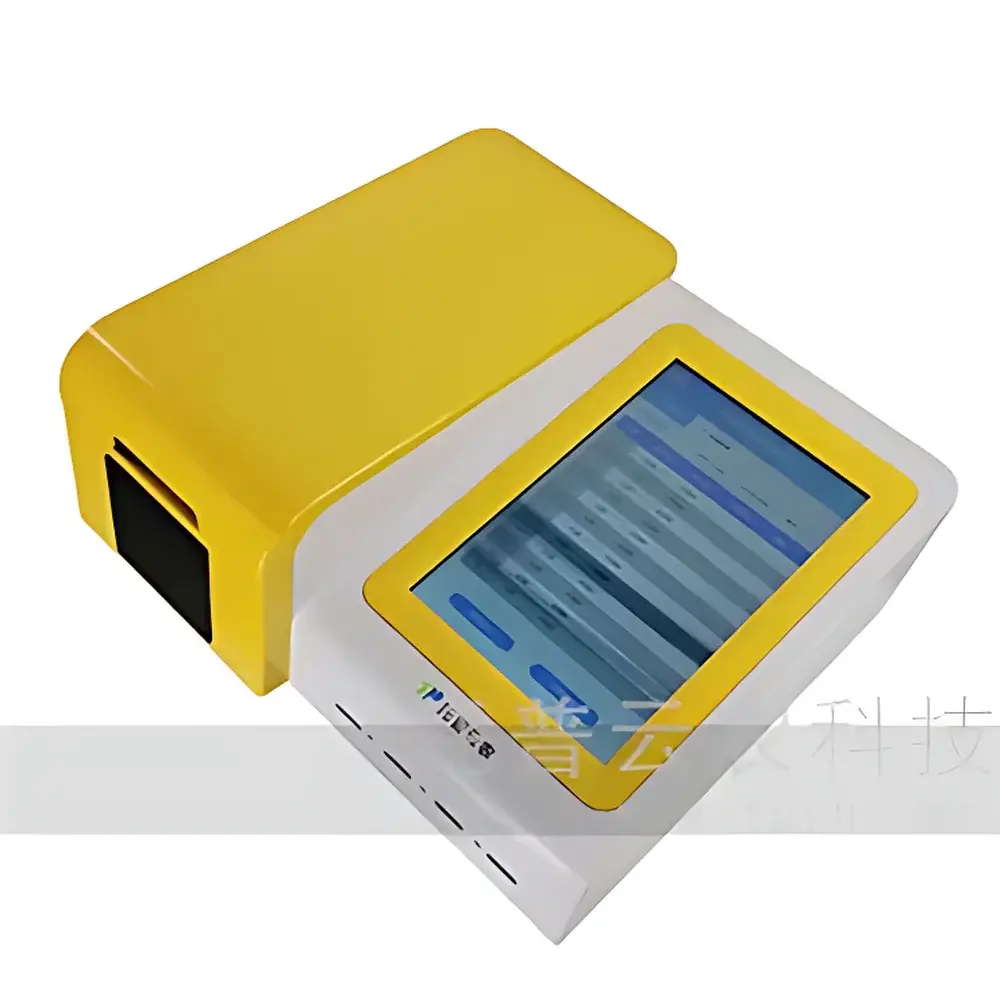
Top Cloud-agri NY-12DG Multi-Functional Pesticide Residue Rapid Tester
| Brand | Top Cloud-agri |
|---|---|
| Origin | Zhejiang, China |
| Manufacturer Type | Direct Manufacturer |
| Country of Origin | China |
| Model | NY-12DG |
| Price | ¥38,000 |
| Detection Channels | 12 (spectrophotometric) + 3 (colloidal gold) |
| Display | 10.1-inch capacitive touchscreen |
| OS | Android-based embedded system |
| Wavelengths | 410 nm / 412 nm |
| Photometric Accuracy | ±2.0% transmittance |
| Photometric Repeatability | ≤0.2% |
| 3-Minute Stability | ≤0.2% |
| Data Storage | Internal + SD card expansion |
| Connectivity | Dual USB, Wi-Fi, Bluetooth, RJ45, optional 4G/5G & GPS/AGPS |
| Printing | Integrated thermal printer for test reports and peel-off traceability certificates |
| Compliance | Designed for alignment with GB/T 5009.199–2003, NY/T 448–2001, and ISO/IEC 17025 laboratory practice frameworks |
Overview
The Top Cloud-agri NY-12DG Multi-Functional Pesticide Residue Rapid Tester is a dual-mode, field-deployable analytical instrument engineered for high-throughput screening of organophosphorus and carbamate pesticide residues in fresh produce, grains, tea, and other edible agricultural commodities. It operates on two complementary optical detection principles: (1) enzyme inhibition-based spectrophotometry at fixed wavelengths (410 nm and 412 nm), quantifying acetylcholinesterase (AChE) activity suppression as an indirect measure of anticholinesterase pesticide concentration; and (2) lateral-flow colloidal gold immunochromatography, enabling qualitative/semi-quantitative detection of structurally diverse pesticide classes including neonicotinoids, triazoles, and synthetic pyrethroids. Unlike benchtop GC-MS or LC-MS systems, the NY-12DG delivers results within 10–15 minutes per batch—without solvent extraction, derivatization, or certified reference standards—making it suitable for decentralized testing at origin points, wholesale markets, and regulatory checkpoints where rapid triage and decision support are operationally critical.
Key Features
- Dual-channel architecture: 12 independent photometric channels for enzyme inhibition assays + 3 dedicated colloidal gold strip readers—expandable to 5–10 gold channels via firmware update.
- Integrated traceability infrastructure: Embedded thermal printer produces tamper-evident, QR-coded agricultural product compliance certificates; scannable codes link to cloud-stored metadata (sample ID, location, tester ID, timestamp, raw absorbance values).
- Android-based human-machine interface: 10.1-inch capacitive touchscreen supports multilingual input (English/Chinese), pinyin-assisted sample naming, handwriting recognition, and embedded video tutorials for standardized assay execution.
- Robust data governance: Local storage (internal flash + microSD slot) retains ≥50,000 test records with full audit trail—including sample name, producer information, measured absorbance, calculated inhibition rate, pass/fail determination, and environmental temperature/humidity logs.
- Networked interoperability: Equipped with dual USB ports, Wi-Fi 802.11 b/g/n, Bluetooth 4.2, and RJ45 Ethernet; optional 4G/LTE or 5G cellular module enables real-time synchronization with national food safety surveillance platforms (e.g., China’s National Food Safety Risk Monitoring Information System).
- Remote service capability: Firmware updates, diagnostic telemetry, parameter calibration, and operator training delivered over-the-air without physical access—critical for distributed deployment across rural cooperatives and municipal inspection stations.
Sample Compatibility & Compliance
The NY-12DG accepts homogenized extracts from leafy vegetables (e.g., spinach, cabbage), fruit pulps (e.g., apple, citrus), cereal grains (rice, wheat), and dried tea leaves following standardized pre-treatment protocols (e.g., GB/T 5009.199–2003). Its photometric module meets national metrological requirements for transmittance accuracy (±2.0%) and short-term baseline stability (≤0.2% drift over 3 min), ensuring reproducibility across operators and environments. While not a primary reference method, the instrument is validated for use in routine monitoring programs aligned with ISO/IEC 17025 quality management systems and supports GLP-compliant documentation workflows—including electronic signature capture, time-stamped audit logs, and exportable CSV/Excel reports traceable to ISO/IEC 17025 Clause 7.11.
Software & Data Management
The embedded software suite provides role-based access control (administrator/operator modes), configurable pass/fail thresholds per analyte, and automated report generation compliant with Chinese agricultural administrative reporting templates. All test data—including raw optical density values, inhibition percentages, and certificate images—are encrypted during transmission to the Top Cloud-agri AgriTrace™ cloud platform (AES-256 TLS 1.2). The platform supports API integration with third-party regulatory dashboards (e.g., provincial market supervision bureaus) and enables longitudinal trend analysis, outlier detection, and geospatial heat mapping of residue prevalence. Data exports meet FDA 21 CFR Part 11 requirements for electronic records, including immutable timestamps, user authentication logs, and version-controlled audit trails.
Applications
- Routine screening at farm gates and cooperative collection centers prior to distribution.
- On-site verification in farmers’ markets, school canteens, and supermarket quality control labs.
- Regulatory surveillance by county-level agriculture bureaus and municipal food safety commissions.
- Contractual compliance testing for GAP-certified producers and export-oriented agribusinesses.
- Environmental monitoring of pesticide drift impact near orchards and paddy fields.
FAQ
What pesticide classes does the NY-12DG detect?
It detects organophosphates (e.g., chlorpyrifos, malathion) and carbamates (e.g., carbaryl, methomyl) via AChE inhibition, and selected neonicotinoids (imidacloprid), triazoles (tebuconazole), and pyrethroids (deltamethrin) via colloidal gold immunoassays.
Can the instrument be calibrated externally?
Yes—calibration is performed using NIST-traceable neutral density filters and certified enzyme reagent kits; calibration logs are stored locally and synced to the cloud.
Is the cloud platform accessible outside mainland China?
AgriTrace™ supports global HTTPS access; however, regional data residency policies may require local server deployment for EU or ASEAN users.
Does the device meet international regulatory acceptance criteria?
While not CE-marked or FDA-cleared as a medical device, its methodology aligns with AOAC Official Method 2007.01 (for enzyme inhibition) and follows validation guidelines outlined in SANTE/11945/2015 for rapid screening tools.
How is measurement uncertainty estimated?
Uncertainty is derived from repeatability studies (n ≥ 6 replicates per matrix), photometer linearity testing, and reagent lot-to-lot variability—reported in internal validation reports per ISO/IEC 17025 Annex A.3.




