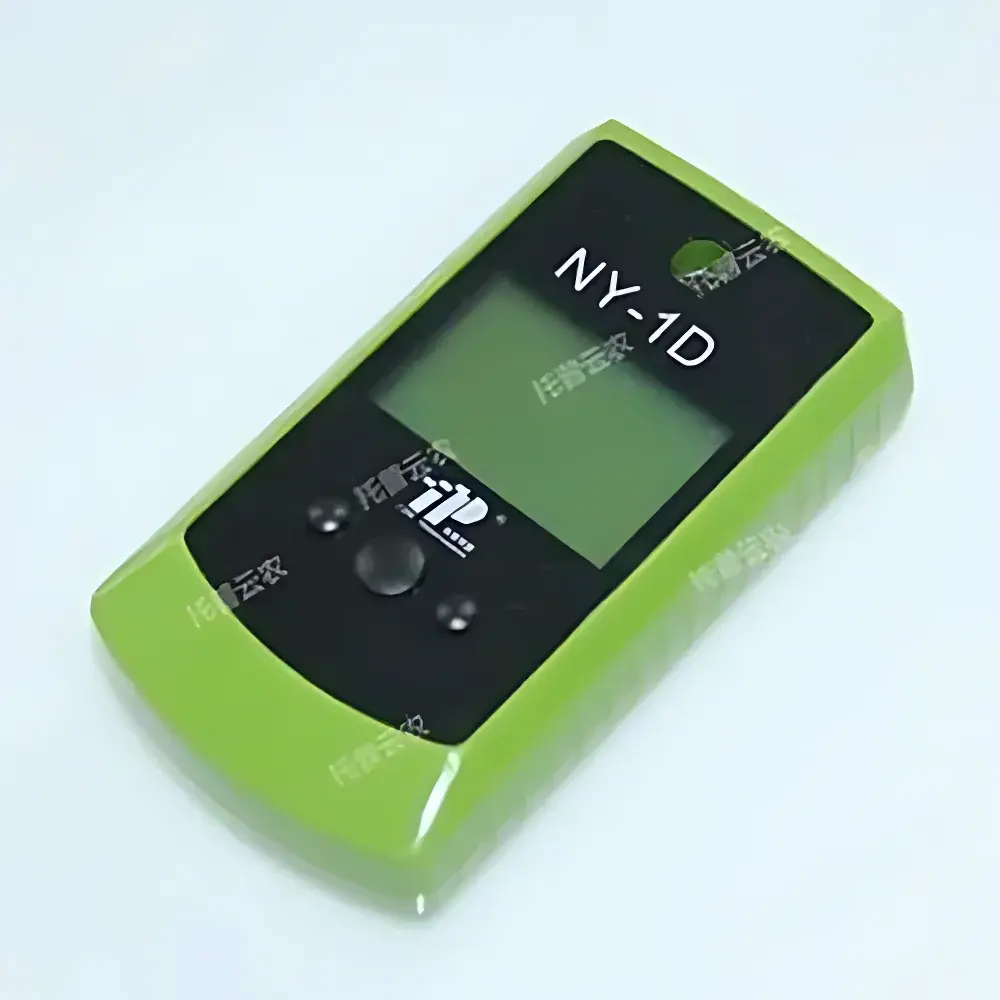
Top Cloud-agri NY-1D Portable Pesticide Residue Rapid Tester
| Brand | Top Cloud-agri |
|---|---|
| Origin | Zhejiang, China |
| Manufacturer Type | Direct Manufacturer |
| Country of Origin | China |
| Model | NY-1D |
| Price | USD 495 (approx.) |
| Photometric Accuracy (Transmittance) | ±3% |
| Photometric Repeatability (Transmittance) | ±2% |
| Linearity Error | ±5% |
| Operating Temperature | 0–40 °C |
| Operating Humidity | 35–85% RH |
| Power Supply | Built-in 3.7 V Li-ion Battery + External 5 V DC Input |
| Data Storage Capacity | 500 Test Records |
| Interface | USB 2.0 |
| Display | Backlit Chinese LCD |
| Keypad | Panasonic Tactile Membrane Switches |
Overview
The Top Cloud-agri NY-1D Portable Pesticide Residue Rapid Tester is a field-deployable photometric analyzer engineered for the qualitative and semi-quantitative detection of organophosphorus and carbamate pesticides in agricultural commodities and environmental matrices. It operates on the principle of acetylcholinesterase (AChE) inhibition assay—a standardized biochemical method recognized by national food safety standards in China (e.g., GB/T 5009.199) and aligned with international screening protocols for rapid pesticide residue surveillance. The instrument measures enzymatic activity suppression in reaction with pesticide-contaminated extracts, converting optical density changes into inhibition rate (%)—a validated surrogate metric for relative pesticide load. Designed for regulatory field use, it delivers lab-grade screening performance without requiring reagent preparation, calibration curves, or manual calculation, making it suitable for time-sensitive inspections at farms, markets, border checkpoints, and mobile food safety units.
Key Features
- Integrated AChE-based enzymatic assay platform with pre-loaded test strips or reagent vials—no pipetting or dilution steps required.
- Dual-power architecture: rechargeable 3.7 V lithium-ion battery (up to 8 hours continuous operation) plus universal 5 V DC input; real-time battery level indicator with low-power warning.
- Optical system featuring long-life LED light source (rated >10,000 hours), minimizing maintenance and drift over extended deployment cycles.
- Intelligent timing control: programmable reaction incubation (1–15 min), auto-start countdown upon sample loading, and precise endpoint detection.
- Backlit monochrome LCD with adjustable backlight duration (5–60 sec); full Chinese interface optimized for operator efficiency in multilingual field environments.
- Onboard data management: automatic timestamping, inhibition rate calculation, and storage of up to 500 test records with sample ID, date/time, and operator tag.
- Auto-calibration function using blank reference measurement prior to each batch; automatic shutdown after 10 minutes of inactivity.
- USB 2.0 interface compliant with mass-storage class protocol—enables direct file transfer without proprietary drivers.
Sample Compatibility & Compliance
The NY-1D supports homogenized aqueous extracts from fresh produce (e.g., lettuce, apples, tomatoes), tea leaves, cereal grains, surface water, and soil leachates. Sample preparation follows standardized extraction protocols (e.g., QuEChERS-lite or AOAC 2007.01 adapted for rapid screening). The instrument meets technical requirements specified in China’s Ministry of Agriculture and Rural Affairs (MARA) Notice No. 2549-2018 for rapid pesticide testers and conforms to photometric performance criteria outlined in JJG 861-2015 (Chinese National Verification Regulation for Spectrophotometers). While not intended for definitive quantification per ISO/IEC 17025, its inhibition-rate output satisfies GLP-aligned field screening thresholds for regulatory triage under national food safety inspection frameworks.
Software & Data Management
The NY-1D interfaces with the Top Cloud-agri Instrument Management Cloud Platform—a secure, browser- and Android-compatible C/S architecture supporting centralized aggregation of data from distributed portable and fixed-site analyzers. Uploaded datasets include inhibition rates, timestamps, GPS metadata (when enabled via paired mobile device), and operator identifiers. The platform provides audit-trail-enabled data visualization: trend curves for longitudinal monitoring, statistical summaries (min/max/mean), zoomable time-series charts, and exportable CSV/PDF reports. All stored data are encrypted at rest and backed up across redundant cloud nodes. Firmware updates are delivered over-the-air (OTA) with version-controlled release notes and rollback capability. The desktop software client supports data import/export, customizable report templates, and integration with LIMS via RESTful API (optional license).
Applications
- Routine surveillance at agricultural cooperatives and wholesale markets to verify compliance with Maximum Residue Limits (MRLs) for organophosphates (e.g., chlorpyrifos, malathion) and carbamates (e.g., carbaryl, methomyl).
- Emergency response during foodborne outbreak investigations—rapidly identifying suspect batches prior to confirmatory GC-MS analysis.
- Pre-harvest field testing to guide integrated pest management (IPM) decisions and reduce unnecessary pesticide applications.
- Training and capacity building for rural extension agents and cooperative QA staff under national “Green Food” certification programs.
- Supporting municipal food safety offices in fulfilling statutory sampling mandates under China’s Food Safety Law (Article 112).
FAQ
What types of pesticides does the NY-1D detect?
It detects organophosphorus and carbamate pesticides via AChE inhibition—common examples include diazinon, parathion-methyl, carbofuran, and propoxur. It does not detect neonicotinoids, pyrethroids, or glyphosate.
Is the instrument suitable for quantitative analysis?
No. It provides inhibition rate (%) as a semi-quantitative screening index. Confirmatory quantification requires HPLC or GC-MS per ISO 17025-accredited methods.
Can test results be exported to Excel or LIMS?
Yes—raw data files (.csv) and formatted reports (.pdf) are exportable via USB or cloud platform. LIMS integration is available through optional API licensing.
What is the shelf life of the enzyme reagents?
Lyophilized AChE reagents retain activity for ≥12 months when stored at –20 °C; working solutions remain stable for 24 hours at 4 °C.
Does the device comply with FDA or EU regulatory requirements?
The NY-1D is designed to meet Chinese national standards (GB/T, JJG) and supports screening workflows compatible with FDA’s Pesticide Analytical Manual (PAM) Tier 1 protocols—but it is not CE-marked or FDA-cleared for clinical or EU market use.