
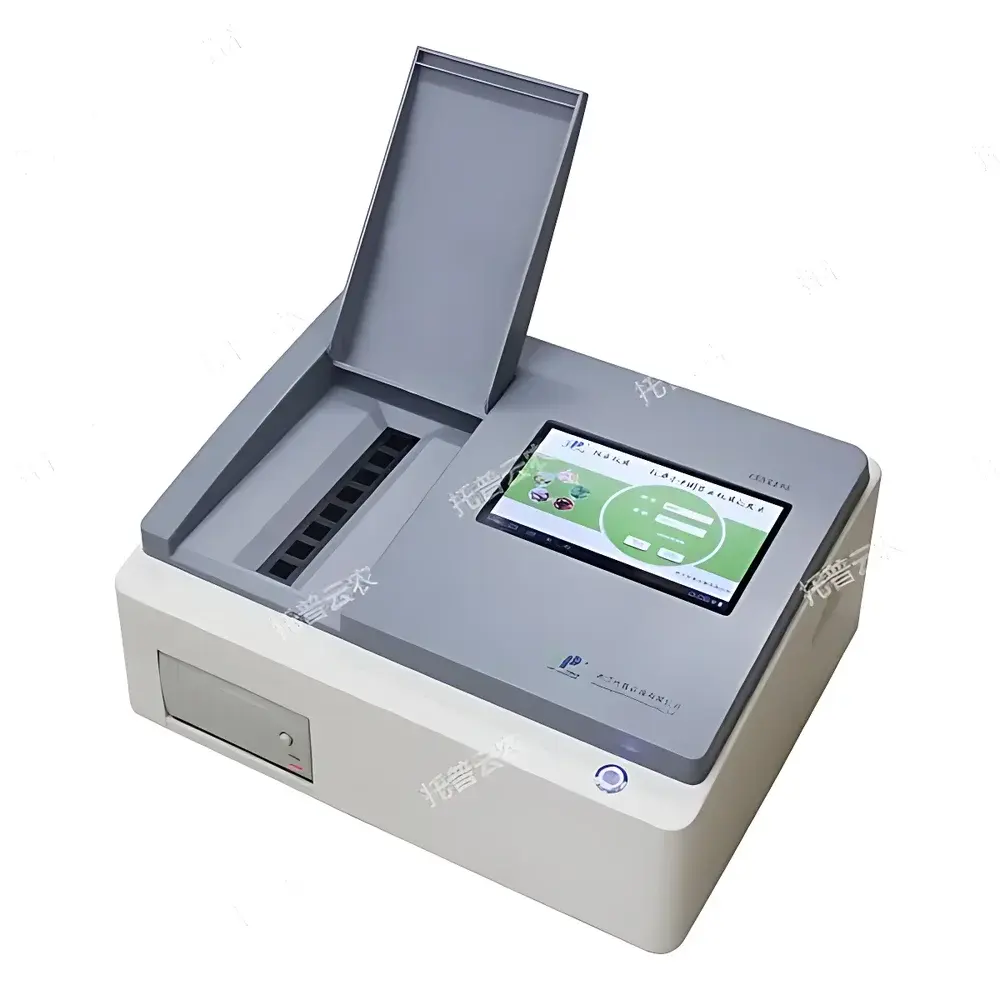
Top Cloud-agri NY-8DA Pesticide Residue Rapid Tester (Enzyme Inhibition Method)
| Brand | Top Cloud-agri |
|---|---|
| Origin | Zhejiang, China |
| Manufacturer Type | Direct Manufacturer |
| Country of Origin | China |
| Model | NY-8DA |
| Detection Method | Enzyme Inhibition Spectrophotometry |
| Measurement Range (Inhibition Rate) | 0–100% |
| Number of Channels | 8 |
| Measurement Error | ±10% |
| Quantitative Range | 0–20 mg/kg |
| Photometric Accuracy (Transmittance) | ≤±1.5% |
| Photometric Repeatability (Absorbance) | ≤0.005 A |
| Stability (3-min Drift after 20-min Warm-up) | ΔT ≤1.0% (or ΔA ≤0.005) |
Overview
The Top Cloud-agri NY-8DA Pesticide Residue Rapid Tester is a field-deployable, multi-channel photometric analyzer engineered for the rapid qualitative and semi-quantitative screening of organophosphorus and carbamate pesticide residues in agricultural commodities. It operates on the internationally standardized enzyme inhibition principle—specifically, the acetylcholinesterase (AChE) inhibition assay—as defined in GB/T 5009.199–2003 (China National Standard) and aligned with AOAC Official Method 992.13 and ISO/IEC 17025–compliant validation frameworks. In the presence of target pesticides, enzymatic hydrolysis of acetylthiocholine is suppressed, resulting in reduced yellow-colored 5-thio-2-nitrobenzoic acid (TNB) formation under reaction with Ellman’s reagent. The degree of colorimetric signal attenuation—measured as percent inhibition—is directly proportional to residue concentration. Designed for regulatory-grade field use, the NY-8DA delivers reproducible results without requiring laboratory infrastructure, making it suitable for decentralized food safety surveillance across supply chain nodes.
Key Features
- Eight independent optical detection channels enable parallel analysis of up to eight samples per run—significantly improving throughput for high-volume screening at markets, cooperatives, or county-level inspection stations.
- 7-inch capacitive touch LCD running Android OS provides intuitive, icon-driven operation; firmware supports over-the-air (OTA) updates via 4G/Wi-Fi connectivity.
- Integrated thermal printer produces audit-ready reports containing sample ID, inhibition rate (%), estimated residue level (mg/kg), pass/fail status, GPS coordinates (≤5 m accuracy), ambient temperature/humidity, PAR (photosynthetically active radiation), and timestamp—all embedded in a single printout.
- Onboard data management stores ≥200,000 test records with automatic timestamping, user-defined vegetable name library (≥40 entries), and configurable pass/fail thresholds per analyte class.
- Self-calibrating optical system performs automatic light source diagnostics at startup—eliminating manual zeroing with neutral density filters.
- Role-based user authentication (username/password) enforces procedural integrity and traceability in GLP-aligned workflows.
- Expandable environmental sensor interface accommodates optional air temperature, relative humidity, dew point, and PAR probes—synchronizing environmental metadata with analytical results for contextual interpretation.
Sample Compatibility & Compliance
The NY-8DA is validated for homogenized extracts from fresh produce (leafy greens, fruits, tomatoes), cereal grains, tea leaves, surface water, and soil leachates. Sample preparation follows standardized extraction protocols using phosphate buffer (pH 7.6) and acetone/water mixtures per GB 23200.113–2018. The instrument meets essential performance criteria outlined in China’s “Supervision and Inspection Technical Specifications for Pesticide Residue Rapid Detection” (No. 2021–15, Ministry of Agriculture and Rural Affairs). While not intended for definitive quantification under ISO 17025 accreditation, its inhibition-rate output supports triage decisions consistent with EU Regulation (EC) No 396/2005 MRL screening thresholds and US EPA tolerance levels for common organophosphates (e.g., chlorpyrifos, malathion) and carbamates (e.g., carbaryl, methomyl).
Software & Data Management
Data acquisition and reporting are supported by dual-tier software architecture: (1) Embedded Android application enabling real-time visualization, local export (CSV/Excel), and encrypted cloud upload; (2) Cloud-based C/S platform accessible via web browser or Android app. The platform provides time-series trend analysis, statistical summaries (mean, min/max, standard deviation), cross-parameter correlation charts, and customizable report templates compliant with internal QA documentation requirements. All data transmissions employ TLS 1.2 encryption; audit trails record user actions, configuration changes, and calibration events—supporting FDA 21 CFR Part 11–aligned electronic record integrity where locally implemented. Raw absorbance values, inhibition calculations, and environmental metadata are retained in immutable format with version-controlled backups.
Applications
- Routine pre-market screening at wholesale markets and farmers’ cooperatives to enforce national residue limits.
- Field verification during Good Agricultural Practice (GAP) audits and certification inspections.
- Surveillance testing by municipal food and drug administration bureaus in response to outbreak investigations.
- Training and capacity building for rural extension agents conducting community-level food safety education.
- Baseline residue mapping in agro-ecological zones to inform integrated pest management (IPM) strategy development.
FAQ
What pesticides does the NY-8DA detect?
It detects organophosphorus and carbamate compounds—including chlorpyrifos, dimethoate, omethoate, carbaryl, and methomyl—based on their shared inhibition mechanism against acetylcholinesterase.
Is the instrument suitable for quantitative compliance reporting?
No. It provides semi-quantitative inhibition rates (%) and estimated concentrations (mg/kg) for screening purposes only. Confirmatory analysis requires GC-MS or LC-MS/MS per ISO/IEC 17025 standards.
How is data integrity ensured during remote transmission?
All uploads to the cloud platform use end-to-end TLS 1.2 encryption; each record includes digital signature, geotag, and device-specific serial number to prevent tampering.
Can the instrument operate offline?
Yes. Full functionality—including measurement, printing, and local storage—is available without network connectivity; data syncs automatically when connection resumes.
Does the system support multi-user environments with permission levels?
Yes. Administrators can assign roles (e.g., operator, supervisor, auditor) with granular access control over data editing, report generation, and system configuration.




