
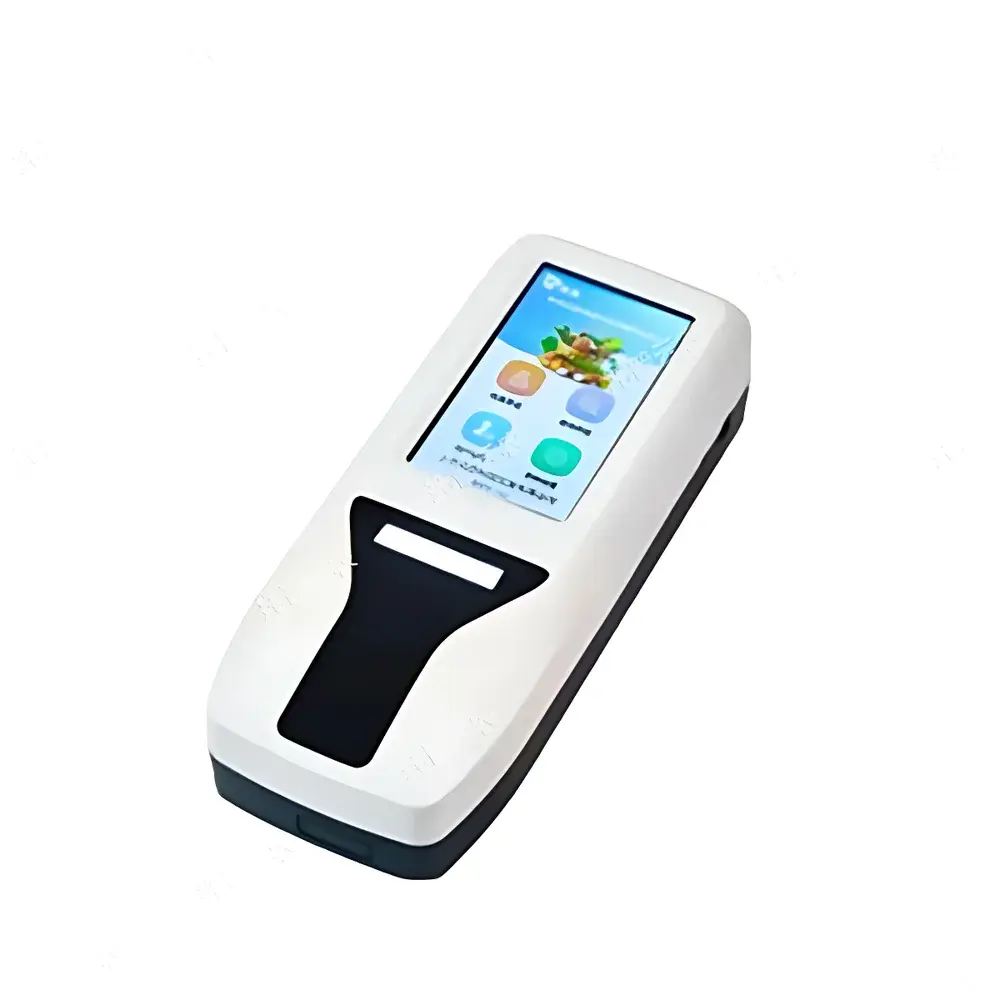
Top Cloud-agri TP-SJ-1B Portable Pesticide Residue Analyzer
| Brand | Top Cloud-agri |
|---|---|
| Origin | Zhejiang, China |
| Manufacturer Type | Direct Manufacturer |
| Country of Origin | China |
| Model | TP-SJ-1B |
| Detection Principle | Colloidal Gold Immunochromatographic Assay (CGIA) with CCD-based quantitative optical readout |
| Detection Channels | 1 |
| Measurement Time | <2 s per test |
| Output Modes | Colorimetric intensity, C/T ratio, Test line (T-line) signal, Control line (C-line) signal |
| Display | 5-inch capacitive touchscreen (Android OS) |
| Connectivity | Wi-Fi, Bluetooth 4.0, USB 2.0 |
| Power Supply | Rechargeable lithium-ion battery (≥8 h continuous operation) |
| Data Upload | Real-time cloud synchronization via encrypted HTTPS API |
| Compliance | Designed to support GLP-compliant field testing workflows |
Overview
The Top Cloud-agri TP-SJ-1B Portable Pesticide Residue Analyzer is an embedded-field diagnostic instrument engineered for rapid, on-site quantitative screening of pesticide residues in fresh agricultural commodities—including fruits, vegetables, tea leaves, and edible fungi. It operates on the principle of colloidal gold immunochromatographic assay (CGIA), a well-established lateral-flow immunoassay technology widely adopted in food safety surveillance programs across Asia, Africa, and Latin America. Unlike conventional ELISA or chromatographic methods requiring centralized labs, the TP-SJ-1B performs objective, operator-independent optical quantification of test strip signals using a high-resolution CCD sensor array calibrated for consistent reflectance measurement across variable ambient lighting conditions. Its architecture integrates hardware-level signal normalization—compensating for batch-to-batch strip variability—and real-time algorithmic discrimination between valid assay cards and non-functional or expired strips. The device is not intended for regulatory confirmation but serves as a validated prescreening tool aligned with national rapid-testing protocols (e.g., China’s GB/T 5009.199–2003 and NY/T 448–2001) for early hazard identification and risk prioritization.
Key Features
- Single-channel CCD optical reader with auto-focus and ambient light compensation, enabling reliable T/C ratio calculation under field conditions (indoor/outdoor, shaded/bright).
- Android-based 5-inch touchscreen interface with intuitive icon-driven navigation, multilingual UI support (English, Spanish, Vietnamese, Arabic), and embedded procedural video guides accessible offline.
- Zero-sample-handling requirement: direct plug-and-read compatibility with standardized colloidal gold test strips from multiple domestic and international suppliers.
- Integrated rechargeable lithium-ion battery supporting ≥8 hours of continuous operation—validated at 15–35°C ambient temperature range.
- On-device data persistence: automatic local storage of raw image captures, processed T/C values, pass/fail flags, concentration estimates (µg/kg), and contextual metadata (time, GPS coordinates, operator ID).
- Expandable connectivity: native Wi-Fi (802.11 b/g/n), Bluetooth 4.0 for peripheral pairing (e.g., portable thermal printers), and USB-C host mode for firmware updates or bulk data export.
- Cloud-ready architecture: TLS 1.2–secured HTTP POST transmission to vendor-hosted or client-deployed cloud platforms, supporting RESTful API integration with LIMS, ERP, or government food safety dashboards.
Sample Compatibility & Compliance
The TP-SJ-1B is validated for use with homogenized aqueous extracts prepared from solid food matrices using standardized extraction kits (e.g., QuEChERS-compatible buffer systems). It supports detection of over 70 active ingredients across four pesticide classes: organophosphates (e.g., chlorpyrifos, omethoate), carbamates (e.g., carbaryl, methomyl), pyrethroids (e.g., cypermethrin, deltamethrin), neonicotinoids (e.g., imidacloprid, thiamethoxam), plus selected fungicides (e.g., carbendazim, azoxystrobin) and plant growth regulators (e.g., forchlorfenuron, paclobutrazol). All assay interpretations adhere to manufacturer-specified cutoff thresholds defined per compound (typically 0.01–5.0 mg/kg), traceable to reference standards certified by CNAS-accredited laboratories. While not ISO/IEC 17025 accredited as a standalone system, its operational documentation, calibration logs, and electronic records are structured to facilitate internal GLP audits and alignment with national rapid-test validation guidelines.
Software & Data Management
Firmware v3.2+ implements role-based access control (admin/operator modes), time-stamped audit trails, and cryptographic hashing of all stored records to prevent post-acquisition modification. Data exports are generated in CSV and PDF formats—with optional digital signature embedding—and include full assay metadata: strip lot number, expiration date, environmental temperature/humidity (if external sensor connected), GPS geotag, and operator biometric or PIN authentication log. Cloud synchronization employs OAuth 2.0 authorization and AES-256 encryption in transit and at rest. Integration with third-party platforms is supported via documented REST APIs compliant with OpenAPI 3.0 specifications, enabling bidirectional sync with national food safety information systems (e.g., China’s NIFSI, Vietnam’s VinaCheck).
Applications
- Pre-harvest field scouting by extension officers to guide harvest timing and residue mitigation strategies.
- Wholesale market gate inspection for incoming produce batches prior to distribution.
- Supermarket quality assurance teams performing random lot verification before shelf placement.
- Government food safety inspectors conducting unannounced roadside or wet-market surveillance.
- Contract laboratories deploying mobile units for multi-site client audits under service-level agreements.
- Educational institutions utilizing the platform for hands-on training in immunoassay principles and food safety risk assessment.
FAQ
Does the TP-SJ-1B require external calibration standards for each test?
No. The instrument performs self-calibration using the built-in control line (C-line) reference and factory-characterized optical baseline profiles. Strip-specific calibration curves are embedded in QR-coded assay card packaging and auto-loaded upon scanning.
Can the device store historical results without cloud connectivity?
Yes. All test records—including raw images—are retained locally on internal eMMC storage (8 GB) until manually exported or overwritten per configurable retention policy (default: 10,000 records).
Is GPS location data mandatory for test submission?
GPS capture is enabled by default but can be disabled in admin settings for privacy-sensitive deployments. Geotags are stored locally and transmitted only when cloud upload is initiated.
What is the recommended maintenance interval for the CCD optical module?
No routine optical recalibration is required. Users should perform weekly cleaning of the sample chamber window using lint-free wipes and isopropyl alcohol; full functional verification is advised every 6 months using included QC test strips.
How does the system handle invalid or expired test strips?
The CCD scanner detects absence of control line development or abnormal signal morphology and classifies the strip as “invalid” with a visual alert—preventing erroneous result interpretation or cloud upload.






