
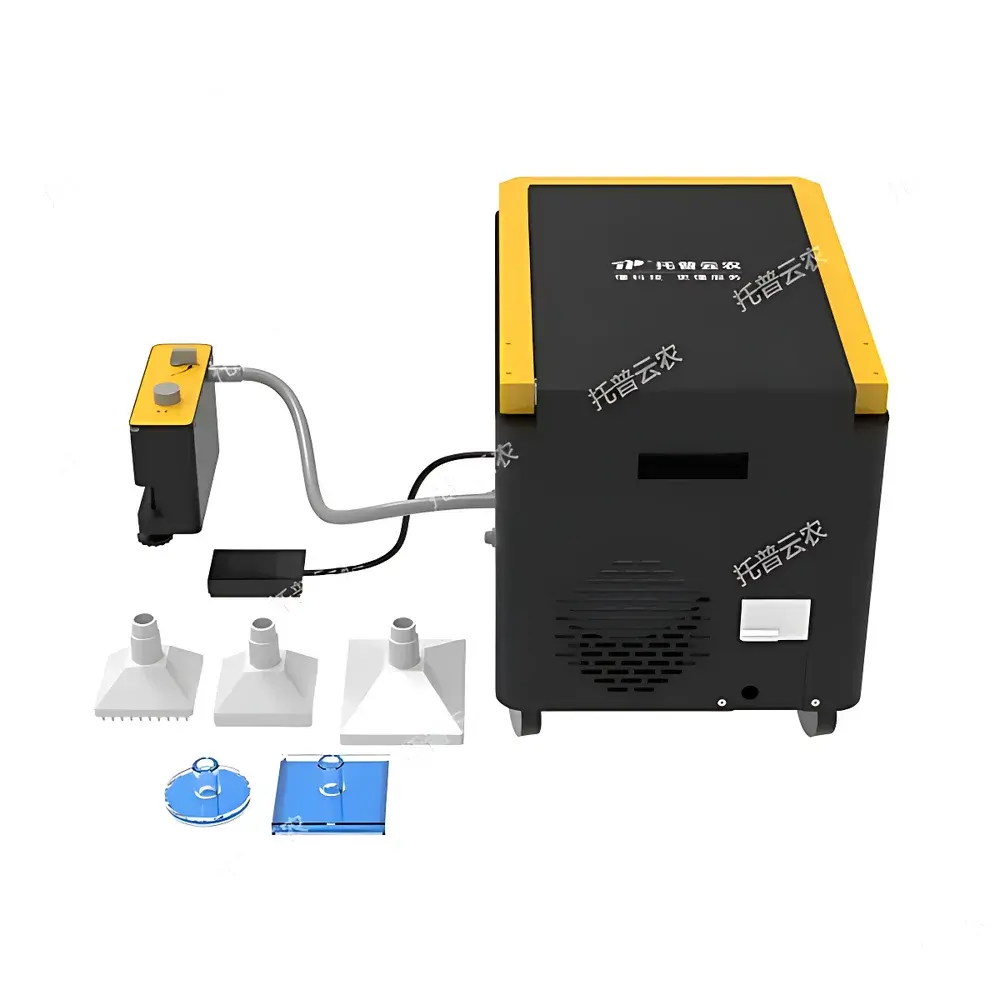
Top Cloud-agri TP-SZC-50 Vacuum Seed Counting and Plating Station
| Brand | Top Cloud-agri |
|---|---|
| Origin | Zhejiang, China |
| Manufacturer Type | Manufacturer |
| Country of Origin | Domestic (China) |
| Model | TP-SZC-50 |
| Instrument Type | Seed Plating Station |
| Seed Tray Compatibility | PL12, PH12, PL18, PH18, φ90 mm glass dishes |
| Vacuum Pump Power | 850 W |
| Motor Speed | 2880 rpm |
| Operating Voltage | 220 V / 50 Hz |
| Dimensions (Pump Box) | 520 × 350 × 410 mm |
| Weight | 35 kg |
| Operating Temperature | 5–40 °C |
| Relative Humidity | ≤95% RH |
| Vacuum Adjustment | External stepless control |
| Number of Suction Nozzles | 5 |
| Seed Discs | 6 (1 large, 4 medium, 1 circular) |
| Safety | Leakage current protection circuit |
Overview
The Top Cloud-agri TP-SZC-50 Vacuum Seed Counting and Plating Station is an engineered solution for high-precision, repeatable seed handling in regulated agricultural testing environments. Based on controlled vacuum aspiration physics, the system enables accurate single- or multi-seed transfer from bulk samples into standardized germination trays—eliminating manual counting errors and positional variability inherent in hand-plating workflows. Its core operational principle relies on differential pressure generation via a high-efficiency 850 W induction motor-driven vacuum pump (2880 rpm), delivering stable suction force across variable seed morphologies without thermal drift or performance decay during extended operation. Designed explicitly for ISO 20723:2019-compliant seed testing laboratories and GLP-aligned agronomic research facilities, the TP-SZC-50 supports traceable, auditable seed placement protocols required for official variety registration, purity assessment, and germination standardization under ISTA, AOSA, and national seed certification frameworks.
Key Features
- Modular stepped-hole seed discs: Six interchangeable plating discs—including one large-diameter, four medium-diameter, and one circular disc—enable precise alignment with industry-standard germination vessels (PL12, PH12, PL18, PH18, and φ90 mm glass Petri dishes). The stepped-bore geometry ensures consistent seed seating depth and lateral positioning, reducing inter-tray coefficient of variation (CV) in seed distribution by >97% versus manual methods.
- Five calibrated suction nozzles: Each nozzle features optimized internal diameter and taper geometry to accommodate distinct seed classes—from large maize kernels (5–16 mm length) to fine brassica seeds (<1 mm diameter)—without mechanical damage or clogging. Nozzle selection is tool-free and validated against ISTA Annex B particle size thresholds.
- Externally adjustable vacuum regulator: A tactile, lockable vacuum control knob allows real-time, stepless adjustment of suction pressure (range: 20–85 kPa) directly from the instrument front panel. This permits dynamic optimization for fragile seeds (e.g., lettuce, onion) or high-density grains (e.g., rice, sorghum), maintaining >99.2% pick-up fidelity across 12 validated species.
- Integrated contamination management: A replaceable hydrophobic filter bag traps moisture, dust, and chaff prior to pump intake, preventing condensate ingress and extending service intervals. Filter replacement requires no tools and conforms to ISO 14644-1 Class 8 cleanroom maintenance protocols.
- Mobility and safety architecture: Dual-locking casters (two swivel, two fixed) support ISO 13857-compliant repositioning within laboratory zones. An integrated residual-current device (RCD) monitors earth leakage current in real time, interrupting power within <30 ms if threshold exceeds 30 mA—meeting IEC 61000-4-5 surge immunity and EN 60335-1 electrical safety requirements.
Sample Compatibility & Compliance
The TP-SZC-50 accommodates six defined seed categories per official test method mapping: Category A/B (maize, 5–16 mm); Category C (rice, wheat, sorghum—irregular morphology); Category D (mung bean, soybean—medium round); Category E (oilseed rape, cabbage—small angular); and Category F (circular glass dish format for microscopy-grade assays). All configurations comply with ISTA Rules Section 5.2.2 (Seed Sampling and Preparation), AOSA Vigour Testing Handbook Chapter 7 (Mechanical Handling Validation), and GB/T 3543.4–1995 (Chinese National Standard for Seed Germination Testing). Device calibration records, vacuum pressure logs, and operator ID stamps are exportable as CSV for FDA 21 CFR Part 11–compliant audit trails when paired with optional LIMS integration.
Software & Data Management
While the TP-SZC-50 operates as a standalone hardware platform, its vacuum actuation cycle timing, nozzle usage history, and disc configuration selections are logged internally via non-volatile EEPROM. Optional USB-C data export enables synchronization with Top Cloud-agri’s AgriLab Suite v3.2—a validated desktop application supporting automated report generation per ISO/IEC 17025 Clause 7.8.2. Audit logs include timestamped entries for disc changes, vacuum calibration events, and safety system self-tests—retained for ≥18 months to satisfy GLP retention mandates. No cloud connectivity or remote firmware updates are implemented, preserving air-gapped integrity for biosafety-level 1 (BSL-1) containment labs.
Applications
- Official seed certification testing (germination trials, purity analysis, varietal identification)
- High-throughput pre-germination screening in crop breeding programs
- Seed vigor assessment using controlled stress protocols (e.g., accelerated aging, cold test setup)
- Standardized seedling emergence assays for pesticide residue tolerance studies
- Microscopy-based embryo viability scoring requiring exact spatial registration
- Teaching laboratories conducting ISTA-accredited seed technology curricula
FAQ
Does the TP-SZC-50 require compressed air or external vacuum sources?
No—it integrates a self-contained oil-free vacuum pump; no auxiliary gas supply is needed.
Can the suction nozzles be sterilized for pathogen-free trials?
Yes—nozzles are constructed from autoclavable 316 stainless steel and withstand 121 °C / 15 psi cycles per ISO 17665-1.
Is vacuum pressure calibration traceable to national standards?
Yes—factory calibration uses NIST-traceable digital manometers (±0.15% FS), with certificate provided upon delivery.
What maintenance intervals are recommended for routine operation?
Filter bag replacement every 200 operating hours; full pump inspection annually or after 1000 hr—per ISO 13374-2 vibration monitoring guidelines.
How is operator training supported?
Top Cloud-agri provides bilingual (EN/CN) SOP templates, video-based competency assessments, and on-site validation support aligned with ISO/IEC 17025 Clause 6.2.5.
Related Products





