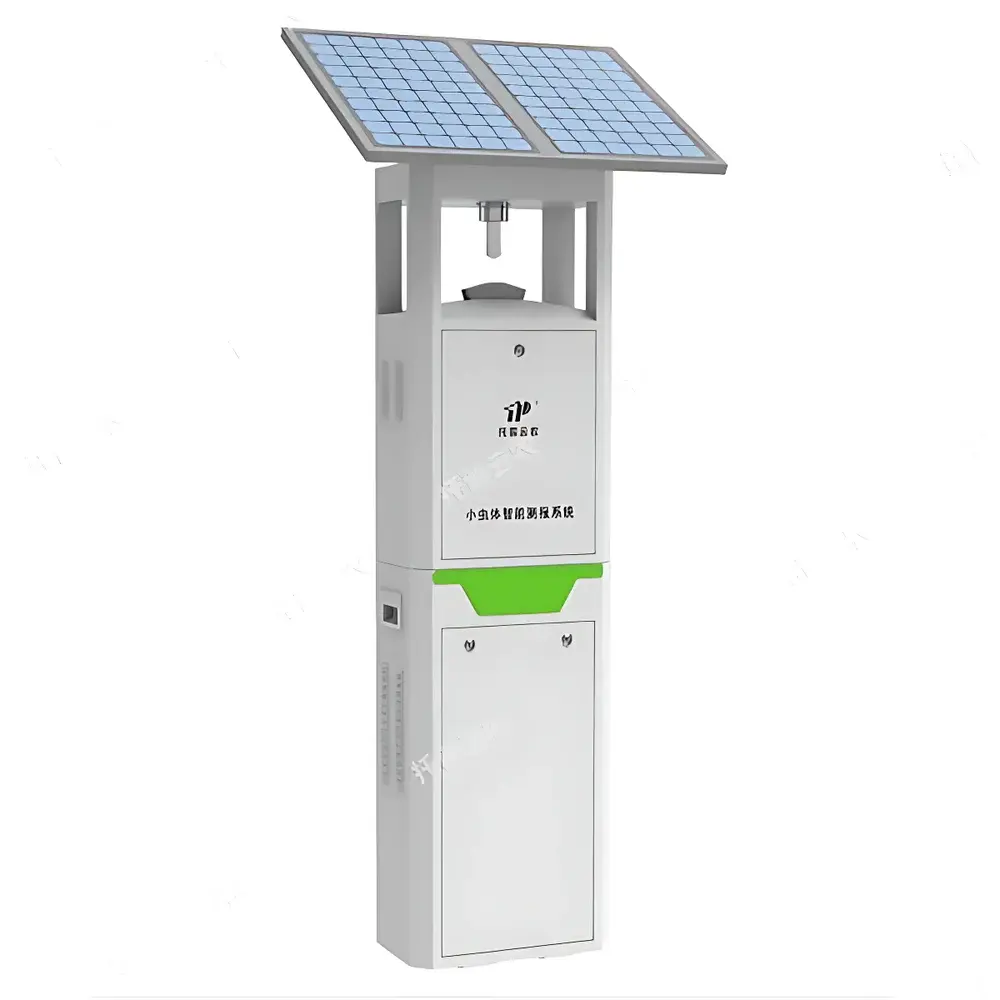
Top Cloud-agri TPCB-XCDY-P Intelligent Micro-Insect Monitoring System for Planthopper Surveillance
| Brand | Top Cloud-agri |
|---|---|
| Origin | Zhejiang, China |
| Manufacturer Type | Direct Manufacturer |
| Country of Origin | China |
| Model | TPCB-XCDY-P |
| Instrument Category | Pest Monitoring and Control Equipment |
| Application Domain | Rice Paddy, Tea Garden, Orchards (Pear, Grape, Apple, Peach, Pomegranate) |
Overview
The Top Cloud-agri TPCB-XCDY-P Intelligent Micro-Insect Monitoring System is a purpose-built, field-deployable surveillance instrument engineered for continuous, automated monitoring of phototactic micro-insects—particularly planthoppers (Nilaparvata lugens, Sogatella furcifera, Laodelphax striatellus), leafhoppers (Cicadellidae), and mirid bugs (e.g., Apolygus lucorum)—in agricultural ecosystems. It operates on an integrated principle combining selective phototactic attraction, controlled live-insect capture, high-fidelity dorsal-view imaging, and edge-deployed deep learning inference. Unlike conventional light-trap systems that rely on passive trapping and manual enumeration, this system implements real-time morphological acquisition under non-lethal conditions: insects are gently aspirated into a climate-stabilized capture chamber where they remain alive and undistorted, enabling optimal dorsal orientation for feature-rich image capture. The optical subsystem employs narrowband UV–blue spectral emission (365–450 nm) calibrated to maximize attraction efficiency for target Hemipteran species while minimizing non-target bycatch. Data output includes time-stamped, georeferenced event logs with species-level classification, count, and confidence scoring—supporting quantitative pest pressure assessment aligned with IPM (Integrated Pest Management) decision frameworks.
Key Features
- Millimeter-scale insect-specific intake architecture: Engineered inlet geometry filters out macro-arthropods (>5 mm), ensuring preferential entry and retention of target micro-insects (1.2–4.5 mm body length).
- Live-insect dorsal imaging: Non-destructive aspiration maintains >98% specimen integrity; mechanical orientation control ensures consistent dorsal presentation for standardized morphometric analysis.
- On-device AI inference engine: Trained convolutional neural network (CNN) model classifies ≥20 phototactic pest taxa in real time; average per-frame identification accuracy exceeds 90% (tested across field-collected validation sets); inference latency ≤100 ms per image.
- Remote operational management: Fully web-enabled via embedded LTE/4G module; configurable through responsive web interface and native iOS/Android application—supports firmware updates, mode scheduling (e.g., dusk-to-dawn activation), and diagnostic telemetry.
- Integrated GNSS module: Provides autonomous GPS/GLONASS positioning with <5 m CEP accuracy; enables spatial mapping of trap locations and tamper-responsive geofence alerts in case of unauthorized displacement.
- Intelligent photoperiod control: Ambient light sensor triggers automatic lamp activation at civil twilight (lux <10) and deactivation at dawn; immune to transient overexposure (e.g., vehicle headlights, lightning flashes).
- All-weather enclosure: IP65-rated housing with heated lens window and condensation-resistant airflow design ensures uninterrupted operation during rain, fog, or high-humidity conditions (operational range: −10°C to +50°C).
Sample Compatibility & Compliance
The TPCB-XCDY-P is validated for continuous deployment in open-field rice paddies, terraced tea plantations, and high-density fruit orchards—including pear, grape, apple, peach, and pomegranate cultivation systems. Its detection profile covers economically significant Hemiptera exhibiting positive phototaxis under defined spectral bands. While not intended for regulatory residue testing or pesticide efficacy trials, the system’s data structure conforms to FAO Pest Monitoring Data Standards (v3.2) and supports export to common agri-data platforms (e.g., Crop Protection Atlas, PestWatch). All electronic components comply with IEC 60529 (IP65), IEC 61000-6-3 (EMC emissions), and RoHS Directive 2011/65/EU. Firmware logging meets GLP-aligned traceability requirements, including immutable timestamps, operator ID tagging, and audit-ready event history.
Software & Data Management
Data acquisition, processing, and visualization occur via the proprietary Top Cloud-agri AgriSight™ Cloud Platform. Each unit generates structured JSON payloads containing timestamp, GPS coordinates, species label, confidence score, image hash, and environmental metadata (ambient temperature, humidity, luminance). Raw images are retained locally for 72 hours and automatically purged post-cloud sync unless flagged for review. The platform supports temporal aggregation (hourly/daily/weekly pest density heatmaps), cross-site comparative analytics, and threshold-based alerting (e.g., “Nilaparvata lugens count >50/hour for 3 consecutive nights”). Role-based access control (RBAC), TLS 1.2+ encrypted transmission, and optional 21 CFR Part 11-compliant electronic signature modules are available for research institutions requiring audit trails.
Applications
- Rice planthopper population dynamics modeling and early-warning forecasting in major Asian rice-growing regions.
- Seasonal phenology tracking of mirid bugs in deciduous fruit orchards to inform targeted intervention windows.
- Validation of biocontrol agent release timing against leafhopper vectors in organic vineyards.
- Long-term monitoring of pest resistance development through longitudinal spectral response profiling.
- Integration with precision irrigation and variable-rate pesticide application systems via API-driven data feeds.
FAQ
What insect size range does the TPCB-XCDY-P reliably detect?
It is optimized for insects measuring 1.2–4.5 mm in body length, with highest sensitivity for planthoppers (1.8–3.2 mm) and leafhoppers (2.0–4.0 mm).
Can the AI model be retrained for new species not included in the default taxonomy?
Yes—Top Cloud-agri provides supervised fine-tuning services using customer-submitted image datasets; minimum requirement is 500 annotated specimens per target taxon.
Is offline operation supported if cellular connectivity is unavailable?
Yes—the device stores up to 30 days of compressed image metadata and counts locally; full-resolution images are cached for 72 hours and uploaded upon connection restoration.
How frequently does the system require maintenance in field conditions?
Optical lens cleaning and intake mesh inspection are recommended every 14 days in high-dust environments; annual calibration of light-sensor thresholds and GNSS antenna alignment is advised.
Does the system support integration with third-party farm management software (FMS)?
Yes—RESTful API documentation and sample Python/Node.js SDKs are provided; compatible with standard FMS platforms including FarmLogs, Granular, and Agworld via ISO 11783-10 (ISOBUS) data mapping templates.
Related Products