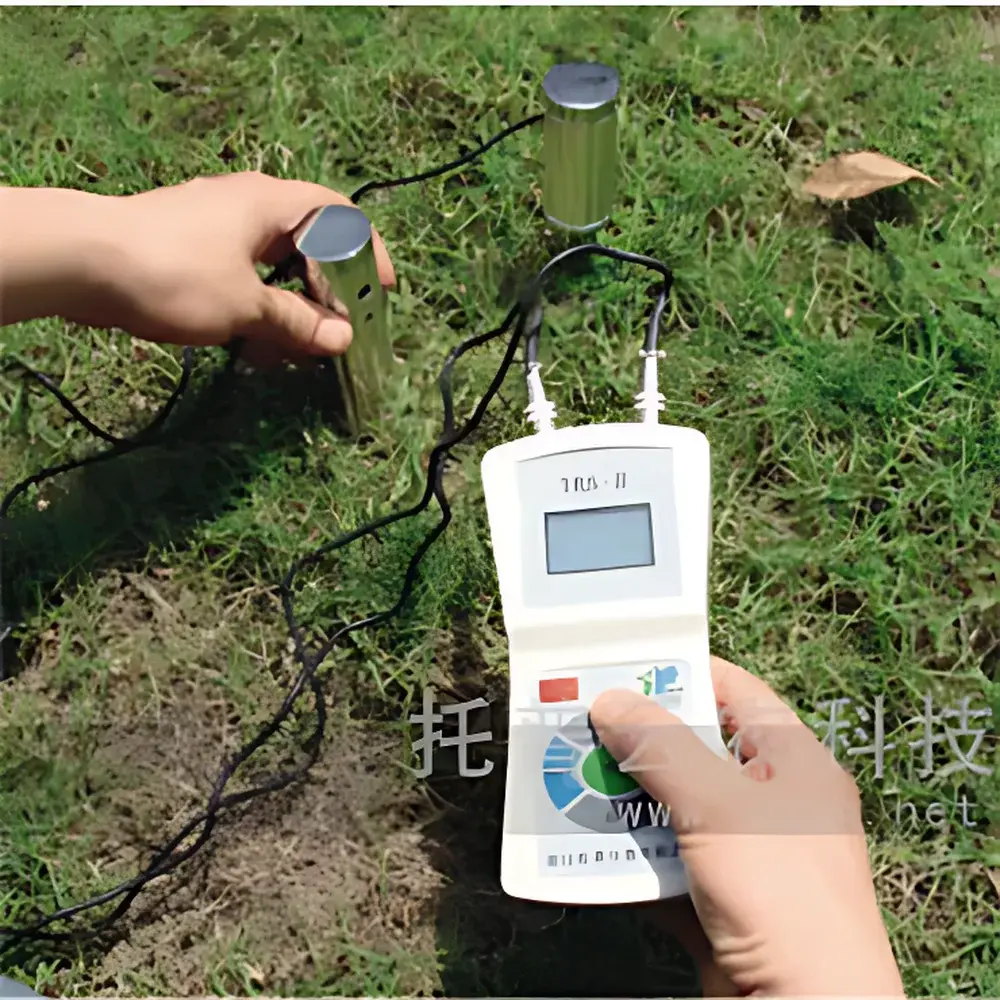
Top Cloud-agri TRS-II Portable Soil Water Potential Meter
| Brand | Top Cloud-agri |
|---|---|
| Origin | Zhejiang, China |
| Manufacturer Type | Direct Manufacturer |
| Model | TRS-II |
| Resolution | 0.01 kPa |
| Accuracy | ±0.25 kPa or ±0.5% F.S. |
| Operating Temperature Range | −55 to +150 °C |
Overview
The Top Cloud-agri TRS-II Portable Soil Water Potential Meter is a field-deployable, high-precision instrument engineered for direct in situ measurement of soil water potential (ψ) and concurrent soil temperature. It operates on the principle of thermocouple psychrometry—measuring the vapor pressure deficit across a thermally regulated sensor surface in equilibrium with soil moisture—enabling quantitative assessment of plant-available water status without sample extraction. Designed for agronomic research, irrigation scheduling, drought stress monitoring, and ecohydrological studies, the TRS-II delivers real-time, non-destructive data critical for understanding soil–plant–atmosphere continuum dynamics. Its ruggedized handheld architecture supports rapid deployment across heterogeneous field plots, greenhouse environments, and controlled growth chambers, fulfilling core requirements for ISO 27668-compliant soil physical property characterization.
Key Features
- Simultaneous dual-parameter acquisition: soil water potential (ψ) and temperature (T), both measured at the same spatial location and timestamp.
- High-resolution detection: 0.01 kPa resolution with accuracy specified as ±0.25 kPa or ±0.5% of full scale (F.S.), validated against NIST-traceable reference standards under controlled humidity and thermal conditions.
- Field-optimized ergonomics: lightweight (≤1.2 kg), integrated backlit LCD display, and 10-minute auto-shutdown to conserve battery life during intermittent use.
- Peak capture algorithm: automatically identifies and logs the maximum absolute water potential value within a user-defined measurement window—critical for detecting transient drying fronts or root zone desiccation events.
- Configurable operational parameters: programmable sampling interval, full-scale range setting (−100 kPa default), and time-stamped data logging with sequential storage indexing.
- Modular probe architecture: single main unit compatible with up to five interchangeable water potential tubes and optional auxiliary temperature probes—reducing capital cost per monitoring point and enabling spatial replication without hardware duplication.
Sample Compatibility & Compliance
The TRS-II is validated for use with mineral soils (sand to clay loam), organic substrates (peat, compost), and hydroponic media (rockwool, coco coir). It meets ASTM D4944 (Standard Test Method for Field Determination of Soil Moisture Content) for indirect water potential inference and aligns with FAO Irrigation and Drainage Paper No. 56 protocols for crop water stress index derivation. All firmware and calibration routines are documented per GLP principles; raw data files include embedded metadata (UTC timestamp, probe ID, ambient temperature, operator ID) to support audit readiness. While not FDA 21 CFR Part 11 certified out-of-the-box, the system supports export of CSV-formatted datasets compatible with validated LIMS environments requiring electronic record integrity.
Software & Data Management
Data retrieval occurs via USB-C interface to Windows/macOS platforms. The proprietary TopCloud DataLink software (v3.2+) provides visualization tools including ψ–T scatter plots, time-series overlays, and spatial heatmaps when paired with GPS-tagged probe deployments. All measurements are stored in non-volatile memory with automatic rollover buffering (≥20,000 records). Export options include ISO 8601-compliant CSV, Excel (.xlsx), and XML schemas compliant with ISA-Tab metadata standards for integration into FAIR-aligned research repositories. Firmware updates are delivered through digitally signed packages with SHA-256 hash verification.
Applications
- Precision irrigation management: triggering drip or micro-sprinkler activation based on real-time root-zone ψ thresholds (e.g., −30 kPa for maize, −60 kPa for grapevine).
- Soil hydraulic property modeling: deriving soil water retention curves (SWRC) and unsaturated hydraulic conductivity functions via inverse modeling with HYDRUS-1D.
- Crop phenotyping trials: correlating water potential gradients with stomatal conductance, leaf turgor loss point (TLP), and drought tolerance indices.
- Restoration ecology monitoring: evaluating rehydration kinetics in degraded soils post-amelioration (biochar, cover cropping).
- Educational field labs: supporting undergraduate instruction in soil physics, plant water relations, and environmental instrumentation design.
FAQ
What measurement principle does the TRS-II employ?
It uses thermocouple psychrometry, where a thermally controlled junction measures the dew point depression of air in equilibrium with soil moisture—converted to water potential using the Clausius–Clapeyron relation.
Can the TRS-II be used in frozen soils?
Yes—the extended temperature range (−55 °C to +150 °C) allows operation in seasonally frozen ground; however, interpretation requires correction for ice–water phase transition effects below 0 °C.
Is probe calibration traceable to international standards?
Factory calibration is performed against saturated salt solutions (LiCl, MgCl₂, NaCl) with certified water potentials per ISO 24333, and includes temperature-compensated psychrometric validation at three independent humidity setpoints.
How many probes can be connected simultaneously to one TRS-II unit?
The host unit supports sequential connection of up to five water potential tubes and one dedicated temperature probe; multiplexing is manual via quick-disconnect fittings—no internal switching matrix is included.
Does the device meet CE or RoHS requirements for export to the EU?
The TRS-II complies with IEC 61326-1:2013 (EMC for laboratory equipment) and RoHS Directive 2011/65/EU; CE marking documentation is available upon request for customs clearance.