
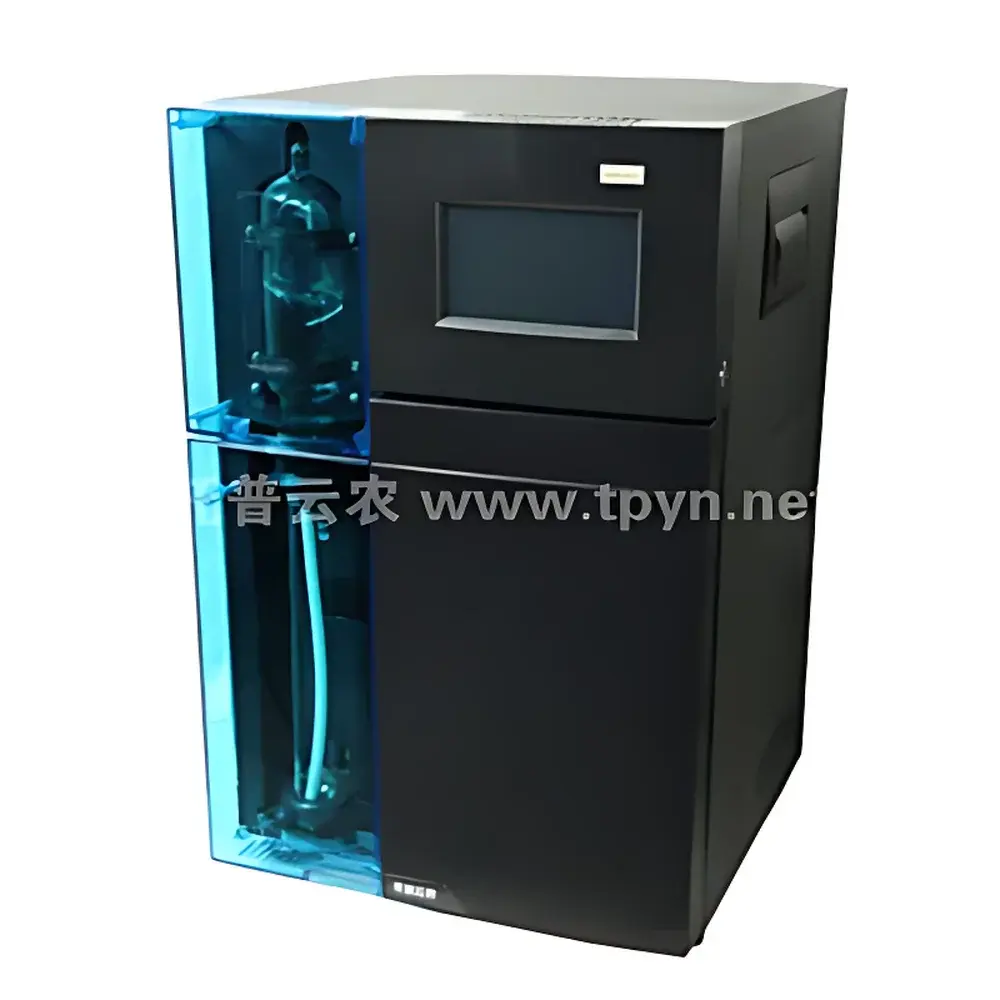
Top Cloud-agri ZDDN-III-C Automated Kjeldahl Nitrogen Analyzer
| Brand | Top Cloud-agri |
|---|---|
| Origin | Zhejiang, China |
| Manufacturer Type | Direct Manufacturer |
| Model | ZDDN-III-C |
| Price | USD 28,500 (FOB Zhejiang) |
| Measurement Range | 0.1–200 mg N |
| Repeatability (RSD) | ≤1% (at 30 mg N, using 0.1 mol/L HCl) |
| Sample Capacity | Solids ≤6 g |
| Titration Resolution | 1.0 µL/step |
| Nitrogen Recovery Rate | ≥99.5% |
| Analysis Time per Sample | 4–6 min |
| Titration Curve Display | Real-time |
| Digestion Tube Waste Disposal | Manual/Automatic Dual Mode |
| Titration Solution Standardization | Manual Input or On-Instrument Auto-Standardization |
| Heating Power | 2000 W |
| Dimensions (W×D×H) | 470 × 440 × 710 mm |
| Power Supply | AC 220 V, 50 Hz |
| Data Storage Capacity | Up to 1 million test records |
| Interface Options | USB, RS458, RJ45 Ethernet |
| Network Management Support | Centralized monitoring & control for up to 50 units |
Overview
The Top Cloud-agri ZDDN-III-C Automated Kjeldahl Nitrogen Analyzer is a fully integrated, laboratory-grade instrument engineered for precise and reproducible total nitrogen quantification in accordance with AOAC 984.27, ISO 5983-1:2009, and GB/T 6423–2022 methodologies. Based on classical Kjeldahl digestion–distillation–titration principles, the system automates the complete analytical workflow—from acid digestion of organic matrices to alkaline distillation, boric acid trapping, and potentiometric titration—minimizing operator intervention while maintaining strict adherence to regulatory requirements for food safety, agricultural quality control, and environmental testing laboratories.
Key Features
- Modular tri-stage architecture: independent digestion, steam distillation, and precision titration modules ensure process isolation and cross-contamination prevention.
- Four-channel corrosion-resistant peristaltic metering pumps (imported German OEM components) deliver reagents—including concentrated NaOH, boric acid, and titrant—with volumetric accuracy ±0.5% across full operational range.
- 7.5-inch high-resolution TFT touchscreen interface powered by Siemens S7-1200 PLC controller, supporting bilingual (English/Chinese) operation, audit-trail-enabled user authentication, and context-sensitive help prompts.
- Programmable steam generation system with dual-pressure output (low/high mode) enables optimized volatilization for both low-nitrogen matrices (e.g., purified water blanks) and high-protein samples (e.g., soybean meal, casein).
- Integrated cooling water management module continuously monitors inlet temperature (±0.5 °C), pressure (0–0.6 MPa), and flow rate (0.5–3.0 L/min), triggering automatic shutdown if parameters fall outside pre-set safety thresholds.
- Self-cleaning titration cup system performs sequential rinse–dry–neutralize cycles between analyses to eliminate carryover effects, critical for trace-level determinations and method blanks.
- Multi-layer safety architecture compliant with IEC 61010-1:2010: includes leakage current protection (<30 mA), digestion tube position sensing, interlocked safety door actuation, steam boiler overtemperature/overpressure cutoff (max. 120 °C / 0.25 MPa), and auto-refill function with level sensor feedback.
- On-board titrant standardization routine eliminates manual calibration bias by performing in-situ acid–base equivalence point verification prior to each batch analysis.
Sample Compatibility & Compliance
The ZDDN-III-C accommodates heterogeneous solid and liquid matrices without modification: cereal grains, compound feed, dairy powders, fermented beverages, soil extracts, and fertilizer formulations. Its validated performance meets the repeatability (RSD ≤1%) and recovery (≥99.5%) criteria specified in AOAC Official Methods of Analysis® (OMA) Chapter 4, USP , and ISO 8968-1 for milk protein determination. Instrument firmware supports GLP-compliant data integrity protocols—including electronic signatures, immutable audit trails, and timestamped event logs—fully compatible with FDA 21 CFR Part 11 requirements when deployed with optional networked software configuration.
Software & Data Management
Embedded firmware provides local data handling with 1 million-test non-volatile memory, searchable by sample ID, date/time stamp, operator ID, or method version. Optional PC-based ControlSuite™ software (Windows 10/11 compatible) enables remote instrument scheduling, real-time status dashboarding, batch report generation (PDF/CSV/XLSX), and integration into LIMS via HL7 or ASTM E1384 interfaces. The built-in 110-mm thermal printer outputs full analytical reports—including titration curves, raw pH vs. volume plots, and QC flag annotations—directly from the instrument.
Applications
This analyzer serves as a primary nitrogen quantification platform in accredited QA/QC labs across agri-food supply chains. Typical use cases include: crude protein estimation in animal feedstuffs per AOAC 954.01; total Kjeldahl nitrogen (TKN) in wastewater and compost per EPA Method 351.2; ammoniacal nitrogen screening in nitrogenous fertilizers; and regulatory compliance testing for protein content labeling under EU Regulation (EU) No 1169/2011. Its programmable digestion ramp profiles also support modified methods for heat-labile samples requiring controlled sulfuric acid decomposition.
FAQ
Does the ZDDN-III-C support unattended overnight operation?
Yes—equipped with automatic digestion tube ejection, waste drainage sequencing, and end-of-batch self-diagnostic routines, it supports continuous batch processing with minimal supervision.
Can the instrument be validated for GMP environments?
Yes—when paired with ControlSuite™ and configured with 21 CFR Part 11 add-ons (electronic signature, audit trail encryption, role-based access), it fulfills IQ/OQ/PQ documentation requirements.
Is method transfer possible from legacy Kjeldahl systems?
Yes—the instrument accepts custom distillation time, steam intensity, and titrant concentration parameters, enabling direct replication of established SOPs without revalidation.
What maintenance intervals are recommended?
Daily: cleaning of condenser bore and titration electrode; Quarterly: calibration of peristaltic pump volumes and pH electrode verification; Annually: full steam generator descaling and pressure relief valve certification.
How does the “re-alkalization” function improve robustness?
During distillation, the system monitors real-time pH drift in the condensate; if alkalinity falls below threshold, supplemental NaOH is injected in discrete pulses—preventing incomplete ammonia release and preserving sample integrity.





