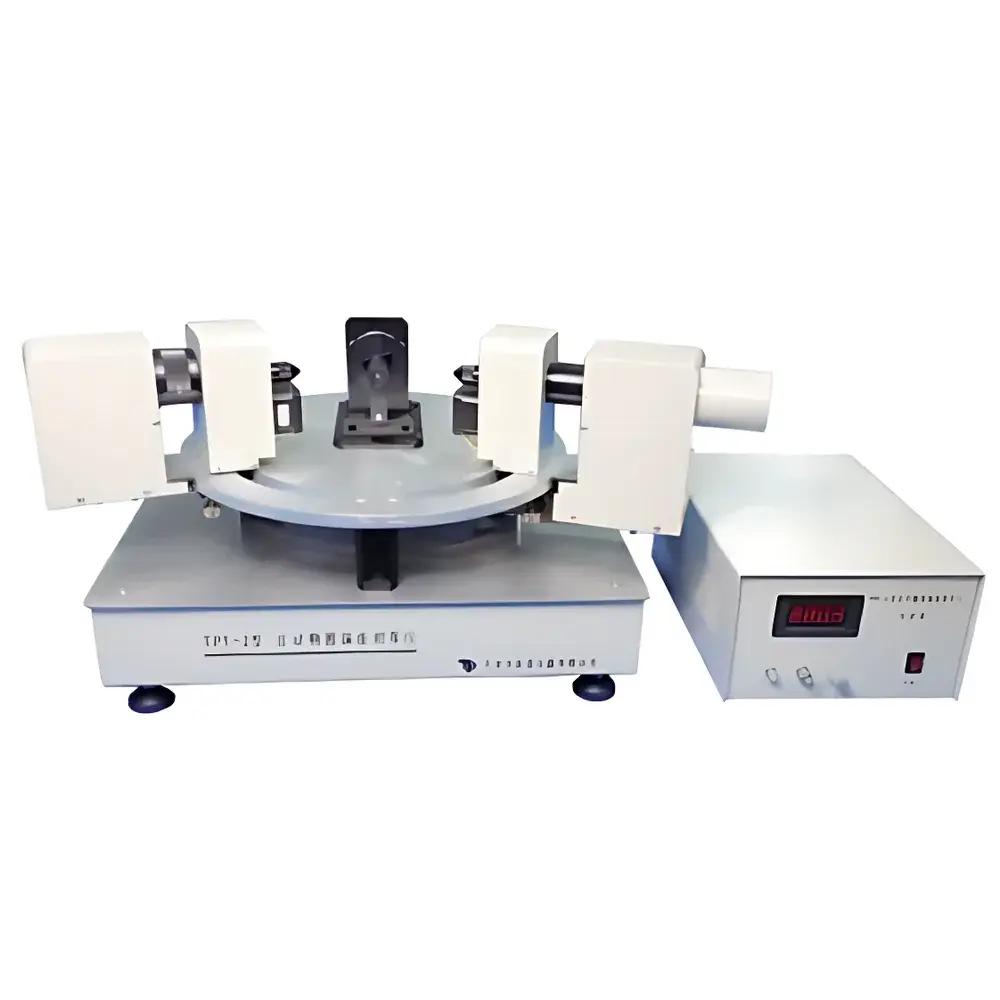
Top Instruments TPY-1 Ellipsometer
| Brand | Top Instruments (TP) |
|---|---|
| Origin | Tianjin, China |
| Manufacturer Type | Direct Manufacturer |
| Product Origin | Domestic (China) |
| Model | TPY-1 |
| Price | Upon Request |
| Angle of Incidence | 20°–90° (±0.05° resolution) |
| Film Thickness Measurement Accuracy | ±1 nm |
| Thickness Range | 1–300 nm |
| Refractive Index Range | 1.0–10.0 |
| Minimum Display Resolution | ≤1 nm |
| Laser Wavelength | 632.8 nm (He-Ne) |
| Optical Center Height | 80 mm |
| Max Sample Diameter | φ140 mm |
| Min Sample Diameter | φ10 mm |
| Max Sample Thickness | 16 mm |
| Polarizer Azimuth Range | 0°–180° (0.05° resolution) |
| Thickness Repeatability | ±1 nm |
| Refractive Index Repeatability | ±0.01 |
| Instrument Weight | 25 kg |
Overview
The Top Instruments TPY-1 Ellipsometer is a precision optical metrology system engineered for non-destructive, contactless characterization of thin films using the ellipsometric principle. It operates on the fundamental physics of polarized light interaction with layered dielectric or semiconductor structures: upon reflection from a sample surface, the incident linearly polarized beam undergoes phase shift and amplitude modulation—quantified as the ellipsometric parameters Ψ (psi) and Δ (delta). These parameters are uniquely sensitive to film thickness and complex refractive index (n + ik), enabling sub-nanometer resolution without physical contact or sample preparation. Designed for laboratory and R&D environments in academia, microelectronics, photovoltaics, and optical coating development, the TPY-1 delivers high reproducibility in controlled ambient conditions and supports rapid qualitative screening as well as quantitative modeling-based analysis.
Key Features
- Automated nulling ellipsometry (extinction method) with motorized incidence angle adjustment (20°–90°) and polarizer azimuth control (0°–180°), both with 0.05° angular resolution
- Stabilized helium–neon (He-Ne) laser source at 632.8 nm, ensuring wavelength consistency and long-term power stability essential for repeatable optical measurements
- Integrated mechanical stage accommodating samples from φ10 mm to φ140 mm in diameter and up to 16 mm in thickness, with precise height alignment referenced to 80 mm optical centerline
- Dedicated ellipsometry software suite providing real-time data acquisition, lookup table generation, iterative regression fitting, and multi-layer optical model construction
- Rugged aluminum-alloy optical bench architecture with vibration-damped base, optimized for stable operation on standard optical tables or lab benches
Sample Compatibility & Compliance
The TPY-1 supports a broad range of transparent, semi-transparent, and weakly absorbing thin-film systems deposited on rigid substrates—including SiO₂/Si, ITO/glass, polymer-on-metal, and biomolecular monolayers on functionalized quartz. It is compatible with single-layer and bilayer models by default; advanced users may extend modeling to three-layer or graded-index configurations via custom dispersion relations. While not certified to ISO/IEC 17025 or ASTM E1937, the instrument adheres to foundational principles outlined in ASTM F1590 (Standard Guide for Ellipsometry) and supports traceable calibration workflows. Data integrity aligns with GLP documentation requirements when paired with version-controlled software logs and timestamped measurement reports.
Software & Data Management
The bundled Windows-based application provides full control over hardware positioning, signal acquisition, and parameter inversion. Raw Ψ/Δ data are stored in ASCII-compatible .txt format alongside metadata (date, operator ID, sample ID, model assumptions). The software includes built-in Cauchy and Sellmeier dispersion models, automatic convergence diagnostics, and residual error mapping. Export options include CSV, PNG, and PDF formats suitable for inclusion in technical reports or peer-reviewed publications. Audit trails—recording all user-initiated changes to fit parameters or model constraints—are retained locally and support internal quality review processes compliant with basic GxP documentation expectations.
Applications
- Thickness and refractive index determination of antireflection, high-reflection, and filter coatings in optical manufacturing
- Process monitoring of ALD and PVD-deposited gate oxides and passivation layers in semiconductor device fabrication
- Characterization of self-assembled monolayers (SAMs) and protein adsorption kinetics on biosensor surfaces
- Quality assurance of transparent conductive oxides (TCOs) such as ZnO:Al and SnO₂:F in flat-panel display and solar cell R&D
- Evaluation of degradation-induced optical property shifts in encapsulation films under environmental stress testing
FAQ
What types of substrates can be measured with the TPY-1?
Standard substrates include silicon wafers, fused silica, BK7 glass, and polished metals—provided surface roughness remains below λ/10 (~60 nm) at 632.8 nm.
Does the system support multi-wavelength or spectroscopic ellipsometry?
No—the TPY-1 is a fixed-wavelength (632.8 nm) instrument. Spectroscopic capability requires upgrade to the TPY-S series or third-party integration.
Can the software perform dispersion modeling for absorbing films?
Yes—users may define complex refractive index (n + ik) inputs or apply Tauc-Lorentz, Drude, or Cody-Lorentz oscillator models for metals and semiconductors.
Is remote operation or automation via API supported?
The current software does not expose a public API; however, serial command protocols are documented for OEM-level integration into automated test stations.
What calibration standards are recommended for routine verification?
NIST-traceable Si/SiO₂ reference wafers with certified oxide thicknesses (e.g., 10 nm, 100 nm) are recommended for daily performance checks.