
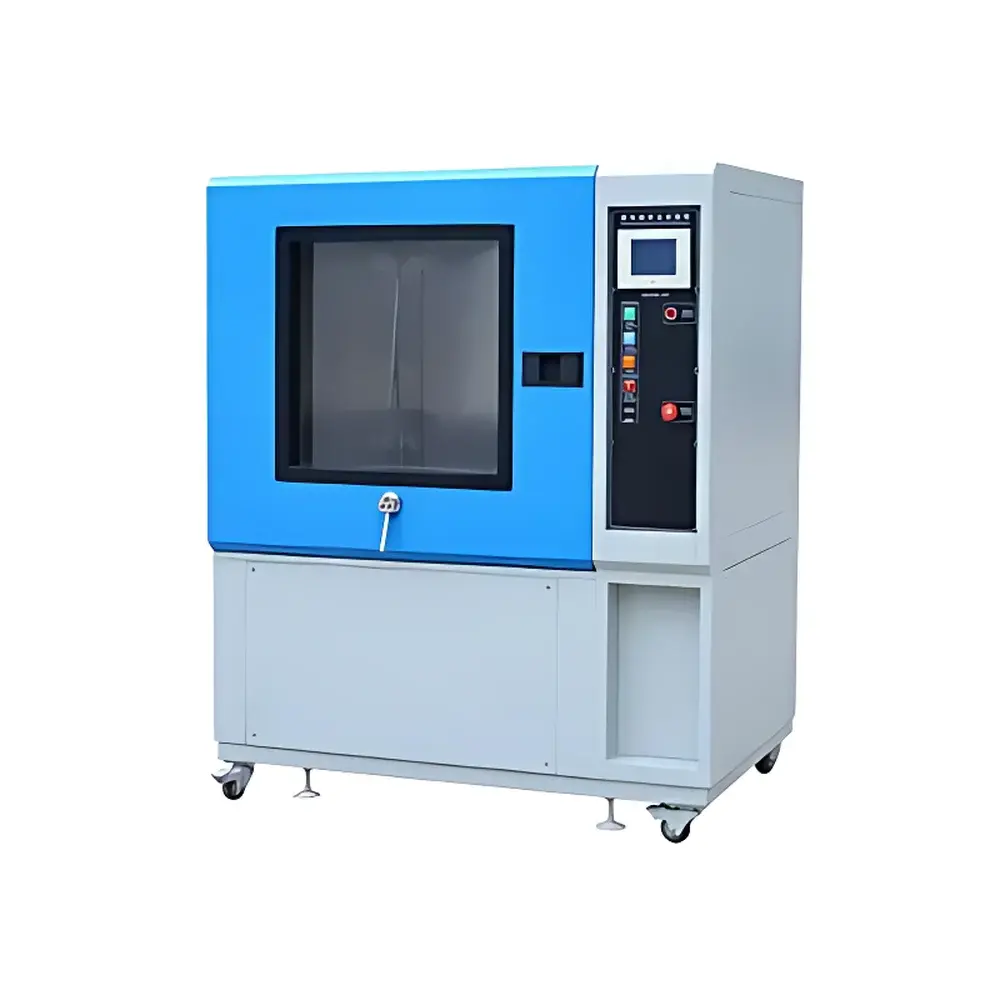
Topfeng TF-340A Sand and Dust Test Chamber
| [Brand | Topfeng |
|---|---|
| Origin | Shanghai, China |
| Manufacturer Type | Direct Manufacturer |
| Model | TF-340A |
| Sand Composition | 97–99% SiO₂ (silicon dioxide) |
| Sand Blowing Concentration | 1 g/m³ ± 0.25 g/m³ |
| Sand Blowing Velocity | 0–29 m/s |
| Dust Blowing Concentration | 0.1–10.6 g/m³ |
| Dust Blowing Velocity | 8.9 m/s |
| Internal Dimensions (W×D×H) | 800 × 800 × 800 mm |
| Mesh Filter | 50 µm wire diameter, 75 µm nominal spacing |
| Test Dust | Standard talcum powder per IEC 60529 & GB/T 4208 |
| Air Extraction Rate | 2 L/s |
| Vibration Duration Range | 0–99 h 59 min 59 s |
| Fan Operation Duration Range | 0–99 h 59 min 59 s |
| Dust Collection Funnel | 304 mirror-finish stainless steel interior with conical geometry |
| Enclosure Material | Powder-coated cold-rolled steel exterior |
| Control System | Weinview HMI touchscreen controller |
| Safety Protections | Overtemperature, short-circuit, fan overload, phase loss, leakage current, reverse rotation prevention, specimen protection] |
Overview
The Topfeng TF-340A Sand and Dust Test Chamber is an engineered environmental simulation system designed to evaluate the ingress protection (IP) performance of electrical and electronic enclosures under controlled airborne particulate exposure. It operates on the principle of forced-convection dust suspension and directional particle impingement—mimicking real-world conditions where equipment is subjected to dry sandstorms, desert dust, or urban/industrial airborne particulates. Unlike static dust settling tests, this chamber generates turbulent, non-laminar vertical air recirculation laden with standardized test dust (talcum powder per IEC 60529 Annex B and GB/T 4208–2008), enabling rigorous assessment of sealing integrity, abrasion resistance, and functional reliability after exposure. The system complies with IP5X and IP6X dust ingress verification protocols and supports both continuous and programmable intermittent blowing cycles—critical for validating long-term operational resilience in automotive lighting, outdoor LED fixtures, aerospace avionics housings, and industrial control cabinets.
Key Features
- Programmable dual-mode operation: independent control of sand-blowing (0–29 m/s, 1 g/m³ ±0.25 g/m³) and dust-blowing (8.9 m/s, 0.1–10.6 g/m³) regimes, each with adjustable duration, pause intervals, and total cycle count
- Integrated vibration mechanism with adjustable amplitude and timing (0–99 h 59 min 59 s) to simulate mechanical agitation during dust exposure, enhancing particle penetration realism
- High-efficiency recirculation system featuring a sealed alloy centrifugal blower (300 W, low-noise design) and precision-engineered 304 stainless steel conical interior that directs settled dust toward the suction inlet for consistent re-suspension
- Weinview 7-inch capacitive touchscreen HMI with intuitive parameter navigation—no nested menu diving required; direct access to setpoints, real-time status (current blow time, elapsed cycle, temperature), and waveform-style blow/pause sequencing
- Dual-stage filtration: primary cyclonic separation + secondary HEPA-grade particulate capture ensures operator safety and chamber longevity while maintaining stable dust concentration within tolerance
- Comprehensive safety architecture including overtemperature cutoff, phase-loss detection, motor overload monitoring, reverse-rotation lockout, and ground-fault circuit interruption (GFCI)
Sample Compatibility & Compliance
The TF-340A accommodates specimens up to 800 mm × 800 mm × 800 mm (W×D×H), making it suitable for full-assembly testing of automotive headlamps, junction boxes, telecom base station enclosures, and military-grade portable electronics. It is fully aligned with the test methodology requirements of IEC 60529 (IP Code), GB/T 4208–2008 (equivalent to IEC 60529), GB 4942.1–1985 (low-voltage equipment enclosure protection), GB 7000.1–2015 (luminaire safety), and DIN 40050–9 (automotive dust resistance). While not configured for wind-driven sand abrasion per MIL-STD-810H Method 510.7 or GJB 150.12A (which require external high-velocity wind tunnels), it fulfills all standard IP5X/IP6X validation needs under laboratory-controlled ambient conditions (+5 °C to +35 °C operating range).
Software & Data Management
The embedded Weinview controller logs timestamped operational parameters—including actual blow velocity, measured dust concentration (via calibrated mass flow feedback), vibration activation windows, and thermal stability data—for traceable GLP-compliant reporting. Exportable CSV files support integration into LIMS or QA documentation workflows. Optional RS-485 or Ethernet interface enables remote supervision and centralized fleet management across multi-chamber test labs. All user-modifiable settings are protected by configurable password levels, and audit trails record parameter changes, operator ID, and session timestamps—meeting basic FDA 21 CFR Part 11 readiness criteria for electronic records in regulated manufacturing environments.
Applications
- IP rating verification (IP5X, IP6X) for consumer electronics, smart home devices, and outdoor IoT sensors
- Functional endurance testing of automotive lighting systems (headlamps, fog lamps, DRLs) per ECE R112 and SAE J575
- Validation of ingress resistance in railway signaling equipment exposed to ballast dust and tunnel particulates
- Pre-certification screening for UL 50E, CSA C22.2 No. 94, and EN 60529 compliance prior to third-party lab submission
- Material compatibility studies—e.g., evaluating gasket degradation, lens haze formation, or connector contact resistance shift after repeated dust cycling
FAQ
Does the TF-340A meet IEC 60529 IP6X requirements?
Yes—it delivers the specified talcum powder concentration (0.1–10.6 g/m³), airflow velocity (8.9 m/s), and 8-hour continuous exposure capability required for IP6X dust-tight validation.
Can it perform sand abrasion testing per MIL-STD-810?
No—the chamber lacks externally sourced high-velocity wind generation and calibrated silica sand feed mechanisms required for Method 510.7; it is optimized for standardized dust ingress evaluation only.
What dust type is recommended for routine IP testing?
Talcum powder conforming to IEC 60529 Annex B (particle size distribution D50 ≈ 1–10 µm, density ~2.7 g/cm³) is mandatory; quartz sand (SiO₂) is reserved for specialized sand erosion protocols outside IP certification.
Is vacuum capability integrated for post-test dust evacuation?
Yes—a dedicated 2 L/s extraction system with pressure gauge, filter-regulator-lubricator (FRL) unit, and calibrated venturi flow path ensures rapid, residue-free chamber clearance between test cycles.
How is temperature stability maintained during extended dust cycles?
The chamber does not include active heating or cooling; ambient temperature must be maintained between +5 °C and +35 °C per GB/T 4208, with internal thermal rise limited to <5 K above ambient during 8-hour operation due to low-power motor design and passive heat dissipation.



