
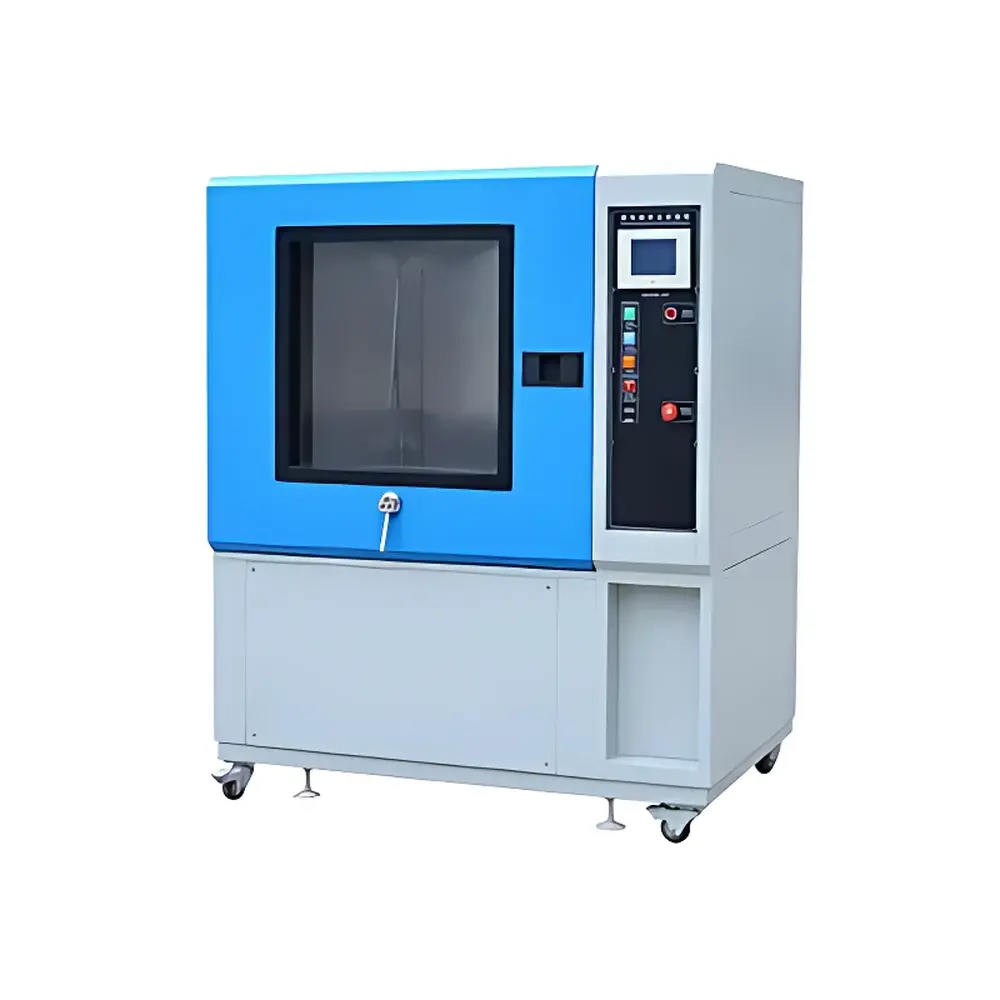
Topfeng TF-340B Sand and Dust Test Chamber
| [Brand | Topfeng |
|---|---|
| Origin | Shanghai, China |
| Manufacturer Type | Direct Manufacturer |
| Model | TF-340B |
| Sand Composition | 97–99% SiO₂ (silicon dioxide) |
| Sand Blowing Concentration | 1 g/m³ ± 0.25 g/m³ |
| Sand Blowing Velocity | 0–29 m/s |
| Dust Blowing Concentration | 0.1–10.6 g/m³ |
| Dust Blowing Velocity | 8.9 m/s |
| Internal Dimensions (W×D×H) | 800 × 800 × 800 mm |
| Filter Mesh | Stainless Steel, Wire Diameter 50 µm, Pitch 75 µm |
| Dust Medium | Standardized talcum powder or limestone powder (2–4 kg/m³) |
| Vacuum Extraction Rate | 2 L/s |
| Vibration Timer Range | 0–99 h 59 min 59 s |
| Fan Timer Range | 0–99 h 59 min 59 s |
| Dust Motor Power | 300 W |
| Control System | Weinview HMI touchscreen interface |
| Cabinet Material | Interior – 304 mirror-finish stainless steel (funnel-shaped floor) |
| Power Supply | 220 V AC / 16 A |
| Safety Protections | Overtemperature, short-circuit, motor overload, earth leakage, phase sequence/missing-phase detection, reverse fan rotation prevention, operator and specimen safety interlocks |
| Operating Ambient Temperature | +5 °C to +35 °C (for cooling operation: +5 °C to +28 °C) |
| Compliance | GB/T 4208–2008 (IP Code), GB 10485, GB 4942.1–1985, GB 7000.1–2015, IEC 60529 equivalent] |
Overview
The Topfeng TF-340B Sand and Dust Test Chamber is an engineered environmental simulation system designed to evaluate the ingress protection (IP) performance of enclosures—specifically their resistance to solid particulate contamination under controlled, reproducible conditions. It operates on the principle of forced-air suspension and directional delivery of standardized dust or sand media, generating non-laminar, vertically recirculating dusty airflow within a sealed test volume. Unlike static dust deposition methods, this chamber subjects specimens to dynamic mechanical stress—including particle impact, abrasive erosion, infiltration pressure differentials, and gravitational settling—enabling realistic assessment of sealing integrity, ventilation filter efficiency, and long-term functional reliability in arid, dusty, or desert operational environments.
Key Features
- Programmable dual-mode operation: independent control of sand-blowing (0–29 m/s, 1 g/m³ ±0.25 g/m³) and dust-blowing (8.9 m/s, 0.1–10.6 g/m³) cycles, each with adjustable duration, pause intervals, and total exposure time
- Funnel-shaped 304 mirror-finish stainless steel interior with centralized suction port, ensuring uniform dust re-suspension and minimizing dead zones
- Integrated vibration mechanism (0–99 h 59 min 59 s timer) synchronized with airflow to simulate mechanical agitation encountered during transport or field deployment
- Weinview industrial-grade HMI touchscreen controller with intuitive parameter navigation—no nested menus required; direct access to setpoints, real-time readings, cycle status, and event logs
- Closed-loop centrifugal blower assembly using low-noise alloy motor (300 W), compliant with IEC 60034 and equipped with French Schneider contactors and Japanese Omron relays for long-term duty-cycle stability
- Comprehensive safety architecture including overtemperature cutoff, phase-sequence monitoring, earth-leakage protection, motor overload sensing, and reverse-rotation lockout for fan safety
Sample Compatibility & Compliance
The TF-340B accommodates specimens up to 800 mm × 800 mm × 800 mm (W×D×H), making it suitable for full-enclosure testing of lighting fixtures (e.g., IP5X-rated luminaires per GB 7000.1–2015), automotive headlamps and ECUs, outdoor telecom cabinets, aerospace avionics housings, and industrial control panels. Its operational parameters align with key national and international standards for solid particle ingress testing, including GB/T 4208–2008 (equivalent to IEC 60529), GB 10485 (sand test method), GB 4942.1–1985 (low-voltage equipment enclosure classification), and DIN 40050–9. While it fulfills requirements for IP5X and IP6X verification per GB/T 4208, it is not configured for wind-driven sand tests per GJB 150.8A (which mandates external high-velocity wind tunnels and calibrated silica sand feed systems).
Software & Data Management
The embedded Weilview HMI supports time-stamped logging of all operational events—including start/stop timestamps, vibration/fan activation cycles, temperature excursions, and fault triggers—with export capability via USB to CSV format. The controller maintains audit-ready records compliant with GLP and pre-GMP documentation needs. Although not 21 CFR Part 11-certified out-of-the-box, the system architecture allows integration with third-party validation packages for regulated industries requiring electronic signature and data integrity assurance. All parameter changes are logged with user ID (if enabled), timestamp, and prior/current values—supporting traceability for quality audits and ISO 9001:2015 process reviews.
Applications
- Verification of IP5X/IP6X ratings for LED streetlights, traffic signal housings, and explosion-proof junction boxes
- Functional endurance testing of automotive sensors, battery enclosures, and ADAS modules under simulated off-road dust exposure
- Validation of ingress resistance in outdoor telecom base station cabinets per Telcordia GR-3108 and ETSI EN 300 019–1–3 Class 3.2 environmental specifications
- Accelerated aging studies of gasket compression set, sealant adhesion loss, and vent membrane clogging mechanisms
- Pre-compliance screening for military-standard enclosure qualification (e.g., MIL-STD-810H Method 510.6, though final certification requires accredited lab execution)
FAQ
What dust media are recommended for IP5X testing per GB/T 4208–2008?
Standardized talcum powder (particle size distribution D50 ≈ 25 µm) or limestone powder (2–4 kg/m³ loading) is specified. Silica sand (97–99% SiO₂) is reserved for sand-specific tests such as GB 10485.
Can the TF-340B perform continuous 72-hour dust exposure cycles?
Yes—the fan and vibration timers support up to 99 hours, 59 minutes, and 59 seconds per segment, and multiple segments can be chained via programmable cycle sequencing.
Is the internal stainless-steel chamber resistant to abrasive wear from repeated sand testing?
The funnel-shaped 304 mirror-finish stainless steel interior is mechanically polished and corrosion-resistant; however, prolonged use with high-concentration silica sand may necessitate periodic inspection of the suction port and floor weld seams for micro-pitting.
Does the chamber include vacuum calibration traceability?
The integrated pressure gauge and air filtration/regulation tri-block are factory-calibrated; NIST-traceable recalibration certificates are available upon request at time of purchase or scheduled service.
What ambient conditions must be maintained during operation?
Ambient temperature must remain between +5 °C and +35 °C; for tests involving thermal cycling or extended runtime (>8 h), ambient cooling capacity should maintain ≤+28 °C to ensure stable internal thermal equilibrium.



