
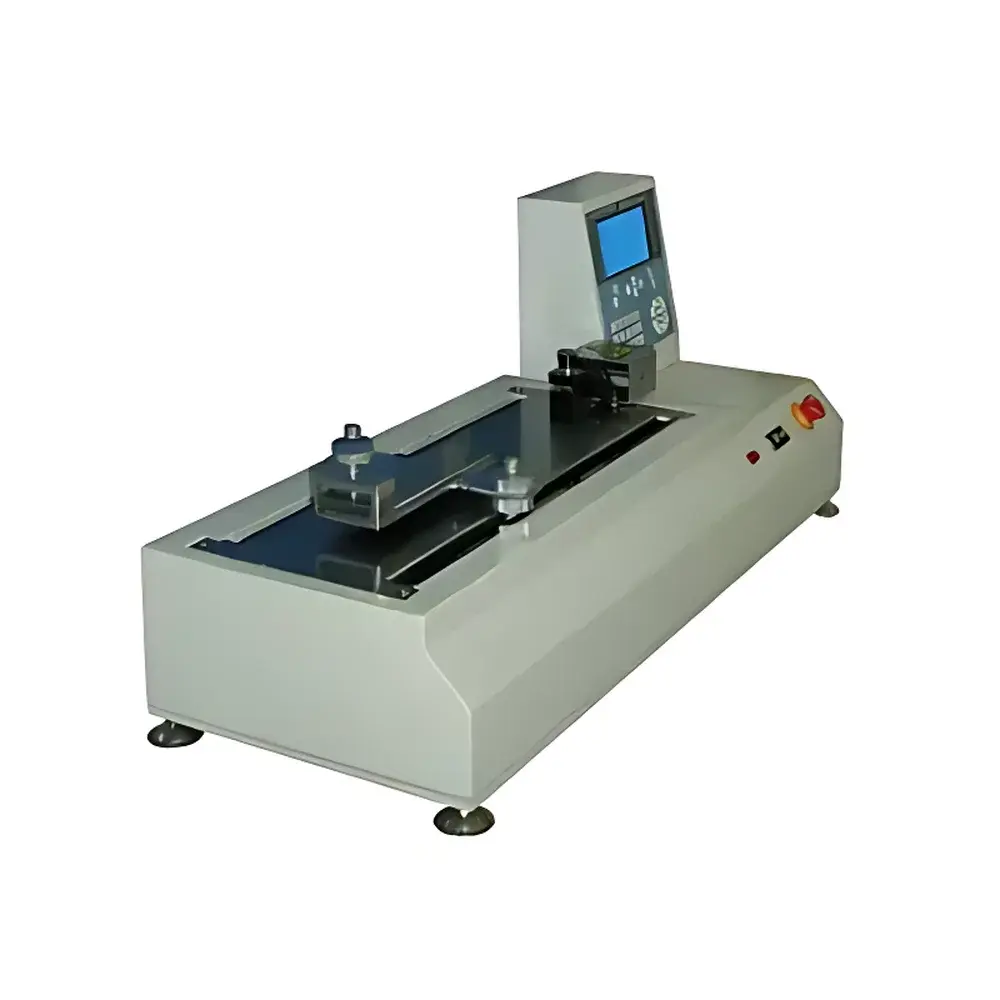

Topfeng TF-W Series Digital Horizontal Tensile Testing Machine
| Brand | Topfeng |
|---|---|
| Origin | Shanghai, China |
| Manufacturer Type | Direct Manufacturer |
| Regional Classification | Domestic (China) |
| Model | TF-W |
| Instrument Type | Electronic Tensile Testing Machine |
| Maximum Test Force | 100 kgf (≈ 0.98 kN) |
| Force Measurement Range | 0.2%–100% of Full Scale |
| Force Accuracy | ±0.5% FS |
| Test Stroke | 400 mm |
| Displacement Resolution | 0.001 mm |
| Voltage Supply | AC 220 V |
| Speed Range | 5–350 mm/min |
| Dimensions (W×D×H) | 380 × 450 × 1000 mm |
| Weight | 60 kg |
Overview
The Topfeng TF-W Series Digital Horizontal Tensile Testing Machine is an electromechanical force-testing system engineered for precision uniaxial mechanical characterization under controlled displacement or load conditions. Its horizontal configuration provides inherent stability for long-stroke tensile, compression, peel, shear, and tear testing—particularly advantageous for specimens with high aspect ratios (e.g., metal tubes, extruded profiles, flexible printed circuits, and laminated composites) where vertical alignment constraints or gravitational sag may compromise data fidelity. The machine operates on a closed-loop servo-controlled DC motor drive, coupled with a high-resolution encoder and a calibrated load cell compliant with ISO 7500-1 Class 0.5 accuracy requirements. It conforms to fundamental test standards including ASTM D638, ISO 527-1, GB/T 1040.1, and ISO 1133 for polymer tensile behavior, as well as ASTM D903 (peel), D1876 (T-peel), and D882 (thin film tensile), enabling traceable, repeatable mechanical property quantification across R&D, QC, and incoming inspection workflows.
Key Features
- Horizontal dual-column architecture optimized for specimen rigidity and axial alignment—minimizing bending moments during high-force testing of rods, pipes, and strips.
- Digital force readout with real-time display of load (N/kgf), displacement (mm), and strain rate (%/min); front-panel interface supports manual jog, preset speed selection, and immediate stop functionality.
- Load cell calibrated to ±0.5% full-scale accuracy per ISO 7500-1, with measurement range spanning 0.2% to 100% FS—ensuring high resolution at low forces and linearity at maximum capacity (up to 980 N).
- Displacement feedback via optical encoder with 1 µm resolution, supporting precise elongation tracking required for modulus calculation and yield point identification.
- Adjustable crosshead speed from 5 to 350 mm/min, programmable in 1 mm/min increments—compatible with quasi-static to medium-rate deformation protocols per ASTM E8/E8M.
- Modular fixture interface (M6 threaded holes on moving and fixed platens) enables rapid interchange of standardized grips (pneumatic, wedge, vise, pin-and-slot), peel blocks, bend fixtures, and custom tooling.
Sample Compatibility & Compliance
The TF-W accommodates specimens ranging from thin films (≥10 µm thickness) to structural metallic sections (up to Ø25 mm round bars or 20 mm × 40 mm rectangular profiles). Its 400 mm effective stroke and open horizontal workspace facilitate testing of continuous materials (e.g., FPC flex circuits, adhesive tapes, nonwovens) without end-fixturing interference. All mechanical components are constructed from hardened steel and anodized aluminum, ensuring long-term dimensional stability under cyclic loading. The system meets CE marking requirements for machinery safety (2006/42/EC), complies with electromagnetic compatibility directives (2014/30/EU), and supports GLP-compliant operation when integrated with optional audit-trail-capable software (see Software & Data Management).
Software & Data Management
Optional PC-based control software (TF-TestSuite Pro) provides full test automation—including multi-step load-displacement profiles, automatic yield detection (0.2% offset method), stress-strain curve derivation, and statistical reporting per ISO 5893. Raw data export is supported in CSV and XML formats; graphical overlays allow comparative analysis across batches or material grades. The software maintains electronic records with user authentication, timestamped test logs, and configurable audit trails aligned with FDA 21 CFR Part 11 requirements for regulated environments. Calibration certificates—including load cell verification, displacement linearity, and speed verification—are generated and archived within the software environment.
Applications
- Tensile strength, elongation at break, and Young’s modulus determination for thermoplastics, elastomers, and fiber-reinforced composites.
- Peel adhesion testing of pressure-sensitive adhesives (PSAs), medical tapes, and packaging laminates per ASTM D3330 and FINAT FTM 1.
- Shear strength evaluation of structural adhesives and solder joints in electronics assembly.
- Bending stiffness and fracture resistance assessment of thin metal foils, PCB substrates, and battery electrode coatings.
- Compression testing of foam cores, gaskets, and soft elastomeric seals under controlled strain rates.
- Quality conformance verification for automotive trim, aerospace fasteners, and medical device components per OEM-specific specifications (e.g., Ford WSS-M3Q373-A, Boeing BMS 7-102).
FAQ
What is the maximum specimen length that can be tested in the TF-W series?
Standard configuration supports up to 400 mm between grips; extended stroke versions (up to 800 mm) are available upon request with reinforced crosshead guidance.
Does the system support high-temperature or environmental chamber integration?
Yes—the horizontal layout allows straightforward integration with external temperature chambers (−70 °C to +300 °C) and humidity-controlled enclosures via side-access ports and feedthrough-compatible load cell cabling.
Can the TF-W perform cyclic fatigue testing?
While primarily designed for monotonic tests, the optional software package includes basic sinusoidal and triangular waveform control for low-cycle fatigue (≤10⁴ cycles) at frequencies up to 5 Hz.
Is calibration documentation provided with shipment?
Each unit ships with a factory calibration certificate traceable to CNAS-accredited national standards, covering force, displacement, and speed verification points.
What safety features are included?
Hardware interlocks disable motor operation when safety guards are open; emergency stop button triggers immediate power cutoff and dynamic brake engagement; overload protection limits actuator current to prevent mechanical damage.



