
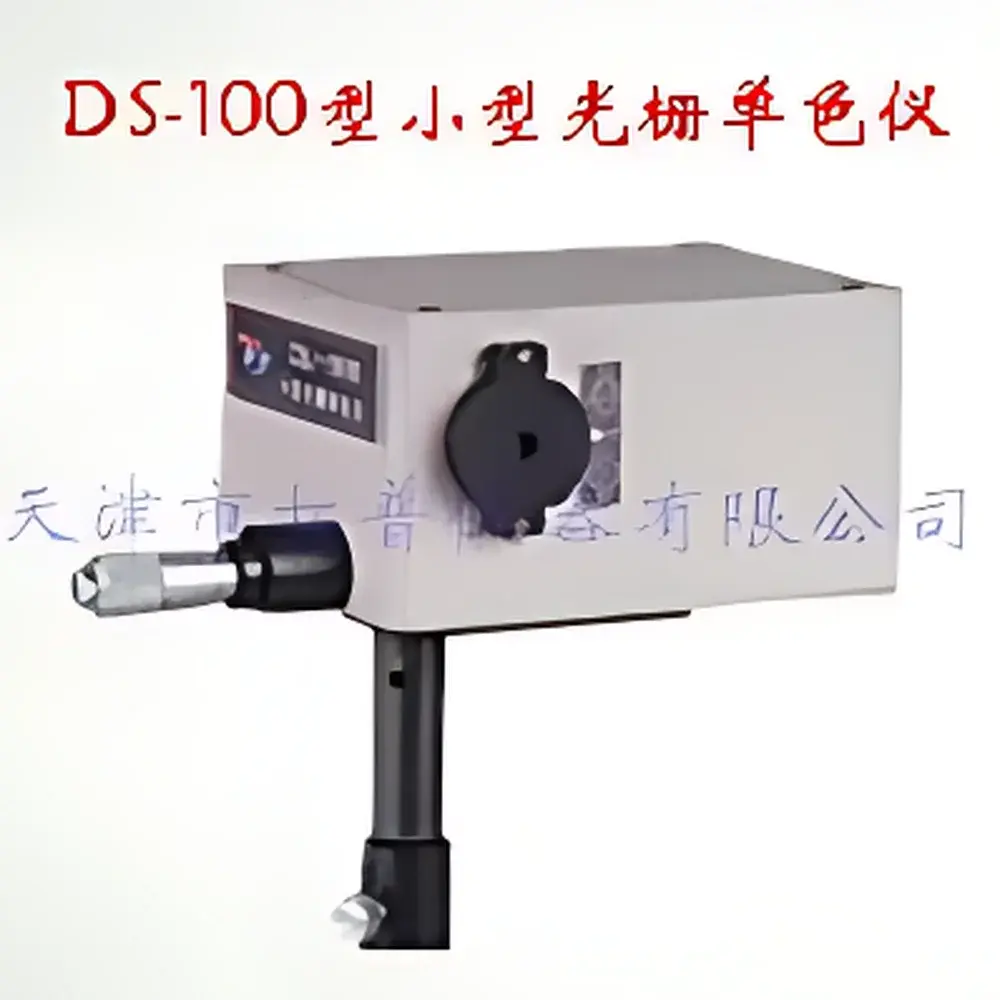
Topo DS-100 Compact Grating Monochromator
| Brand | Topo |
|---|---|
| Model | DS-100 |
| Wavelength Range | 200–800 nm |
| Focal Length | 300 mm or 500 mm |
| Relative Aperture | D/F = 1/7 |
| Wavelength Accuracy | ±0.4 nm |
| Wavelength Repeatability | ±0.2 nm |
| Scanning Method | Manual Drive with Digital Wavelength Display |
| Origin | Tianjin, China |
| Manufacturer Type | OEM Manufacturer |
Overview
The Topo DS-100 Compact Grating Monochromator is a manually operated, entry-level spectroscopic instrument engineered for educational laboratories, undergraduate physics and chemistry teaching labs, and foundational optical research environments. It operates on the principle of Czerny–Turner optical configuration, utilizing a ruled or holographic diffraction grating to spatially separate polychromatic light into its constituent wavelengths. Light entering through the input slit is collimated, dispersed by the grating, and refocused onto the output slit—where a narrow spectral band is selected via precise mechanical rotation of the grating. The DS-100 is optimized for wavelength isolation in the ultraviolet–visible (UV–Vis) range (200–800 nm), supporting applications such as spectral calibration, emission line profiling, filter characterization, and basic absorption spectroscopy. Its compact form factor, rigid aluminum alloy housing, and manual drive mechanism emphasize mechanical transparency and pedagogical utility—enabling students to directly observe the relationship between grating angle, dispersion geometry, and output wavelength.
Key Features
- Manual precision worm-gear drive system with calibrated micrometer scale and integrated digital wavelength display for real-time readout (resolution: 0.1 nm)
- Interchangeable focal length options: standard 300 mm configuration for higher throughput; optional 500 mm variant for improved spectral resolution (~0.3 nm nominal at 500 nm with 1200 grooves/mm grating)
- Czerny–Turner optical layout with adjustable entrance and exit slits (0.02–2.0 mm width, micrometer-driven)
- High-stability kinematic mount for diffraction grating (standard 1200 grooves/mm, blazed at 500 nm; optional gratings available for UV or NIR optimization)
- D/F = 1/7 relative aperture ensures balanced performance between light throughput and stray light suppression
- Wavelength accuracy of ±0.4 nm and repeatability of ±0.2 nm—validated against NIST-traceable mercury–argon emission lines
- Modular flange interfaces (standard SMA905 or M42 × 0.75) for seamless integration with detectors, light sources, and fiber-optic couplers
Sample Compatibility & Compliance
The DS-100 is not a sample analysis instrument per se but serves as a core wavelength-selection component within custom optical setups. It accepts free-space beams up to Ø12 mm or fiber-coupled inputs via optional adapters. No sample chamber or consumables are required; compatibility is defined by optical interface standards and alignment tolerance. The instrument complies with IEC 61000-6-3 (EMC emission limits) and IEC 61010-1 (safety requirements for electrical equipment used in laboratory settings). While not certified for GMP or GLP-regulated production environments, its mechanical consistency and documented wavelength traceability support educational validation protocols aligned with ISO/IEC 17025 clause 5.5.2 (equipment verification) when used under controlled lab conditions.
Software & Data Management
The DS-100 operates independently of proprietary software—its manual operation and digital display eliminate dependency on host computers or drivers. However, it supports third-party integration via analog voltage output (0–10 V corresponding to 200–800 nm) or TTL-compatible encoder signals for motorized retrofitting. Users may log wavelength settings manually or interface with LabVIEW, Python (PyVISA), or MATLAB using optional step-motor controllers (e.g., Thorlabs KDC101). All calibration data—including grating groove density, blaze angle, and focal plane mapping—are supplied in manufacturer-provided technical documentation to facilitate reproducible setup and inter-instrument comparison. Audit trails are maintained via user-recorded logs; no embedded firmware stores operational history.
Applications
- Undergraduate optics laboratories: hands-on instruction in dispersion theory, grating equation derivation, and slit function characterization
- Spectral source calibration: verification of LED, laser diode, or arc lamp emission peaks using Hg/Ar spectral lines
- Filter transmission measurement: pairing with a calibrated photodiode to map bandpass or longpass filter profiles
- Custom spectrometer building blocks: integration into home-built fluorescence or Raman detection systems
- Teaching atomic spectroscopy: resolving hydrogen Balmer series or sodium D-line doublet under controlled slit widths
- Optical component testing: evaluation of coating reflectance or prism dispersion across UV–Vis bands
FAQ
Is the DS-100 compatible with CCD or CMOS array detectors?
Yes—when configured with the 500 mm focal length option and appropriate exit slit width, it delivers sufficient image scale and f-number to couple efficiently with linear or area-array detectors (e.g., Hamamatsu S11639, Princeton Instruments PIXIS).
Can the grating be replaced or upgraded?
Yes—the grating mount uses standard kinematic screws and accepts 50 × 50 mm ruled or holographic gratings with Littrow or Czerny–Turner alignment fixtures.
Does Topo provide NIST-traceable calibration certificates?
Calibration verification data (using Hg/Ar spectral lines) is included in the出厂 test report; full NIST-traceable certification is available as a paid add-on service.
What is the typical stray light level?
Measured < 1×10⁻³ at 435.8 nm when observing 650 nm light—consistent with Czerny–Turner monochromators of comparable focal length and aperture.
Is vibration isolation required for stable operation?
No active isolation is necessary; however, placement on a damped optical table is recommended when operating below 0.1 nm slit widths or during long-exposure detector integration.
Related Products




