
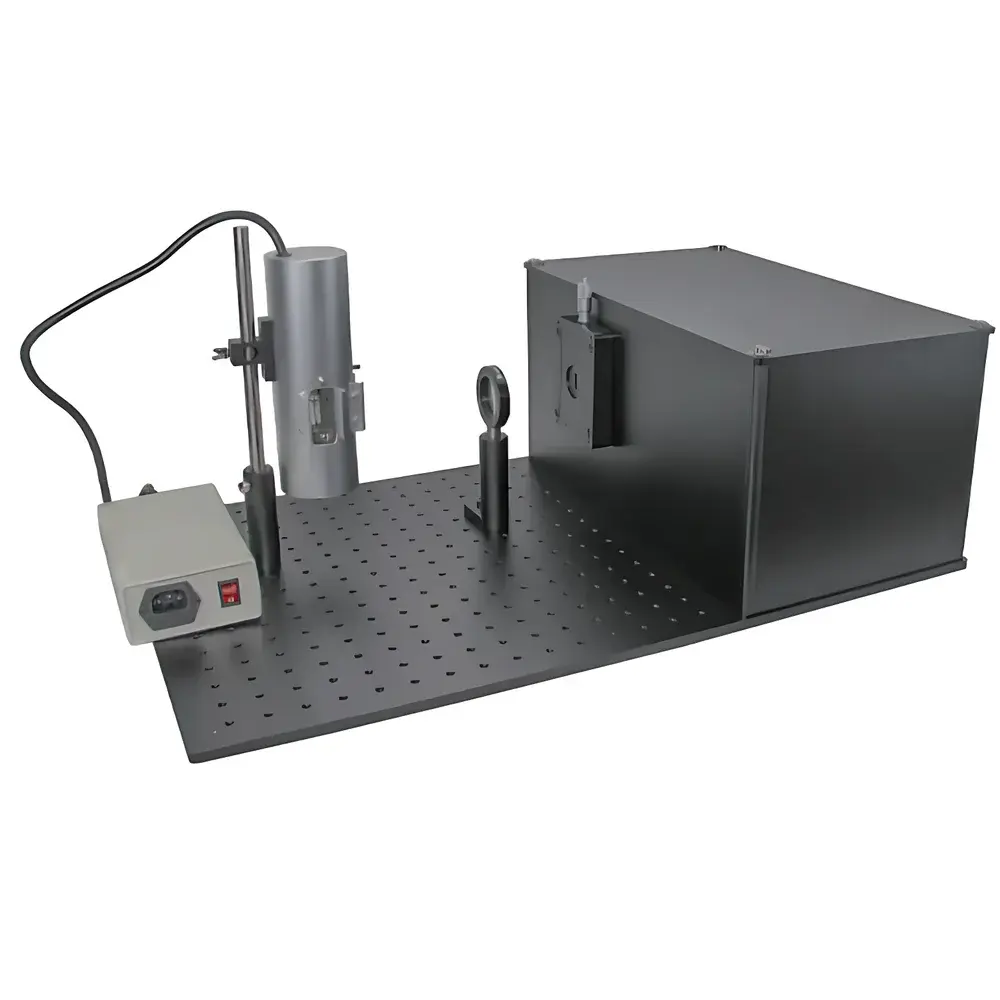
Topo TP-DSA1 Self-Assembly Grating Spectrometer
| Brand | Topo |
|---|---|
| Origin | Tianjin, China |
| Manufacturer Type | Direct Manufacturer |
| Country of Origin | China |
| Model | TP-DSA1 |
| Pricing | Upon Request |
| Application System | Universal |
Overview
The Topo TP-DSA1 Self-Assembly Grating Spectrometer is an educational and research-grade optical instrumentation platform engineered for hands-on pedagogical exploration of spectroscopic principles and optical system design. Based on the Czerny–Turner configuration, it employs a ruled or holographic diffraction grating as the dispersive element to separate polychromatic light into its spectral components across the ultraviolet–visible (UV–Vis) range (typically 200–800 nm). Unlike pre-aligned commercial spectrometers, the TP-DSA1 requires users to physically mount, align, and calibrate core optical components—including entrance slit, collimating mirror, diffraction grating, focusing mirror, and exit slit or detector interface—thereby reinforcing foundational concepts in ray optics, dispersion theory, spectral resolution, and wavelength calibration. Its modular architecture supports both qualitative spectral observation and quantitative absorbance/transmittance measurements when integrated with a calibrated photodetector or CCD array.
Key Features
- Modular optical bench design with precision-machined aluminum rails and kinematic mounts for repeatable component positioning
- Interchangeable diffraction gratings (e.g., 600, 1200, or 1800 grooves/mm) enabling adjustable spectral resolution and free spectral range
- Adjustable entrance and exit slits (10–200 µm width) for balancing signal intensity and spectral bandwidth
- Integrated alignment aids including He–Ne laser reference beam path and crosshair reticles on mirrors
- Compatibility with standard UV–Vis light sources (deuterium, tungsten-halogen, or LED-based) and detectors (photodiode, PMT, or linear CCD)
- Designed for full compliance with undergraduate and graduate laboratory safety standards (IEC 61010-1) and optical training curricula aligned with ISO/IEC 17025 competency frameworks
Sample Compatibility & Compliance
The TP-DSA1 does not perform direct sample analysis but serves as the optical core for custom-built UV–Vis spectrophotometers. It accommodates liquid cuvettes (10 mm pathlength), solid thin-film samples on quartz substrates, and gas cells via external sample compartments. All optical components meet RoHS-compliant material specifications. The system supports method validation protocols required under GLP environments when used in academic method development labs. While not certified for clinical or pharmaceutical release testing, its mechanical and optical repeatability enables student-generated data suitable for ASTM E275 (Standard Practices for Describing and Measuring Performance of UV–Vis Spectrophotometers) benchmarking exercises.
Software & Data Management
The TP-DSA1 operates without proprietary firmware; instead, it integrates seamlessly with open-source or institutionally licensed acquisition software (e.g., Python-based PyVISA + NumPy, LabVIEW, or MATLAB Instrument Control Toolbox). Users configure grating equation parameters (groove density, blaze angle, incidence angle) manually to compute theoretical wavelength dispersion. Calibration is performed using NIST-traceable emission lines from mercury–argon or holmium oxide reference lamps. Raw intensity vs. pixel data is exported in CSV or HDF5 format, supporting post-processing for baseline correction, peak integration, and Beer–Lambert law modeling. Audit trails and metadata tagging (e.g., grating ID, slit width, integration time) are maintained via user-defined logging scripts compliant with basic 21 CFR Part 11 documentation expectations for educational records.
Applications
- Undergraduate physics and chemistry laboratories: Demonstrating grating equation derivation, resolving power estimation, and aberration analysis
- Spectrophotometer construction projects: Assembling functional UV–Vis instruments for measuring absorption spectra of transition metal complexes, organic dyes, or semiconductor nanoparticles
- Instrumentation design courses: Evaluating trade-offs between spectral resolution, throughput, and stray light suppression
- Research methodology training: Developing SOPs for wavelength calibration, photometric accuracy verification, and detector linearity assessment
- Cross-disciplinary capstone projects: Coupling the spectrometer with microfluidic sample handling or electrochemical cells for real-time reaction monitoring
FAQ
Is the TP-DSA1 supplied with a detector or light source?
No. It is a bare optical platform; users select and integrate compatible detectors (e.g., Ocean Insight USB2000+, Thorlabs PDA series) and broadband sources based on their experimental requirements.
Can it be used for fluorescence spectroscopy?
Yes—with appropriate excitation filtering and right-angle detection geometry, though emission collection efficiency requires careful optimization of grating efficiency and detector quantum yield.
What level of wavelength accuracy can be achieved after calibration?
Typically ±0.5 nm across the 200–800 nm range when calibrated against Hg-Ar lamp lines and interpolated using third-order polynomial fitting.
Is mechanical or thermal stabilization included?
The baseplate provides passive thermal mass; active temperature control or vibration isolation must be added externally for high-resolution applications.
Does Topo provide curriculum materials or lab manuals?
Yes—downloadable PDF guides covering alignment procedures, error analysis worksheets, and sample experiment protocols are available through institutional licensing channels upon request.





