
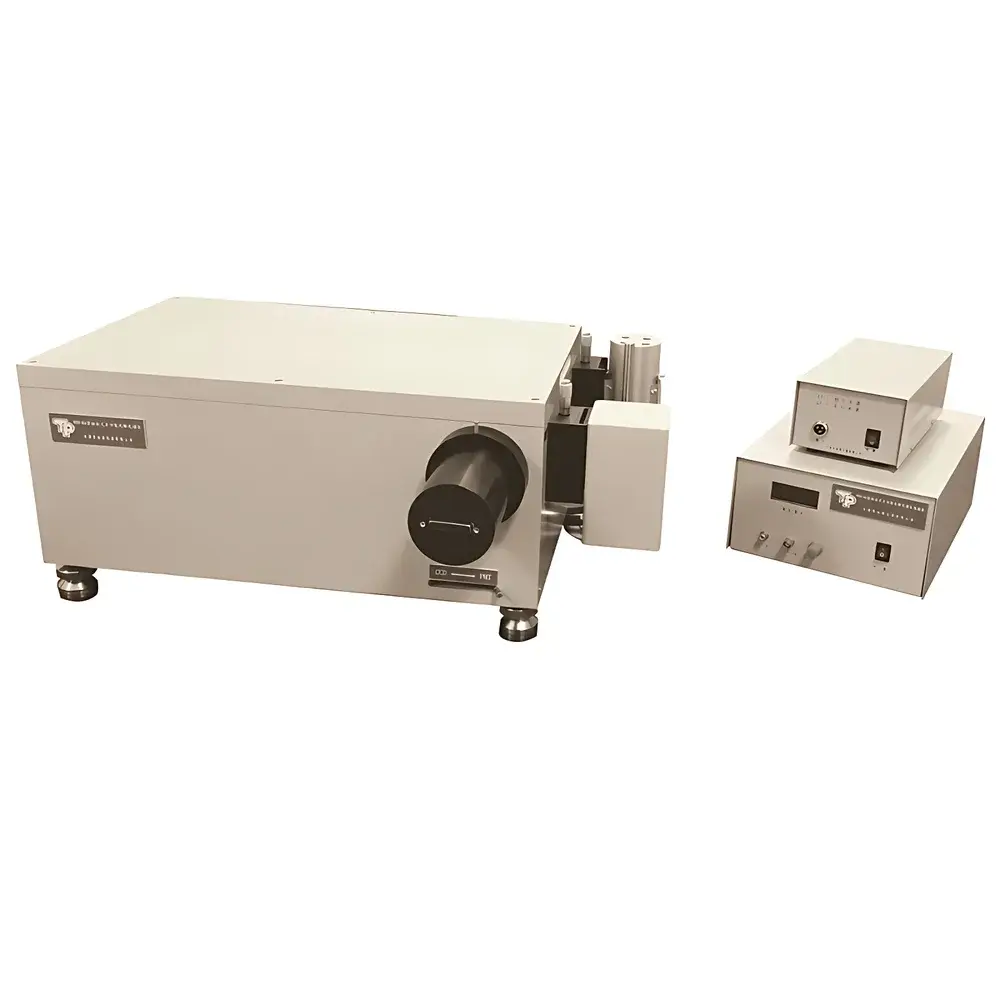
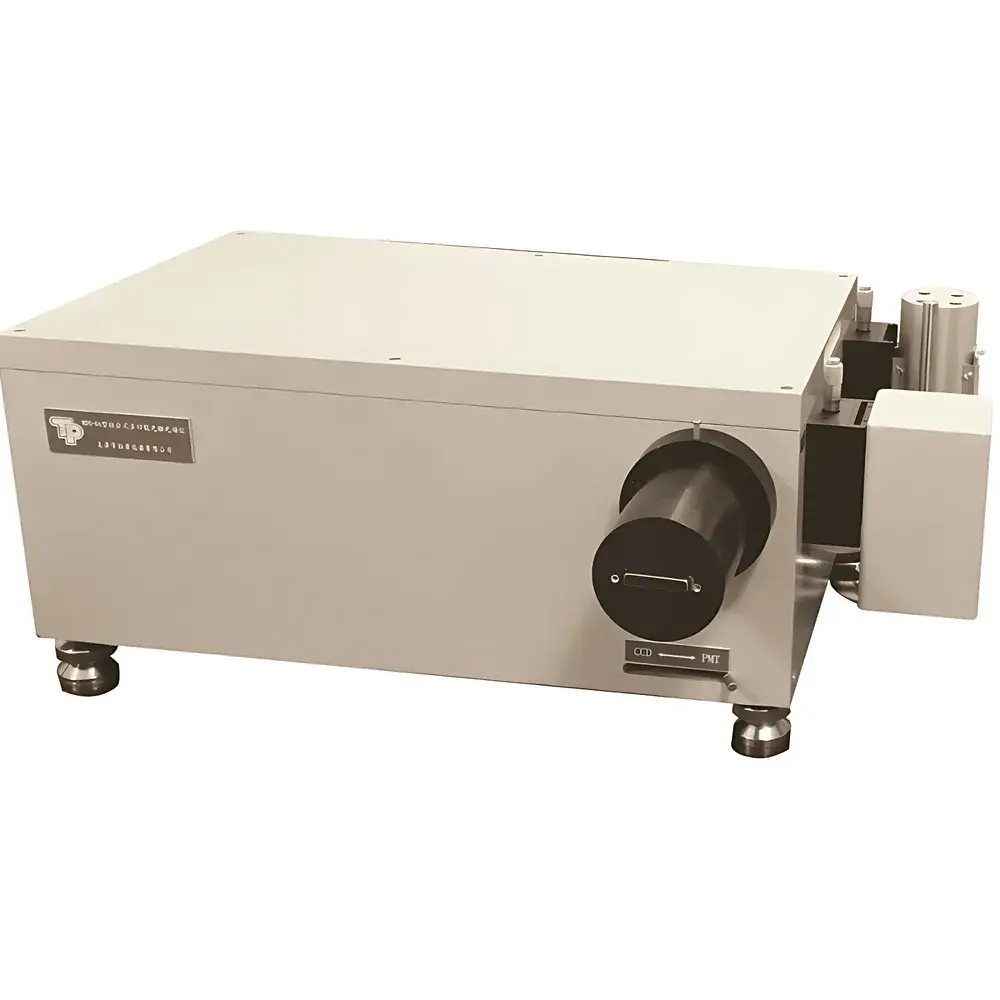
Topo WDS-8A Grating Spectrometer Monochromator
| Brand | Topo/TP |
|---|---|
| Origin | Tianjin, China |
| Manufacturer Type | Direct Manufacturer |
| Product Origin | Domestic (China) |
| Model | WDS-8A |
| Application Systems | Transmission & Reflectance Spectroscopy |
| Grating Mount | Dual-grating turret (exchangeable gratings) |
| Spectral Resolution | ≤0.06 nm (measured at Na I 330.23/330.29 nm doublet) |
| Groove Density | 2400 grooves/mm |
| Wavelength Range | 200–660 nm (PMT detection) |
| F-number | F/7 |
| Wavelength Accuracy | ±0.2 nm (200–660 nm) |
| Wavelength Repeatability | ≤0.1 nm |
| Stray Light | ≤0.1% T |
| Slit Width Adjustment | 0–2 mm, continuously variable |
| Focal Length | 500 mm |
| Relative Aperture | D/F = 1/7 |
| Interface | USB 2.0 |
| Dimensions (L×W×H) | 530 × 330 × 220 mm |
| Weight | 28 kg |
Overview
The Topo WDS-8A Grating Spectrometer Monochromator is a modular, research-grade optical spectrometer engineered for high-resolution spectral analysis in educational and applied laboratory environments. Based on Czerny–Turner optical architecture with a 500 mm focal length and F/7 beam geometry, the instrument employs a precision-machined dual-grating turret system—standard-equipped with a 2400 grooves/mm holographic grating—to deliver consistent dispersion and minimal aberration across its full 200–660 nm spectral range. Its core measurement principle relies on angular dispersion of polychromatic light via diffraction grating, followed by spatial separation and intensity detection at discrete wavelengths using either photomultiplier tube (PMT) or charge-coupled device (CCD) sensors. The system achieves ≤0.06 nm resolution—as validated against the sodium D-line doublet (330.23 nm / 330.29 nm)—and maintains wavelength accuracy within ±0.2 nm over the entire UV-Vis range. Designed for fundamental spectroscopic investigations—including hydrogen/deuterium isotope shift analysis (Balmer series), atomic line identification (e.g., Na I, Hg I), and band-edge characterization—the WDS-8A supports both transmission and reflectance modalities through interchangeable sample interfaces.
Key Features
- Modular Czerny–Turner optical design with 500 mm focal length and F/7 f-number for optimal signal-to-noise ratio and throughput balance
- Dual-output port configuration: simultaneous PMT and CCD detection paths enable real-time comparative acquisition and cross-calibration
- Exchangeable grating turret supporting standardized 2400 grooves/mm master grating; compatible with optional gratings for extended resolution or range optimization
- Continuously adjustable entrance and exit slits (0–2 mm) with micrometer-driven precision for dynamic control of spectral bandwidth and radiant flux
- High-stability mechanical platform with rigid aluminum alloy housing and vibration-damped base—designed to minimize thermal drift and mechanical hysteresis during long-duration scans
- USB 2.0 digital interface compliant with Windows-based host systems; supports trigger-synchronized acquisition and hardware-level shutter control
Sample Compatibility & Compliance
The WDS-8A accommodates a broad class of solid, liquid, and gaseous samples via standardized optical interfaces—including cuvette holders (WDSF-1 transmission cell, WDSF-2 fluorescence cell), fiber-optic coupling adapters, and reflective sample stages. It is routinely deployed in university physics laboratories for ASTM E308-compliant colorimetric analysis, ISO 13406-2-aligned spectral radiance validation, and USP particulate matter spectral fingerprinting protocols. While not certified for GMP or FDA 21 CFR Part 11 compliance out-of-the-box, the system’s deterministic wavelength calibration traceability (via Hg/Na/D₂ lamp references), audit-ready data logging capability (when paired with compliant software), and hardware-level repeatability (≤0.1 nm wavelength reproducibility) support GLP-aligned workflows in academic and pre-clinical research settings.
Software & Data Management
The WDS-8A operates with vendor-provided spectral acquisition software (Windows 10/11 compatible), offering real-time spectrum preview, multi-curve overlay, peak search with centroid fitting, and export to CSV, TXT, or JCAMP-DX formats. Raw intensity data retains full 16-bit dynamic range from the PMT or CCD digitizer. Software supports automated wavelength calibration using known emission lines (e.g., Hg 253.65 nm, Na 589.0/589.6 nm), linear and polynomial dispersion correction, and stray-light subtraction algorithms based on dark-current and reference-background normalization. All acquisition parameters—including slit width, integration time, grating position, and detector gain—are logged with timestamps and stored alongside spectra, enabling full experimental traceability. Third-party integration with LabVIEW, MATLAB, and Python (via DLL or serial API) is supported for custom automation and data pipeline development.
Applications
- Atomic emission spectroscopy: Hydrogen/deuterium isotope shift analysis (Hβ at 486.13 nm vs. Dβ at 486.01 nm), sodium doublet resolution, mercury line mapping
- UV-Vis absorption spectroscopy of dyes, semiconductors, and transition metal complexes using WDSF-1 quartz cuvettes
- Reflectance spectroscopy of thin films, coatings, and optical filters with calibrated integrating sphere attachment (optional)
- Fluorescence excitation/emission profiling using WDSF-2 cell and synchronized dual-monochromator mode (with auxiliary excitation source)
- Calibration and validation of broadband light sources (e.g., deuterium-tungsten halogen lamps) per CIE S 014-2/E:2006
- Undergraduate and graduate physics pedagogy: Rayleigh criterion verification, grating equation derivation, dispersion relation modeling
FAQ
What detectors are supported, and how do their spectral ranges differ?
Two detection modes are natively supported: a side-on photomultiplier tube (PMT) covering 200–660 nm (UV-enhanced cathode), and a back-illuminated CCD array covering 300–660 nm. The PMT offers superior UV sensitivity below 300 nm; the CCD provides parallel multichannel acquisition above 300 nm.
Is wavelength calibration traceable to NIST standards?
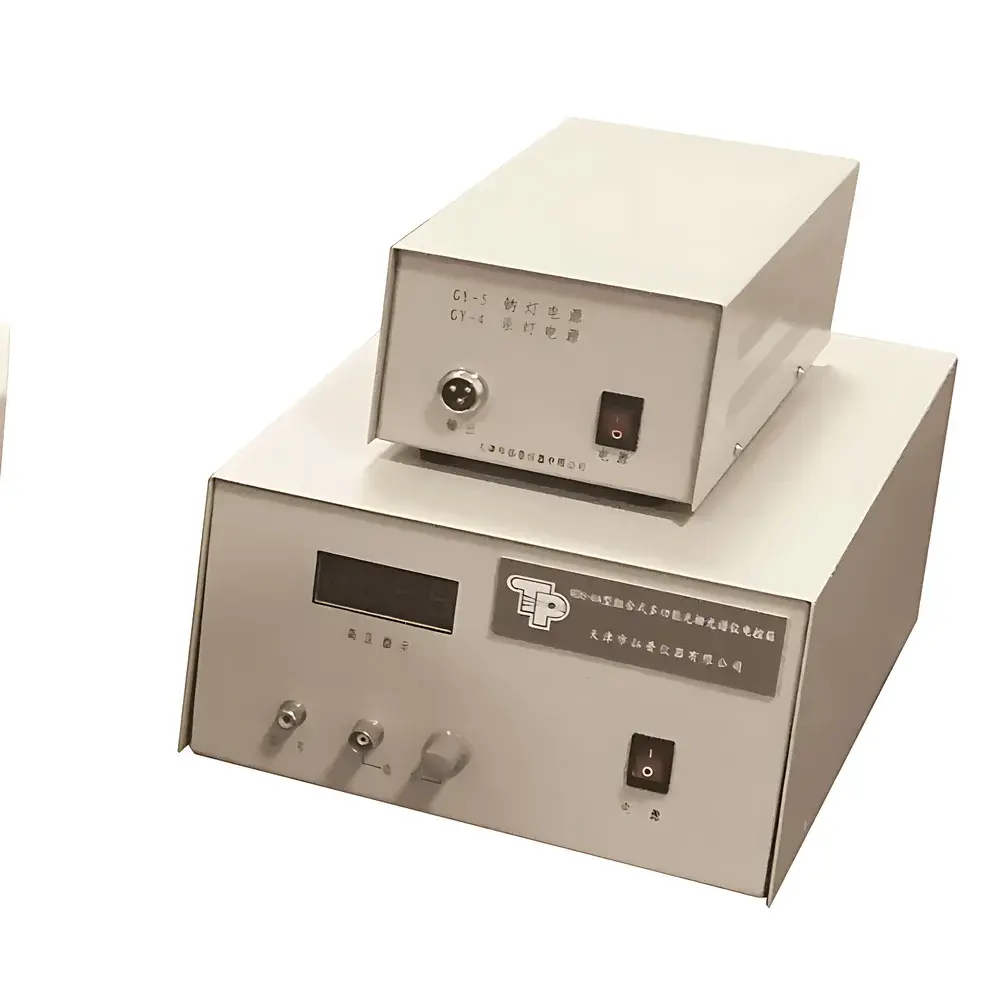
Yes—calibration is performed using certified spectral emission lamps (GY-5 Na, GY-9 H/D, GY-4 Hg), whose line positions are NIST-traceable. Users may generate and store custom calibration files referencing these standards.
Can the WDS-8A be integrated into automated optical benches?
Yes—USB 2.0 command protocol includes full remote control of slit drive, grating selection, detector switching, and scan initiation. TTL trigger inputs/outputs allow synchronization with external lasers, shutters, or motion stages.
What is the typical stray light level, and how is it measured?
Stray light is ≤0.1% transmittance, measured per ASTM E275 using a 5 nm bandwidth centered at 220 nm with a 10 mm path-length quartz cuvette filled with 10 g/L KCl solution (cut-off filter method).
Does the system include spectral deconvolution or chemometric analysis tools?
No—deconvolution, curve fitting, and multivariate analysis require post-processing in third-party software (e.g., OriginPro, Igor Pro, or Python SciPy). The native software provides baseline correction, smoothing, and peak integration only.





