
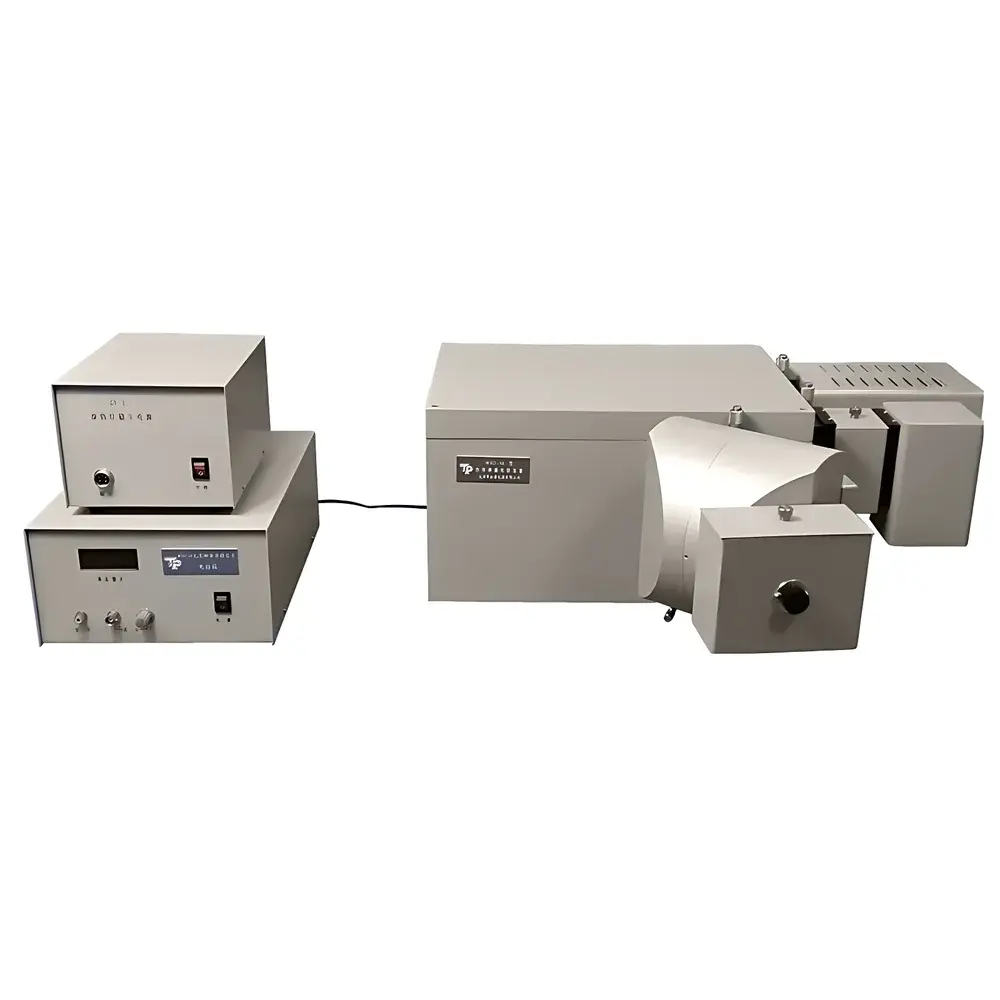
Topo WSD-1A Spectrophotometric Colorimetry Experimental System
| Brand | Topo (TP) |
|---|---|
| Origin | Tianjin, China |
| Manufacturer Type | Direct Manufacturer |
| Country of Origin | China |
| Model | WSD-1A |
| Application System | General-purpose |
| Grating Mount | Yes |
| Dispersion Element | Diffraction Grating |
| Wavelength Range | 380–780 nm |
| Wavelength Accuracy | ±0.4 nm |
| Wavelength Repeatability | ≤0.2 nm |
| Grating Density | 1200 lines/mm |
| Focal Length | f = 300 mm |
| Relative Aperture | D/F = 1/7 |
| Transmittance Accuracy | ±1% T |
| Noise Level | ±0.5% T |
| Slit Width Adjustment | 0–2.5 mm (continuously variable, resolution 0.01 mm per division) |
| Standard Observer | CIE 10° Standard Observer |
| Chromaticity Coordinate Resolution | x, y ±0.001 |
| Chromaticity Measurement Accuracy | Δx ±0.02, Δy ±0.03 |
| Light Source | 12 V / 20 W Tungsten-Halogen Lamp |
Overview
The Topo WSD-1A Spectrophotometric Colorimetry Experimental System is a benchtop, computer-controlled spectrophotometer engineered for fundamental and applied color science education and industrial R&D. It operates on the principle of spectral reflectance and transmittance measurement using monochromatic light generated via a Czerny–Turner optical configuration with a 300 mm focal length grating monochromator. The system integrates a calibrated tungsten-halogen lamp (12 V / 20 W), a precision adjustable slit (0–2.5 mm), a 1200 lines/mm diffraction grating, and a high-sensitivity photomultiplier tube (PMT) detector. Coupled with an integrating sphere accessory for diffuse reflectance and a dedicated transmission cell holder, the WSD-1A enables full spectral acquisition across the visible spectrum (380–780 nm) at ≤0.2 nm wavelength repeatability and ±0.4 nm absolute accuracy—meeting the minimum performance criteria for academic colorimetry labs aligned with CIE Publication No. 15:2018 and ISO/CIE 11664 series standards.
Key Features
- Monochromator-based architecture with 300 mm focal length and 1200 L/mm ruled grating for high optical throughput and spectral resolution in the visible range
- Computer-interfaced PMT detection system with real-time analog-to-digital conversion and noise suppression (±0.5% T baseline stability)
- Dual-measurement capability: integrated sphere for diffuse reflectance (including 10° standard observer geometry) and modular cuvette holder for transmittance of liquids and transparent solids
- Precisely adjustable entrance/exit slits (0–2.5 mm, 0.01 mm/div resolution) enabling spectral bandwidth control and signal-to-noise optimization
- Comprehensive hardware suite: includes certified white reference tile, chromatic glass standards (red, green, violet), and GY-1 halogen source with stabilized DC power supply
- Modular design supports future expansion, including optional WSDF-1 six-color planar LED source for multi-illuminant comparative studies
Sample Compatibility & Compliance
The WSD-1A accommodates solid, liquid, and semi-transparent samples through interchangeable optical paths. Reflectance measurements follow CIE 116:2019 guidelines for integrating sphere geometry (d/10°), while transmittance mode complies with ASTM E308-22 procedures for spectral data interpolation and tristimulus calculation. All chromaticity coordinates (CIE 1931 xy, CIE 1976 u’v’) and derived metrics—including dominant wavelength, purity, and correlated color temperature (CCT)—are computed in accordance with CIE 15:2018. The system’s ±1% T photometric accuracy and Δx/Δy tolerances (±0.02/±0.03) satisfy pedagogical validation requirements for undergraduate physics and materials science laboratories. While not FDA 21 CFR Part 11–certified out-of-the-box, audit trails and raw spectral export (ASCII .txt) support GLP-compliant documentation when deployed with validated lab computing environments.
Software & Data Management
The included WSD-1A专用色度专用软件 (Colorimetry Control & Analysis Suite) provides native Windows-based instrument control, spectral scanning, and CIE-compliant color space visualization. Functions include automatic wavelength calibration using mercury-argon emission lines, real-time spectral overlay, batch processing of reflectance/transmittance curves, and export of CIE XYZ, xyY, L*a*b*, and L*u*v* values. Raw spectral data are saved in tab-delimited ASCII format for interoperability with MATLAB, Python (NumPy/Pandas), or third-party statistical packages. The software enforces user-defined measurement protocols—including integration time, scan speed, and averaging cycles—and logs operator ID, timestamp, and environmental metadata (optional ambient sensor input). For institutional deployment, the application supports role-based access control and configurable report templates compliant with internal QA documentation workflows.
Applications
- University teaching labs: hands-on instruction in CIE colorimetry fundamentals, spectral power distribution analysis, metamerism demonstration, and observer function convolution
- Textile and dye chemistry: batch consistency evaluation, whiteness index (ISO 105-J02), and yellowness index (ASTM E313) quantification
- Paper and packaging: brightness (ISO 2470-1), opacity (ISO 2471), and spectral reflectance profiling for ink formulation validation
- Automotive and signaling: chromaticity verification of LED traffic signals (SAE J1383), automotive interior trim, and safety-critical coatings
- Food and pharmaceuticals: non-destructive color stability monitoring of tablets, powders, and emulsions under controlled illumination conditions
- Materials research: optical characterization of thin-film interference filters, pigment dispersion homogeneity, and scattering coefficient estimation
FAQ
What spectral resolution can be achieved with the WSD-1A under typical operating conditions?
Spectral resolution is slit-width dependent; at 0.2 mm slit setting, the system delivers ~1.2 nm full-width-at-half-maximum (FWHM) resolution across 400–700 nm, consistent with its 300 mm focal length and 1200 L/mm grating.
Is the integrating sphere compatible with both reflectance and fluorescence measurements?
No—the WSD-1A integrating sphere is optimized for reflectance and transmittance only. Fluorescence requires excitation source modulation and dual-monochromator architecture, which is outside this system’s design scope.
Can the software generate reports compliant with ISO/IEC 17025 documentation requirements?
While the software does not auto-generate ISO/IEC 17025–formatted certificates, it exports fully traceable raw spectra and metadata required for accredited lab report authoring and internal audit preparation.
Does the system support NIST-traceable calibration?
Yes—calibration is performed using NIST-traceable tungsten-halogen and mercury-argon spectral line standards; users may re-validate wavelength and photometric accuracy annually using supplied reference materials.
What are the minimum PC requirements for running the control software?
Windows 10 (64-bit), Intel Core i3 or equivalent, 4 GB RAM, USB 2.0 port, and 500 MB free disk space. No GPU acceleration is required.
Related Products





