
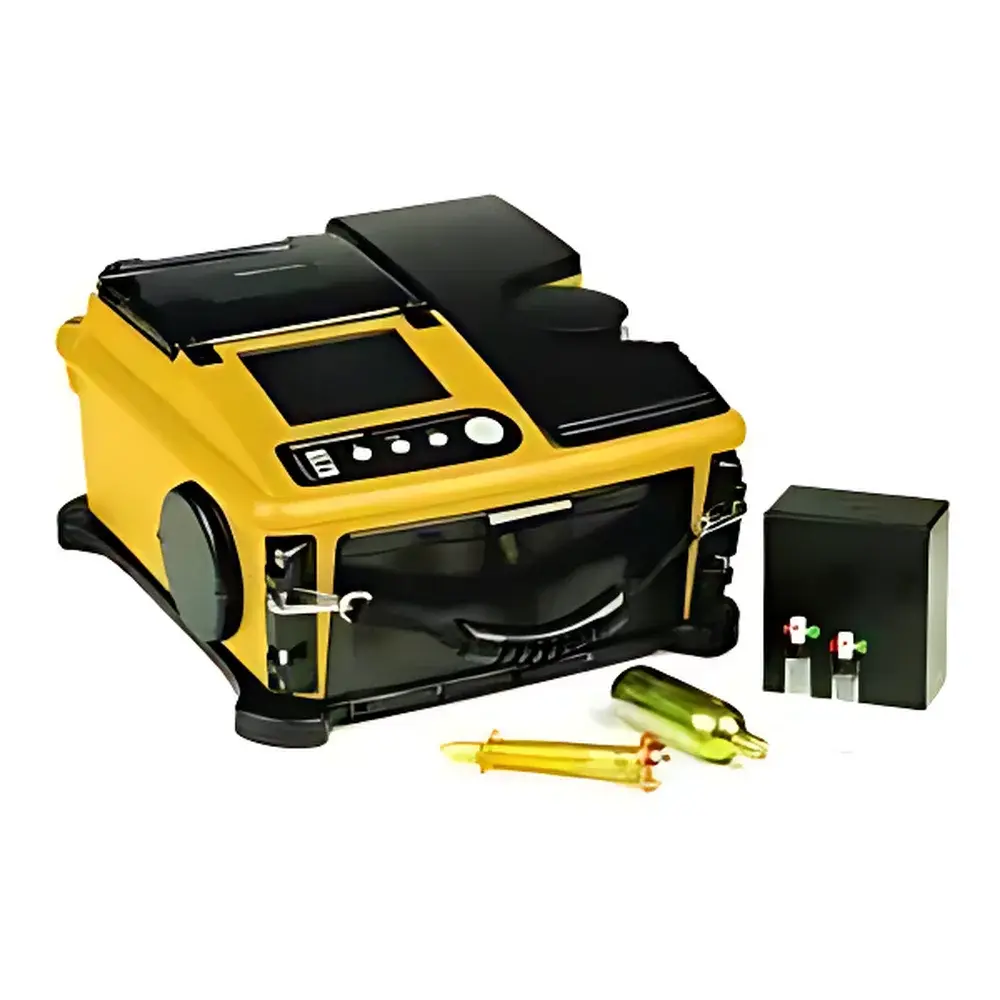
Torion TRIDION™-9 Portable Gas Chromatograph–Ion Trap Mass Spectrometer
| Brand | Torion |
|---|---|
| Origin | USA |
| Manufacturer Type | Authorized Distributor |
| Origin Category | Imported |
| Model | TRIDION™-9 GC-TMS |
| Price | Upon Request |
Overview
The Torion TRIDION™-9 GC-TMS is a field-deployable, benchtop-integrated gas chromatography–ion trap mass spectrometry (GC-ITMS) system engineered for rapid, on-site chemical identification and quantification. Unlike conventional laboratory-based GC-MS platforms, the TRIDION™-9 integrates a Low Thermal Mass (LTM) capillary gas chromatograph with a compact toroidal ion trap mass spectrometer—enabling full analytical workflows outside controlled environments without compromising spectral fidelity or chromatographic resolution. Its core measurement principle relies on electron ionization (EI) of thermally desorbed analytes, followed by mass-selective trapping, isolation, and sequential fragmentation within the ion trap, supporting both full-scan acquisition and targeted MS/MS experiments. Designed for mission-critical applications where time-to-answer, operational robustness, and analytical confidence are non-negotiable, the TRIDION™-9 delivers laboratory-grade data in real-world conditions—from hazardous material response to environmental forensics.
Key Features
- True Field Portability: Weighing 14.5 kg (including integrated Li-ion battery) and measuring only 38.1 × 39.4 × 22.9 cm, the system is certified for transport via commercial air cargo and operates autonomously without external power or gas supply infrastructure.
- Sub-5-Minute Analysis Cycle: Achieved through rapid LTM GC temperature programming (up to 2.5 °C/s ramp rate) and optimized ion trap duty cycle—enabling high-throughput screening without sacrificing peak capacity or mass accuracy.
- Onboard Intelligent Data Processing: CHROMION software features automated deconvolution of co-eluting peaks using retention time alignment and spectral library matching (NIST-compatible), delivering unambiguous compound identification and semi-quantitative results directly on the instrument’s 5.7″ color touchscreen interface.
- Ruggedized Vacuum Architecture: Dual-stage vacuum system comprising a diaphragm roughing pump and a compact turbomolecular pump maintains stable operating pressure (10−3–10−4 Torr) under mechanical shock, vibration, and ambient temperature fluctuations (5–45 °C).
- Modular Sample Introduction: Supports multiple inlet configurations including handheld CUSTODION™-NT gas sampling probe, SPME fiber desorption, and direct liquid injection—ensuring compatibility with volatile organic compounds (VOCs), semi-volatiles, and thermally labile species.
Sample Compatibility & Compliance
The TRIDION™-9 is validated for analysis of compounds across broad polarity and volatility ranges—including hydrocarbons, chlorinated solvents, pesticides, pharmaceutical residues, explosives precursors, and flavor/aroma volatiles. Its EI ion source and toroidal ion trap provide consistent fragmentation patterns suitable for spectral library search (e.g., NIST, Wiley) and method transfer between field and central labs. The system meets key regulatory expectations for field-deployable instrumentation: it supports audit-trail-enabled data capture per FDA 21 CFR Part 11 requirements when operated with configured network logging; complies with ISO/IEC 17025 documentation practices for accredited testing laboratories; and aligns with ASTM D7622 (standard guide for portable GC-MS use in environmental screening) and EPA Method 8270D for semi-volatile organic analysis in soil and water extracts.
Software & Data Management
CHROMION software runs natively on Windows CE embedded OS and provides full control over GC oven programming, MS scan parameters, and data acquisition modes. All raw and processed data—including chromatograms, mass spectra, calibration curves, and deconvoluted component tables—are stored on removable SD cards or exported via Ethernet to secure enterprise servers. The software includes built-in spectral deconvolution algorithms compliant with IUPAC-recommended peak purity assessment protocols. Data export formats include .CDF (NetCDF), .CSV, and .mzXML—ensuring interoperability with third-party chemometric tools (e.g., AMDIS, OpenChrom, MassHunter). Optional remote monitoring and firmware update capability is available via secure HTTPS API integration.
Applications
- Environmental Emergency Response: Real-time detection of VOCs and SVOCs at spill sites, landfill leachate plumes, or indoor air quality incidents.
- Forensic Toxicology & Crime Scene Investigation: Identification of illicit drugs, accelerants, and chemical warfare agent degradation products from trace evidence.
- Food Safety & Flavor Chemistry: Rapid profiling of off-flavors, adulterants, pesticide residues, and authenticity markers in raw materials and finished products.
- Industrial Hygiene & Process Monitoring: Continuous workplace exposure assessment for OSHA-regulated substances and catalyst poisoning diagnostics in petrochemical units.
- Military CBRNE Defense: Mobile detection of nerve agents, blister agents, and toxic industrial chemicals during reconnaissance or perimeter surveillance operations.
FAQ
What is the typical detection limit for target analytes?
Detection limits range from low parts-per-trillion (ppt) to parts-per-million (ppm), depending on compound volatility, ionization efficiency, matrix complexity, and sample introduction method—validated against EPA Method 8260C and ASTM D7622 benchmarks.
Can the system operate without helium carrier gas?
No—the TRIDION™-9 requires high-purity helium (≥99.999%) as carrier gas; alternative gases are not supported due to ion trap pressure stability and chromatographic resolution requirements.
Is method validation support available for regulated industries?
Yes—Torion provides application notes, system suitability test (SST) protocols, and IQ/OQ documentation templates aligned with GLP and GMP frameworks for pharmaceutical and environmental laboratories.
How is data integrity ensured during field operation?
All acquisitions are timestamped, digitally signed, and logged with operator ID, instrument configuration, and environmental metadata—meeting ALCOA+ principles for data reliability and traceability.
What maintenance is required for sustained field performance?
Routine maintenance includes quarterly ion source cleaning, annual turbomolecular pump oil replacement, and biannual calibration verification using perfluorotributylamine (PFTBA) standard—documented in the included preventive maintenance logbook.
Related Products







