
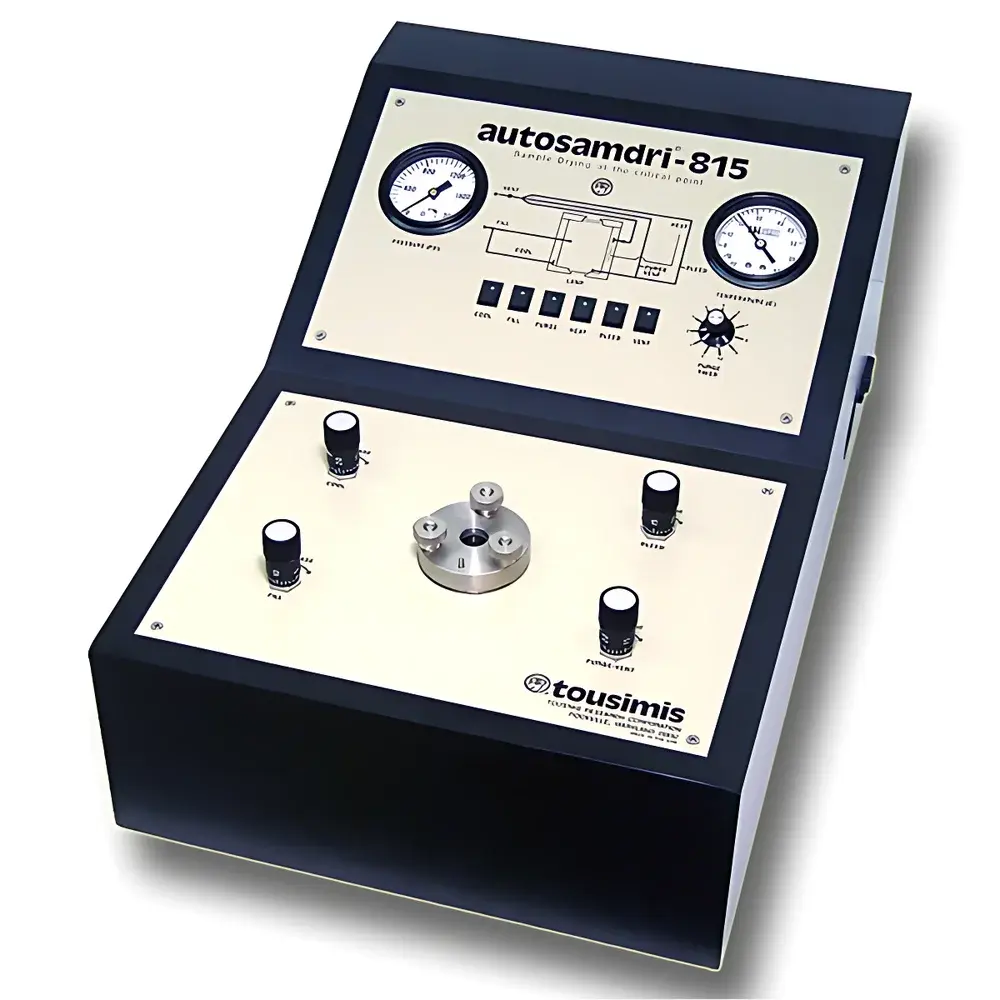
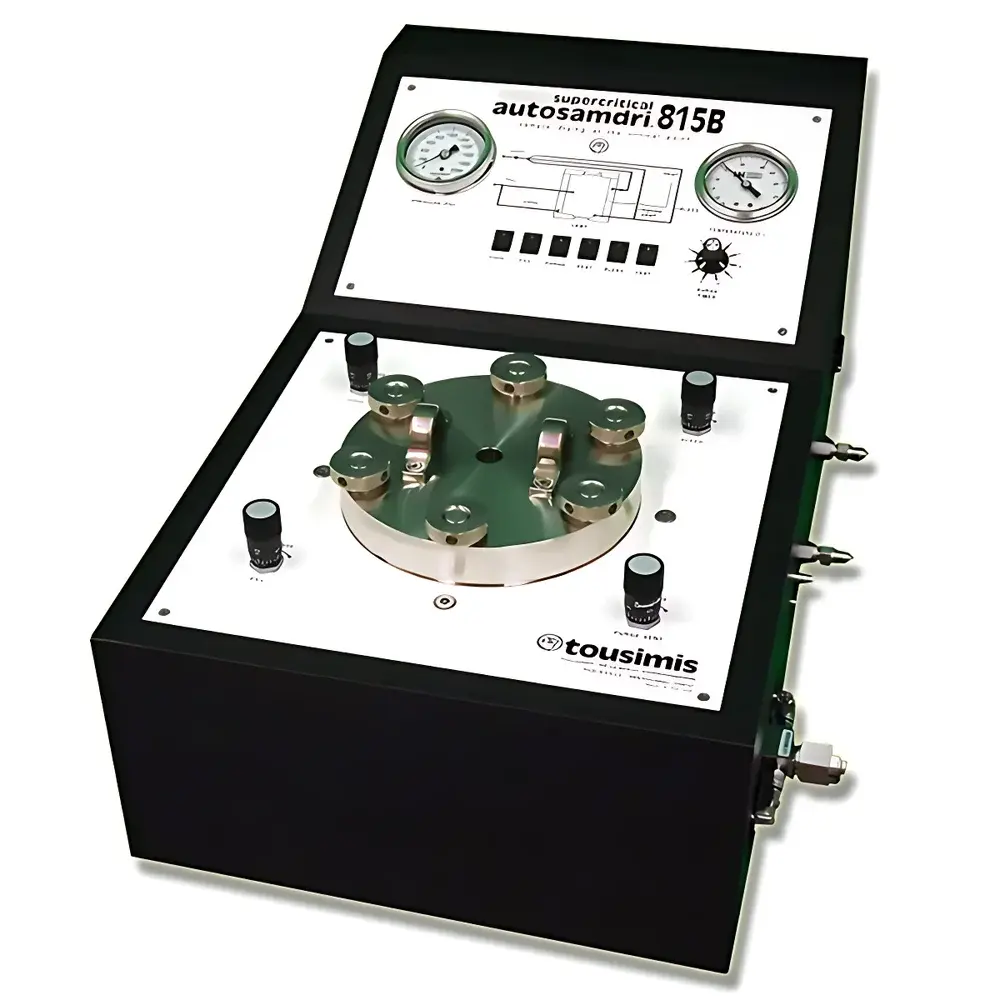
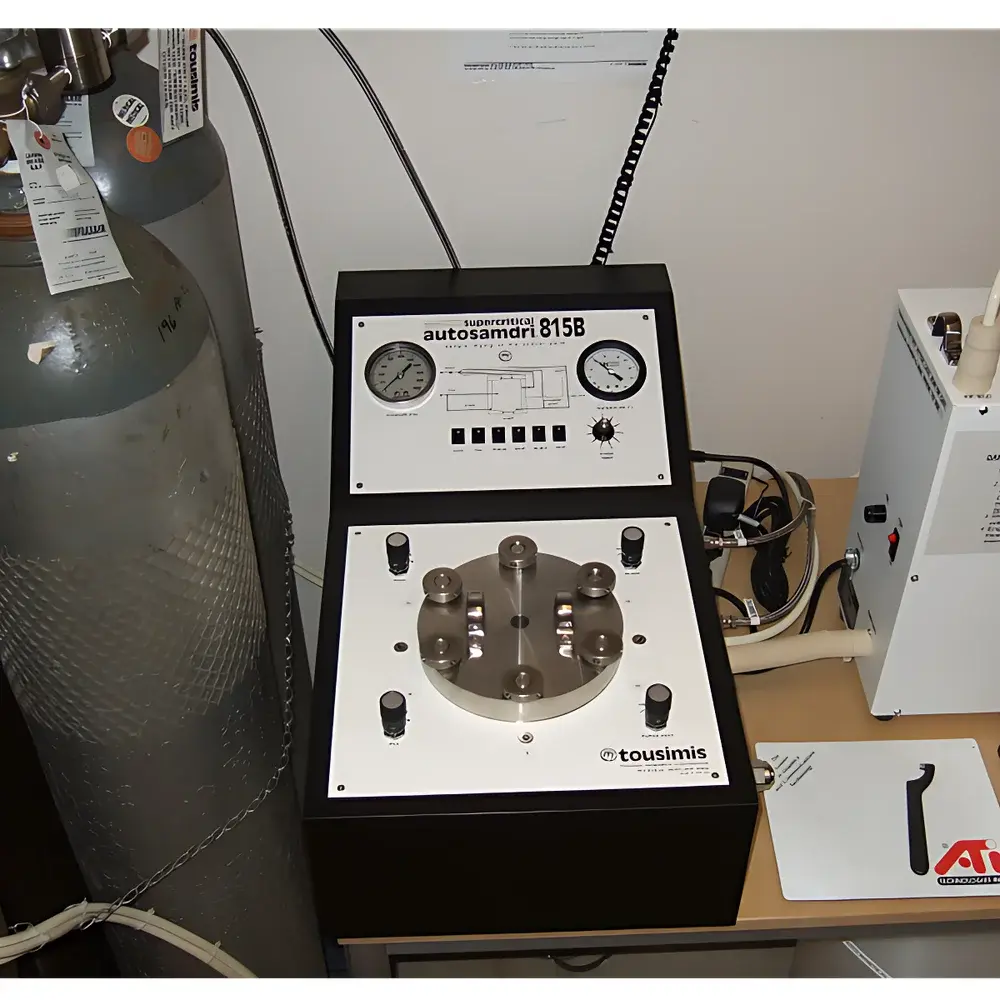
Tousimis Autosamdri®-815/815B Series A Fully Automated Critical Point Dryer
| Brand | Tousimis |
|---|---|
| Origin | USA |
| Model | 815/815B Series A |
| Pressure Range | 0–2000 psi |
| Temperature Range | −30 °C to 60 °C |
Overview
The Tousimis Autosamdri®-815/815B Series A is a fully automated critical point dryer (CPD) engineered for high-fidelity, non-destructive drying of delicate hydrated or solvent-suspended specimens—particularly those with nanoscale topography, porous architectures, or mechanically fragile microstructures. It operates on the physical principle of supercritical fluid processing: by transitioning liquid carbon dioxide (CO₂) across its critical point (31.1 °C, 1072 psi), the system eliminates interfacial surface tension between liquid and vapor phases. This thermodynamic condition prevents capillary collapse, shrinkage, and structural distortion commonly induced during conventional air-drying or freeze-drying—making it indispensable for preserving native morphology in biological tissues, hydrogels, aerogels, MOFs, MEMS devices, graphene monolayers, and semiconductor wafers up to 8 inches in diameter. Unlike water-based critical point drying (requiring 374 °C and 3212 psi), CO₂-based CPD enables low-temperature, chemically inert processing compatible with thermally labile biomolecules and polymer matrices.
Key Features
- Fully automated process control via embedded microprocessor, enabling reproducible, hands-off operation across multi-step protocols (solvent exchange, CO₂ infiltration, pressurization, heating, venting, and purge)
- LED status indicators provide real-time visual feedback for each operational phase—including fill, heat, hold, vent, and cool—enhancing procedural transparency and troubleshooting efficiency
- Top-loading cylindrical chamber with borosilicate viewport allows direct observation of sample behavior during CO₂ phase transitions without compromising pressure integrity
- Precision micro-metering valves regulate CO₂ flow rate with high repeatability, ensuring consistent solvent displacement kinetics and minimizing bubble nucleation artifacts
- Chamber interior constructed from electropolished 316 stainless steel and PTFE-coated components, resistant to corrosion by anhydrous CO₂, ethanol, acetone, and other common transitional solvents
- Integrated safety logic automatically modulates temperature and pressure setpoints to remain within ASME BPVC Section VIII-compliant operating envelopes; includes redundant pressure relief and thermal cutoffs
- Rapid chamber cooling: model 815 achieves −30 °C in ≈60 seconds from ambient; model 815B in ≈180 seconds—enabling rapid thermal cycling for high-throughput labs
- Model 815B includes three interchangeable chamber inserts (3″, 2″, and 1.25″ I.D.), reducing CO₂ consumption by up to 70% when processing small-volume samples
- Optional condenser module (standard on 815B) captures displaced ethanol during solvent exchange, suppressing acoustic emissions during vent cycles and recovering volatile organics for environmental compliance
Sample Compatibility & Compliance
The Autosamdri®-815/815B supports diverse specimen geometries—from single TEM grids and SEM stub-mounted tissue sections to full 4″ wafers (815B) or stacked MEMS arrays. Its design conforms to widely adopted laboratory standards including ASTM E2021 (Standard Guide for Critical Point Drying of Biological Specimens), ISO 16700 (Electron microscopy — Preparation of biological specimens for scanning electron microscopy), and USP (Critical Point Drying of Pharmaceutical Nanomaterials). For regulated environments, optional audit-trail logging (via RS-232 or USB) supports GLP/GMP documentation requirements under FDA 21 CFR Part 11 when paired with validated software platforms. All wetted surfaces meet USP Class VI biocompatibility criteria, and chamber O-rings are certified per MIL-STD-889 for halogen-free elastomer compatibility.
Software & Data Management
While the base unit employs a dedicated front-panel interface with tactile membrane keys and alphanumeric LED display, optional PC connectivity enables protocol archiving, remote monitoring, and batch reporting via Tousimis’ CPD Control Suite (v4.2+). The software logs timestamped pressure/temperature profiles, valve actuation events, and error codes with configurable retention periods. Export formats include CSV and PDF for integration into LIMS or ELN systems. Firmware updates maintain alignment with evolving NIST-traceable calibration guidelines and support future enhancements such as predictive maintenance alerts based on cumulative cycle metrics.
Applications
- High-resolution SEM/TEM sample preparation for plant stomata, insect cuticles, bacterial biofilms, and neural tissue without artifact-induced collapse
- Drying of sol-gel-derived aerogels, silica xerogels, and metal–organic frameworks (MOFs) while retaining >95% of original pore volume and BET surface area
- Post-lithographic release of MEMS cantilevers, microfluidic channels, and RF resonators where residual surface tension would cause stiction failure
- Stabilization of conductive polymer hydrogels and graphene oxide films prior to electrical characterization
- Preparation of photonic crystal templates and colloidal nanoparticle assemblies requiring preserved long-range order
- Wafer-level drying of patterned silicon, GaN, or SiC substrates in semiconductor R&D and failure analysis workflows
FAQ
What solvents are compatible with the Autosamdri®-815/815B?
Ethanol and acetone are the most commonly used transitional solvents due to their miscibility with both water and liquid CO₂. Other solvents—including methanol, isopropanol, and hexamethyldisilazane (HMDS)—may be used subject to compatibility verification with chamber seals and valves.
Is CO₂ purity specification required?
Yes. Use only research-grade (≥99.995%) anhydrous CO₂, preferably with ≤5 ppm H₂O and ≤1 ppm oil content. Optional external filtration (#8784) removes residual moisture, particulates, and hydrocarbon contaminants before entering the chamber.
How does the 815B differ from the 815 in terms of throughput and scalability?
The 815B features a larger 4.5″ I.D. chamber optimized for wafer-scale processing and includes modular inserts to adapt chamber volume dynamically. Its integrated condenser reduces solvent loss and noise, improving operational consistency in shared-core facilities.
Can the system be integrated into automated sample prep workflows?
Yes. Digital I/O ports and serial command protocols allow synchronization with robotic liquid handlers, vacuum transfer chambers, and coating systems—enabling end-to-end unattended EM sample preparation pipelines.
What maintenance intervals are recommended for routine operation?
O-rings should be inspected and replaced every 200 cycles or semiannually; CO₂ inlet filters require replacement every 500 hours of active use; chamber viewport cleaning with CO₂-compatible lens tissue is advised after each run involving volatile organics.



