
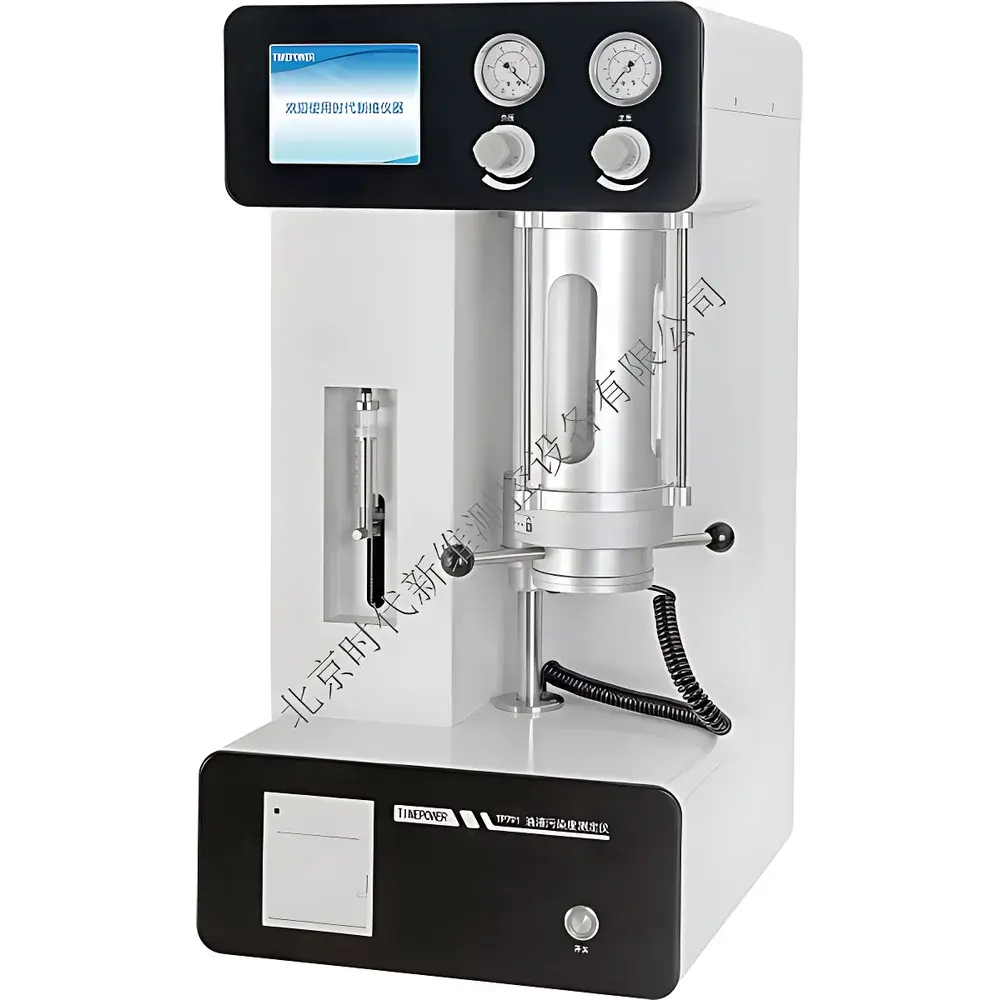
TP791 Oil Particle Counter by TimePower
| Brand | TimePower |
|---|---|
| Origin | Beijing, China |
| Manufacturer Type | Original Equipment Manufacturer (OEM) |
| Country of Origin | China |
| Model | TP791 |
| Pricing | Available upon request |
Overview
The TP791 Oil Particle Counter is a precision laboratory instrument engineered for quantitative analysis of solid particulate contamination in liquid media—primarily hydraulic oils, lubricants, insulating oils (e.g., transformer oil), turbine oils, gear oils, aviation fuels, and water-based hydraulic fluids. It operates on the internationally standardized light extinction (light blockage) principle defined in ISO 11171, ASTM D7647, and GB/T 18854. In this method, particles suspended in a flowing liquid stream pass through a precisely dimensioned sensing zone intersected by a collimated semiconductor laser beam. Each particle obstructs a portion of the incident light proportional to its projected area, generating a transient voltage pulse whose amplitude correlates with particle size. Pulse counting and amplitude classification across 16 user-configurable channels enable simultaneous quantification of particle concentration per size bin and derivation of contamination grades per multiple international standards.
Key Features
- ISO 11171-compliant optical sensor with high-stability semiconductor laser source and low-noise photodetection circuitry
- Precision syringe pump sampling system with programmable volume range from 0.2 mL to 1000 mL and volumetric accuracy better than ±0.5%
- Combined positive/negative pressure chamber (max. +0.8 MPa / −0.08 MPa) enabling controlled sample degassing and accommodation of viscosities up to 650 cSt
- 16-channel size classification with adjustable thresholds within 0.8 μm–600 μm detection range (sensor-dependent)
- Built-in calibration curves compliant with NAS 1638, ISO 4406:2021, GJB 420B, SAE AS4059F, DL/T 432, GB/T 14039, and GOST 17216; supports user-defined grading protocols
- Touchscreen interface with Chinese/English language toggle, on-device data storage, and integrated thermal printer
- RS232 serial interface for bidirectional communication with LIMS or laboratory informatics platforms
- Automated grade assignment per selected standard, including real-time pass/fail evaluation against specification limits
Sample Compatibility & Compliance
The TP791 accommodates a broad spectrum of industrial fluids—including mineral- and synthetic-based hydraulic oils, aviation turbine fuels (Jet A-1, JP-8), phosphate ester fire-resistant fluids, polyalkylene glycol (PAG) lubricants, and polymer solutions—provided they are optically transparent at the operating wavelength and non-corrosive to wetted materials (stainless steel 316, borosilicate glass, fluoropolymer seals). Its design conforms to functional safety requirements outlined in IEC 61010-1 for electrical equipment used in laboratory environments. While not intrinsically rated for hazardous locations, it supports integration into GxP-aligned workflows when operated under documented SOPs and subjected to periodic verification per ISO/IEC 17025 guidelines. The instrument meets electromagnetic compatibility (EMC) requirements per EN 61326-1 and is suitable for use in GLP and GMP-regulated settings where audit-ready data integrity is maintained via timestamped printouts and exportable ASCII/CSV logs.
Software & Data Management
Data acquisition, processing, and reporting are managed through embedded firmware without dependency on external PC software. All measurements include automatic timestamping, operator ID input (via touchscreen keyboard), and storage of raw pulse histograms alongside summary reports. Exported datasets via RS232 retain full metrological traceability—including sensor ID, calibration date, sample volume, flow rate, and environmental temperature—and are structured for seamless ingestion into enterprise quality management systems (QMS) or statistical process control (SPC) platforms. Optional firmware upgrades support enhanced audit trail functionality aligned with FDA 21 CFR Part 11 requirements, including electronic signatures, user access levels, and immutable record retention.
Applications
The TP791 serves critical roles across maintenance reliability engineering and fluid lifecycle management: monitoring in-service oil degradation in wind turbine gearboxes; certifying cleanliness of hydraulic fluid prior to commissioning aircraft actuation systems; verifying filtration efficiency in power plant turbine lube oil circuits; qualifying batch release of transformer oil per IEEE C57.106; assessing microcontamination in semiconductor manufacturing coolant loops; and supporting root-cause analysis of bearing wear in heavy-duty diesel engines. Its versatility extends to R&D applications involving colloidal stability studies of nanofluids and dispersion homogeneity testing of functional additives in base stocks.
FAQ
What particle size standards does the TP791 support out-of-the-box?
The instrument includes preloaded calibration curves for ISO 4406, NAS 1638, GJB 420B, SAE AS4059F, DL/T 432, GB/T 14039, and GOST 17216.
Can the TP791 analyze opaque or highly colored oils?
No—it requires optically transparent samples; turbid or dyed fluids may necessitate dilution or alternative methods such as membrane filtration followed by microscopy.
Is third-party calibration certification available?
Yes—traceable calibration reports issued by CNAS-accredited metrology laboratories can be procured separately.
What maintenance is required between analyses?
After each test, the syringe and fluidic path must be flushed with clean petroleum ether (or equivalent solvent), and the pressure chamber must fully depressurize before opening.
Does the TP791 comply with ASTM D6786?
While ASTM D6786 specifies procedures for automatic particle counters, the TP791’s optical architecture and calibration methodology are compatible with its operational framework when configured per Annex A1.





