
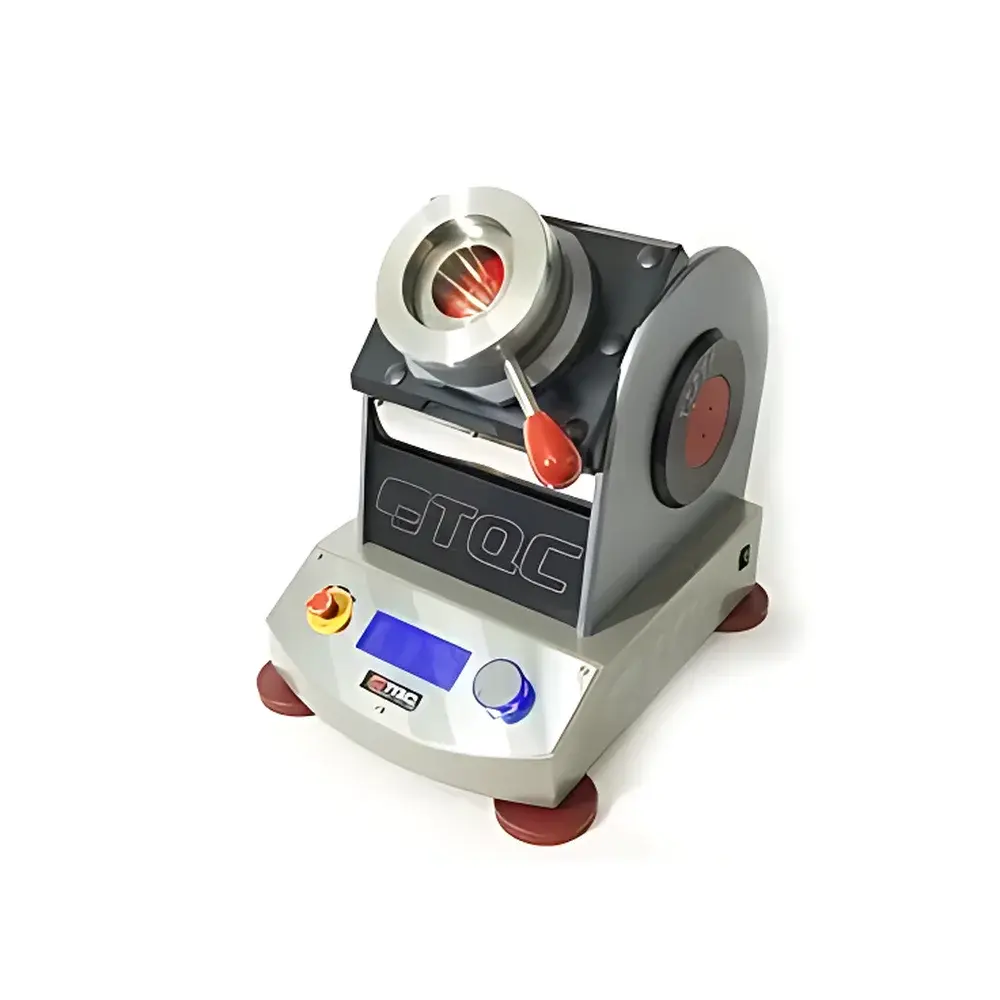
TQC SP4300 Erichsen Cupping Testing Machine
| Brand | TQC |
|---|---|
| Origin | Netherlands |
| Model | SP4300 |
| Instrument Type | Automatic |
| Drive Mechanism | Electronic micro-stepping motor |
| Stroke Range | 0–12 mm |
| Stroke Resolution | 0.01 mm |
| Punch Speed Range | 0.01–0.70 mm/s |
| Speed Accuracy | ±1% of set value |
| Stroke Accuracy | ±0.01 mm |
| Max. Test Panel Width | 100 mm |
| Max. Steel Thickness | 0.8 mm |
| Max. Aluminum Thickness | 1.2 mm |
| Dimensions (D×W×H) | 450 × 350 × 600 mm |
| Net Weight | ~31 kg |
| Power Supply | 115–230 V, 50–60 Hz |
| Max. Power Consumption | 80 W |
| Display | Backlit LCD with multilingual UI |
| Safety Features | Emergency stop button, audible alarm |
| Compliance | ISO 1520, DIN EN ISO 1520, DIN 53156, DIN 53232, BS 3900-E4, NBN T22-104, NF T30-019 |
| Certification | Qualicoat & QIB Laboratory Accredited |
Overview
The TQC SP4300 Erichsen Cupping Testing Machine is an automated, precision-engineered instrument designed to evaluate the ductility, adhesion, and deformation resistance of organic coatings applied on metallic substrates—primarily steel and aluminum sheets. Based on the Erichsen cupping principle defined in ISO 1520, the test subjects a clamped flat panel to controlled, axisymmetric plastic deformation via a hemispherical punch until coating failure (cracking, flaking, or delamination) occurs. The resulting cupping depth—measured in millimeters at the onset of visible failure—is the primary quantitative metric for comparative assessment of coating performance under mechanical stress. Unlike manual cupping testers, the SP4300 employs a closed-loop electronic micro-stepping motor drive system, ensuring continuous, stable, and programmable displacement rates within the standard-specified range of 0.1–0.3 mm/s—critical for reproducible compliance with ISO 1520’s kinematic requirements, especially when testing thicker or higher-strength substrates.
Key Features
- Automated displacement control with adjustable speed from 0.01 to 0.70 mm/s and ±1% speed accuracy—enabling strict adherence to ISO 1520’s mandated deformation rate window.
- Precision stroke resolution of 0.01 mm across a full 12 mm travel range, facilitating high-resolution detection of early-stage coating failure.
- Adjustable test panel clamp with angular positioning capability—ensuring consistent clamping force distribution across variable substrate geometries and thicknesses (up to 0.8 mm steel / 1.2 mm aluminum).
- Integrated multi-directional LED illumination system with independently adjustable intensity, color temperature, and incident angle—optimized for high-contrast visualization of crack initiation and delamination on glossy, matte, textured, or chromatically complex coated surfaces.
- Intuitive rotary-push-button interface with backlit LCD display and multilingual menu navigation (English, German, French, Spanish, Dutch, Chinese), supporting rapid operator training and cross-regional deployment.
- User-performed calibration routine—allowing laboratories to verify and maintain traceable measurement integrity without external service intervention.
- Dual operating modes: manual step-by-step displacement for exploratory analysis, and pre-programmed automatic test sequences for standardized quality control workflows.
Sample Compatibility & Compliance
The SP4300 accommodates rectangular test panels up to 100 mm wide and 12 mm deep, with maximum thickness limits of 0.8 mm for cold-rolled steel and 1.2 mm for aluminum alloys—covering the full scope of industrial coil-coated, electroplated, and powder-coated sheet metal specimens. Its mechanical architecture complies with all dimensional and functional requirements specified in ISO 1520:2022 (Paints and varnishes — Cupping test), as well as harmonized national standards including DIN EN ISO 1520, DIN 53156, DIN 53232, BS 3900-E4, NBN T22-104, and NF T30-019. The instrument has been formally evaluated and accredited by Qualicoat (for architectural aluminum finishing) and QIB (Quality Inspection Bureau) laboratories—validating its suitability for certification-critical testing in aerospace, automotive OEM, and architectural cladding supply chains. All test data generated are compatible with GLP-compliant documentation practices, and the system supports audit-ready record retention when integrated with laboratory information management systems (LIMS).
Software & Data Management
While the SP4300 operates as a standalone benchtop instrument with embedded firmware, its digital architecture enables seamless integration into regulated environments. The device logs timestamped stroke position, real-time speed, and operator-initiated event markers (e.g., “failure observed”) directly to internal memory. Optional USB connectivity (via LD6181 digital microscope kit) allows image capture synchronized with displacement data, enabling annotated failure documentation aligned to exact cupping depth. All stored records export in CSV format for traceability, statistical process control (SPC), and inclusion in 21 CFR Part 11–compliant electronic batch records when paired with validated third-party LIMS platforms. Firmware updates are delivered via secure USB media, preserving configuration integrity and revision history per ISO/IEC 17025 clause 5.9.
Applications
- Coating formulation development and QC screening in R&D labs—quantifying relative ductility improvements from resin modifications or additive incorporation.
- In-line quality assurance for coil coating lines—verifying batch-to-batch consistency of baked enamel, polyester, PVDF, and fluoropolymer finishes.
- Supplier qualification testing per OEM specifications (e.g., Ford WSS-M2G173-A2, GM 6091-M, VW TL 226).
- Failure root-cause analysis following field adhesion loss—correlating lab cupping depth with real-world forming or bending performance.
- Accredited third-party testing services—supporting ISO/IEC 17025 accreditation scopes for metallic substrate coating evaluation.
FAQ
What standards does the SP4300 comply with?
ISO 1520:2022, DIN EN ISO 1520, DIN 53156, DIN 53232, BS 3900-E4, NBN T22-104, and NF T30-019.
Can the SP4300 test aluminum substrates?
Yes—it supports aluminum panels up to 1.2 mm thickness and includes calibrated clamping geometry optimized for non-ferrous substrate behavior.
Is user calibration possible without external tools?
Yes—the instrument includes a built-in self-calibration procedure using reference depth gauges supplied with the system.
Does the SP4300 meet GLP or GMP requirements?
It supports GLP-aligned operation through auditable event logging, user-access controls, and exportable raw data; full 21 CFR Part 11 compliance requires integration with validated LIMS software.
What maintenance is required for long-term accuracy?
Routine cleaning with lint-free cloth, periodic verification of punch alignment and clamp torque, and annual verification against traceable depth standards are recommended per ISO/IEC 17025 clause 6.4.



