
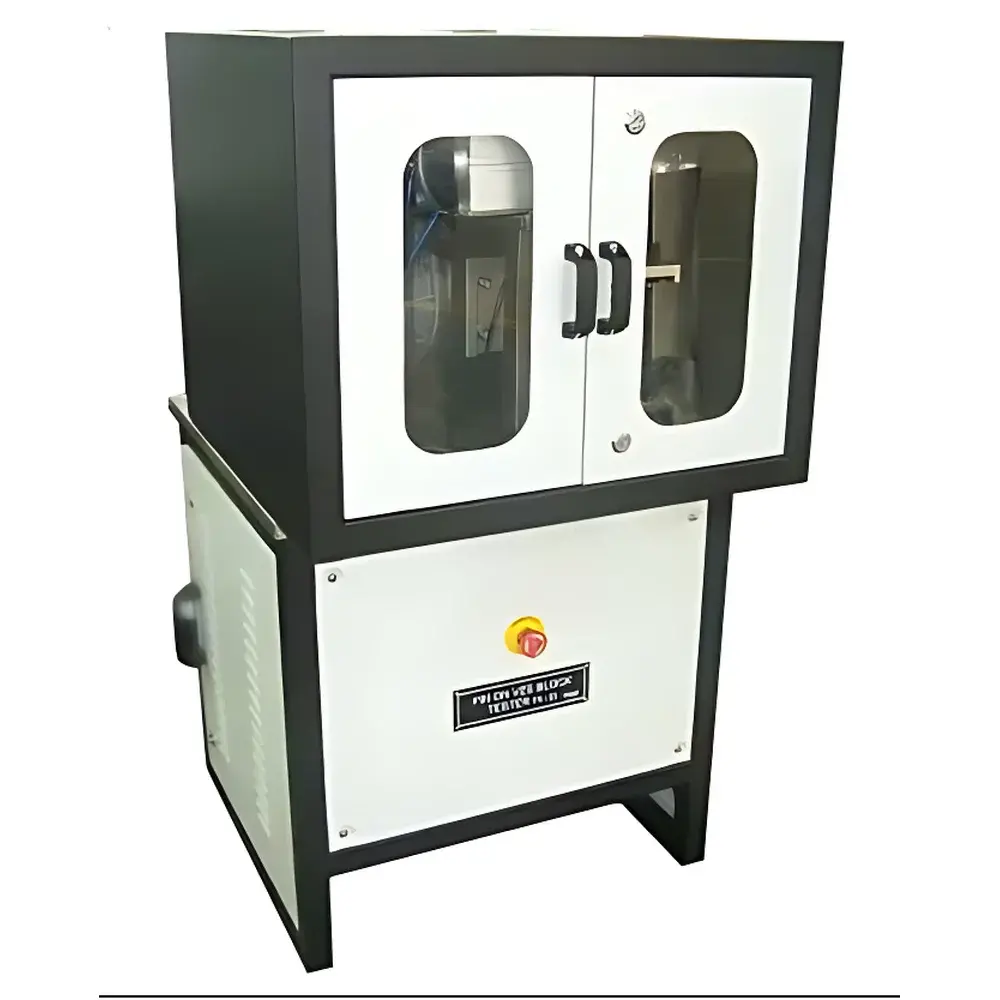
TR 22 Pin-and-V-Block Lubricant Tester by JHT (Yi Cheng Heng Da)
| Brand | JHT (Yi Cheng Heng Da) |
|---|---|
| Origin | USA |
| Manufacturer Type | Authorized Distributor |
| Origin Category | Imported |
| Model | TR 22 |
| Price | Upon Request |
Overview
The TR 22 Pin-and-V-Block Lubricant Tester is a precision-engineered tribological test instrument designed to evaluate the extreme-pressure (EP) performance and anti-wear durability of lubricating oils and greases under controlled, reproducible boundary lubrication conditions. Based on the classical pin-and-v-block geometry defined in ASTM D 2625 and D 2670, the system subjects a rotating cylindrical steel pin to compressive loading against two stationary hardened V-shaped blocks immersed in the test lubricant. The fundamental measurement principle relies on quantifying frictional torque development and load progression behavior as a function of applied normal force and thermal environment—enabling direct assessment of lubricant film strength, seizure resistance, and wear life. The instrument operates within a thermostatically controlled bath (up to 200 °C), ensuring accurate simulation of service-relevant thermal gradients. Its mechanical architecture—featuring a ratchet-driven axial loading mechanism—provides stepwise, repeatable load increments without manual intervention, while integrated overload protection halts rotation upon torque or temperature excursions beyond user-defined thresholds.
Key Features
- Automated ratchet-based axial loading system with incremental, self-locking load application up to 4500 lbf (20 kN), enabling precise determination of weld point and load-carrying capacity.
- Integrated PID-controlled heating bath (ambient to 200 °C) with real-time temperature monitoring and automatic test initiation at preset bath temperature.
- High-fidelity torque transducer (0–100 in·lb range) and calibrated load cell operating across full dynamic range, delivering traceable measurements compliant with ISO/IEC 17025 metrological practices.
- Motorized speed control maintaining constant rotational velocity (100–500 RPM) regardless of load or viscosity-induced drag—critical for consistent shear rate application.
- Comprehensive safety interlocks: automatic motor shutdown triggered by over-torque, over-temperature, or mechanical stall detection.
- Pre-calibrated reference tools included for routine verification of torque, load, and rotational speed—supporting GLP-compliant calibration documentation.
Sample Compatibility & Compliance
The TR 22 accommodates standard test specimens per ASTM D 2625: 1/4″ diameter × 3/4″ long AISI E52100 steel pins (HRC 60–65), paired with two hardened V-blocks (60° included angle, surface hardness ≥62 HRC). Optional accessories include Brinell hardness balls for alternative contact geometry testing (per ASTM D 5620) and microhardness measurement kits for post-test wear scar analysis. The system fully supports compliance with major international standards including ASTM D 2625 (EP performance), ASTM D 2670 (wear life), ASTM D 3233 (load wear index), ASTM D 5620 (ball-on-disk variant), IP 241, and U.S. Department of Defense specifications FTM 791-3807.1 and 791-3812.1. All hardware and software configurations are engineered to meet audit requirements for GMP/GLP environments, including secure user access control and electronic record retention.
Software & Data Management
Data acquisition and analysis are performed using a LabVIEW-based platform configured for continuous synchronized logging of torque (in·lb), applied load (lbf), bath temperature (°C), elapsed time (min), and rotational speed (RPM). The software provides real-time graphical display of torque–load curves, time–torque trends, and wear life metrics (e.g., time to specified torque increase). Raw data files are stored in timestamped CSV format with embedded metadata (operator ID, test ID, calibration date, ambient conditions), supporting 21 CFR Part 11 compliance when deployed with validated electronic signature modules. Post-processing tools enable automated calculation of Load-Wear Index (LWI), Weld Point, and Scar Diameter (via optional microscope integration). Export functions support direct import into LIMS and statistical process control (SPC) systems.
Applications
- Qualification of extreme-pressure additives in gear oils, hydraulic fluids, and metalworking fluids.
- Comparative evaluation of lubricant formulations under high-load, low-speed boundary conditions.
- Determination of scuffing resistance and catastrophic failure thresholds in industrial lubricants.
- Supporting R&D for biodegradable and synthetic lubricants requiring EP performance validation.
- Quality assurance testing in OEM supplier qualification programs governed by SAE, DIN, or OEM-specific lubricant specifications.
- Failure analysis of lubricated components where wear mechanisms correlate to pin-and-v-block stress states.
FAQ
What standards does the TR 22 directly support?
ASTM D 2625, D 2670, D 3233, D 5620, IP 241, and U.S. DoD FTM 791-3807.1 / 3812.1.
Can the system operate at elevated temperatures?
Yes—the heated bath maintains stable temperatures from ambient to 200 °C with ±0.5 °C accuracy via PID control.
Is data export compatible with enterprise LIMS platforms?
Yes—CSV output includes structured metadata; optional 21 CFR Part 11 add-ons enable secure audit trails and electronic signatures.
What consumables are supplied with initial delivery?
50 complete test sets (each comprising one test pin, one shear pin, and two V-blocks), plus calibration tools, microscope, and software license.
Does the TR 22 require external cooling or ventilation?
A dedicated exhaust hood is recommended when operating above 150 °C to manage vapor emissions; no chiller connection is required.



