
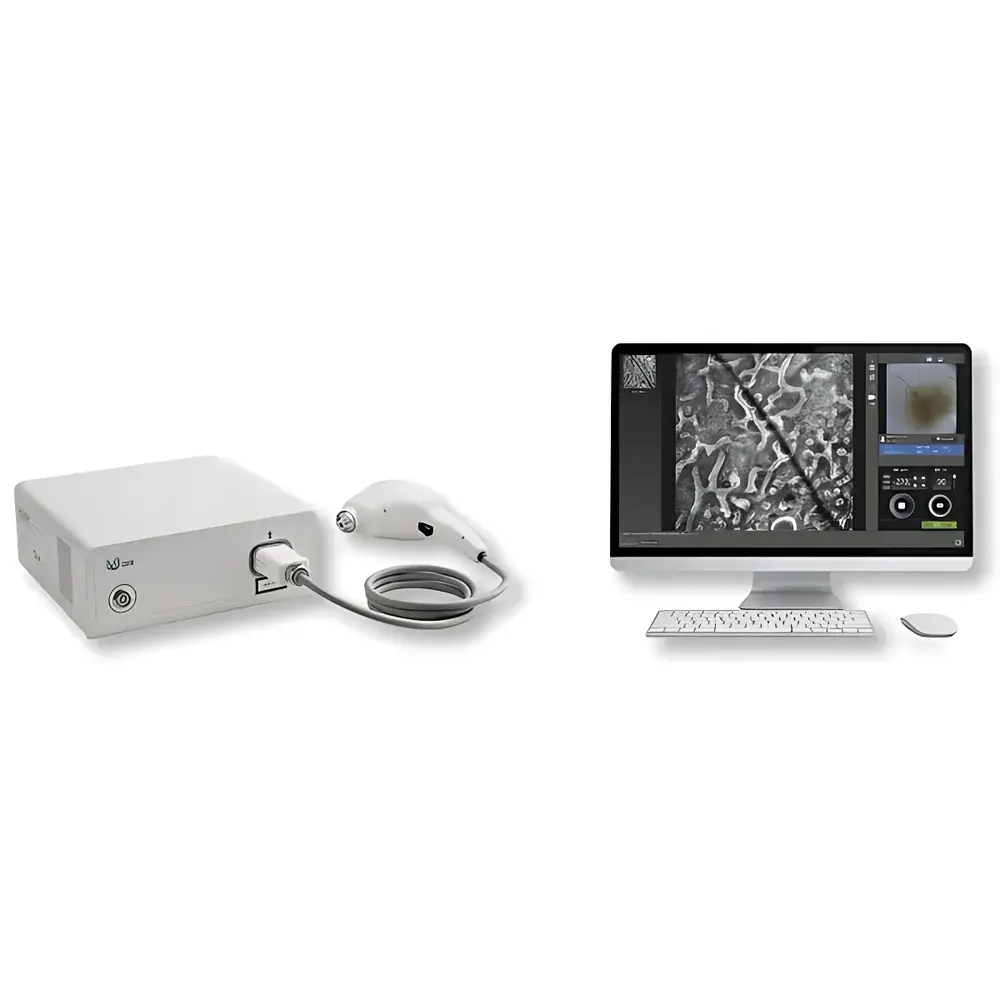
Transcend Vivoscope MY-600 Pro Reflectance Confocal Microscopy System
| Brand | Transcend Vivoscope |
|---|---|
| Model | MY-600 Pro |
| Light Source | 830 nm Near-Infrared Laser |
| Field of View | 1000 µm × 1000 µm |
| Imaging Speed | 15 fps at 1024 × 1024 pixels |
| Axial Resolution | Subcellular (typical for reflectance CCM) |
| Scan Mode | Real-time 2D + High-Accuracy Z-stack Tomography |
| Probe Type | Handheld, Non-contact, In Vivo Compatible |
| Origin | Jiangsu, China |
| Regulatory Classification | Class II Medical Device (CN), CE-marked for Research Use Only (RUO) |
Overview
The Transcend Vivoscope MY-600 Pro Reflectance Confocal Microscopy System is a research-grade, handheld in vivo confocal imaging platform engineered for non-invasive, real-time visualization of human skin microstructure at cellular and subcellular resolution. Unlike conventional epifluorescence or histological methods, this system employs reflectance-based confocal microscopy—leveraging endogenous optical contrast from melanin, keratin, collagen fibers, and erythrocytes—eliminating the need for exogenous fluorescent dyes or tissue biopsy. Its core optical architecture integrates coaxial co-localization of wide-field camera guidance and confocal scanning optics, enabling precise spatial targeting and reproducible re-imaging of identical anatomical sites across longitudinal studies. The 830 nm near-infrared laser source ensures optimal penetration depth (up to ~200–300 µm into viable epidermis and papillary dermis) with minimal phototoxicity and negligible melanin absorption interference—critical for safe, repeated use in clinical research and dermatological trials.
Key Features
- Handheld, ergonomic probe design optimized for flexible positioning on curved anatomical surfaces—including face, scalp, flexural areas, and nail units—without mechanical fixation or vacuum coupling.
- Real-time imaging at 15 frames per second (1024 × 1024 pixels) enables dynamic observation of capillary blood flow, keratinocyte migration, and inflammatory cell trafficking under physiological conditions.
- Automated Z-stack acquisition with sub-micron axial stepping supports volumetric reconstruction and quantitative depth profiling of stratum corneum thickness, epidermal turnover rate, and dermal collagen organization.
- Integrated wide-field preview mode provides contextual anatomical orientation prior to high-resolution confocal scanning—reducing operator dependency and improving inter-observer consistency.
- Ruggedized industrial housing and thermally stabilized laser diode ensure stable performance across ambient temperature fluctuations typical in multi-site clinical environments.
Sample Compatibility & Compliance
The MY-600 Pro is validated for use on intact, hydrated human skin across Fitzpatrick skin types I–VI. It complies with IEC 60601-1 (medical electrical equipment safety) and IEC 60825-1 (laser product safety Class 1). While classified as a Class II medical device in China, it is supplied globally under Research Use Only (RUO) designation—fully compatible with Good Laboratory Practice (GLP) workflows and audit-ready metadata logging. All image acquisition parameters—including laser power, gain, offset, Z-step interval, and scan area—are digitally recorded and embedded in DICOM-SR or TIFF metadata headers, supporting traceability requirements under ISO 13485 and FDA 21 CFR Part 11 (when deployed with compliant LIMS integration).
Software & Data Management
The proprietary Vivoscope Imaging Suite (v4.2+) delivers modular, scriptable control over acquisition, processing, and annotation. Core capabilities include: real-time contrast enhancement via adaptive histogram equalization; semi-automated cell segmentation using trainable U-Net models; cross-sectional intensity profile extraction along user-defined lines; and batch-aligned time-lapse registration for longitudinal change quantification. Export formats include 32-bit TIFF stacks, NIfTI volumes, and standardized JSON metadata files containing instrument configuration, patient ID (de-identifiable), acquisition timestamp (UTC), and environmental sensor readings (ambient humidity/temperature). Data integrity is enforced through SHA-256 hash generation and optional AES-256 encryption for HIPAA- and GDPR-compliant storage architectures.
Applications
- Dermatopharmacology: Quantitative assessment of topical drug penetration kinetics, barrier recovery post-irritation, and formulation-induced stratum corneum modulation.
- Onco-dermatology: In vivo monitoring of actinic keratosis maturation, basal cell carcinoma margin delineation, and treatment response to photodynamic therapy or imiquimod.
- Cosmeceutical validation: Objective evaluation of anti-aging interventions—including collagen synthesis stimulation, elastosis reduction, and pigmentary homogeneity improvement—across 4-, 8-, and 12-week trial endpoints.
- Immunodermatology: Dynamic tracking of Langerhans cell motility, T-cell infiltration patterns, and mast cell degranulation events during allergic contact dermatitis challenge models.
- Multimodal correlation: Integration with OCT, Raman spectroscopy, and transepidermal water loss (TEWL) datasets to construct predictive biomarker panels for disease stratification.
FAQ
Is the MY-600 Pro suitable for pediatric or sensitive skin applications?
Yes—the 830 nm wavelength and <5 mW output power meet Class 1 laser safety limits, and the non-contact probe design eliminates mechanical stress, making it appropriate for neonatal, geriatric, and eczematous skin assessments under IRB-approved protocols.
Can the system be integrated with third-party analysis platforms such as MATLAB or Python-based pipelines?
Yes—raw image data and metadata are accessible via documented REST API and HDF5 export modules, enabling direct ingestion into custom computational workflows for deep learning model training or biomechanical modeling.
What is the recommended maintenance schedule for optical calibration and laser alignment?
A full optical verification protocol is advised every 6 months or after 500 hours of cumulative operation, using NIST-traceable resolution test targets and neutral density filters; field-serviceable modules allow rapid replacement without factory return.
Does the system support multi-center clinical trial deployment with centralized data harmonization?
Yes—Vivoscope Cloud Sync enables encrypted, time-stamped DICOM push to central repositories with DICOMweb-compatible PACS interfaces and automated QC flagging for motion artifacts or focus drift across distributed sites.






