
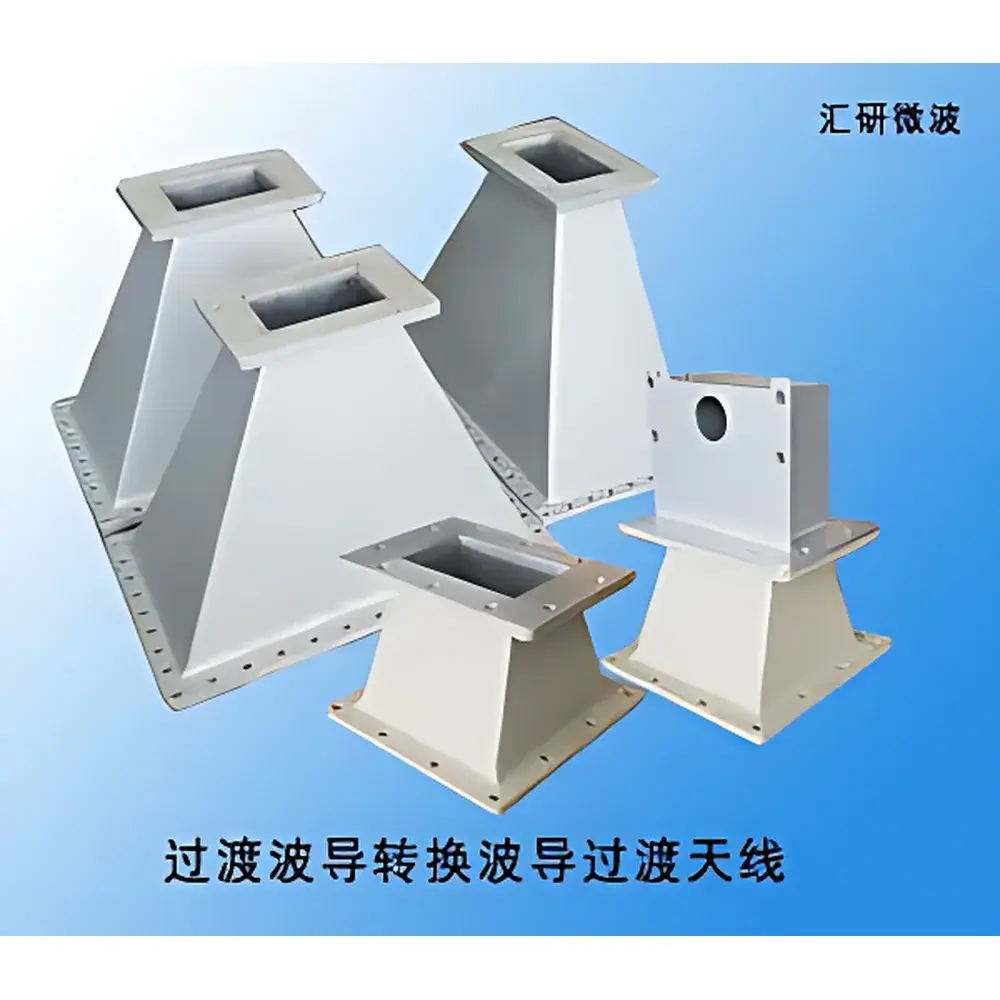
Transition Waveguide Adapter – HY Custom-Built Waveguide Transition Antenna
| Brand | HY |
|---|---|
| Origin | Jiangsu, China |
| Manufacturer Type | Authorized Distributor |
| Origin Category | Domestic (China) |
| Model | Custom-Engineered |
| Pricing | Available Upon Technical Consultation |
Overview
The HY Custom-Built Transition Waveguide Adapter is a precision-engineered passive microwave component designed to enable broadband, low-loss signal coupling between two dissimilar rectangular waveguide standards—such as WR-90 to WR-62, WR-42 to WR-28, or other non-standard cross-sectional transitions. Unlike generic flange adapters, this device operates on the principle of controlled modal transformation: it gradually tapers and reshapes the electromagnetic field distribution along its axial length to minimize higher-order mode excitation, reflection, and insertion loss across the overlapping operational bandwidth of the connected waveguides. It is not a radiating antenna per se, but rather a critical interface element in antenna feed networks, radar front-ends, millimeter-wave test benches, and satellite communication subsystems where impedance matching and phase continuity between mismatched waveguide sections are essential.
Key Features
- Custom-tapered internal geometry optimized for fundamental TE10 mode preservation and suppression of TE20, TE01, and TM11 parasitic modes
- Machined from high-purity 6061-T6 aluminum with optional silver or gold plating for enhanced surface conductivity and corrosion resistance
- Standardized UG-39/U, UG-59/U, or CPR-137 flanges (per MIL-DTL-3922/67) with 100% repeatability in bolt-hole alignment and gasket groove depth
- Thermal stability maintained over −40 °C to +85 °C via stress-relieved fabrication and coefficient-of-thermal-expansion (CTE)-matched joint design
- No active electronics or biasing—fully passive, DC-blocked, and compatible with pulsed and CW RF power up to 5 kW peak (dependent on size and frequency)
Sample Compatibility & Compliance
This transition adapter supports seamless integration with industry-standard waveguide systems including but not limited to IEEE Std 1782-2020-compliant WR-series, IEC 60153-2 waveguide dimensions, and legacy EIA RS-222 flange specifications. Each unit undergoes full-wave electromagnetic simulation (using Ansys HFSS or CST Studio Suite) prior to machining, followed by vector network analyzer (VNA) validation per IEC 61000-4-3 and MIL-STD-461G for conducted emissions and return loss. Mechanical drawings comply with ASME Y14.5–2018 GD&T standards. While not certified under FCC Part 15 or CE RED directives (as it is a component—not an end-product), documentation includes full S-parameter datasets (S11/S21), VSWR plots, and phase delay linearity reports traceable to NIM (National Institute of Metrology, China) calibration references.
Software & Data Management
HY provides complete digital deliverables upon order fulfillment: native STEP/IGES mechanical models, CST/HFSS project files (upon NDA), and measured S-parameter Touchstone (.s2p) files covering the validated operating band (e.g., 12–18 GHz for K-band transitions). All data is timestamped, version-controlled, and archived with audit-trail metadata compliant with ISO 9001:2015 Clause 7.5. For integration into automated test systems, S-parameters are exportable to MATLAB, Python (scikit-rf), or Keysight PathWave ADS for cascaded system modeling. No proprietary software license is required; no cloud connectivity or firmware updates apply—this is a deterministic hardware component governed solely by Maxwell’s equations and dimensional tolerances.
Applications
- Feed network integration between horn antennas and low-frequency transmitter modules in phased array radar systems
- Bandwidth extension of legacy X-band test fixtures to support dual-band (X/Ku) measurement campaigns
- Calibration path bridging in metrology-grade VNA setups requiring traceable waveguide-to-waveguide reference planes
- Millimeter-wave imaging system interconnects where mechanical misalignment tolerance must remain below ±0.025 mm
- Space-qualified payload interfaces meeting ECSS-E-ST-20-07C mechanical shock and thermal vacuum survivability requirements
FAQ
What determines the usable frequency range of a custom waveguide transition?
The operational bandwidth is defined by the overlap region between the cutoff frequencies of the two connected waveguides—and further constrained by the onset of the first higher-order mode in the transition section. For example, a WR-90 (8.2–12.4 GHz) to WR-62 (12.4–18.0 GHz) adapter typically performs optimally from 12.4–16.0 GHz.
Can this adapter handle high-power pulsed radar signals?
Yes—provided the peak electric field remains below the air breakdown threshold (~3 MV/m at sea level) and average power stays within thermal dissipation limits. Derating curves and multipactor thresholds are supplied per ANSI C95.1-2019 guidelines.
Do you provide flange torque specifications and gasket recommendations?
Yes—each shipment includes a certified assembly sheet listing exact torque values (in N·m), recommended gasket material (e.g., Eccosorb LS-300 or Viton O-ring), and sequence for multi-bolt flanges to ensure uniform compression and minimal VSWR variation.
Is RoHS or REACH compliance documented?
All base materials and plating processes conform to EU Directive 2011/65/EU (RoHS 2) and Regulation (EC) No 1907/2006 (REACH), with full SVHC declaration available upon request.
How long is the typical lead time for a custom design?
Standard lead time is 6–8 weeks from finalized mechanical drawing approval; expedited fabrication (4-week delivery) is available with priority engineering review and premium machining allocation.



