
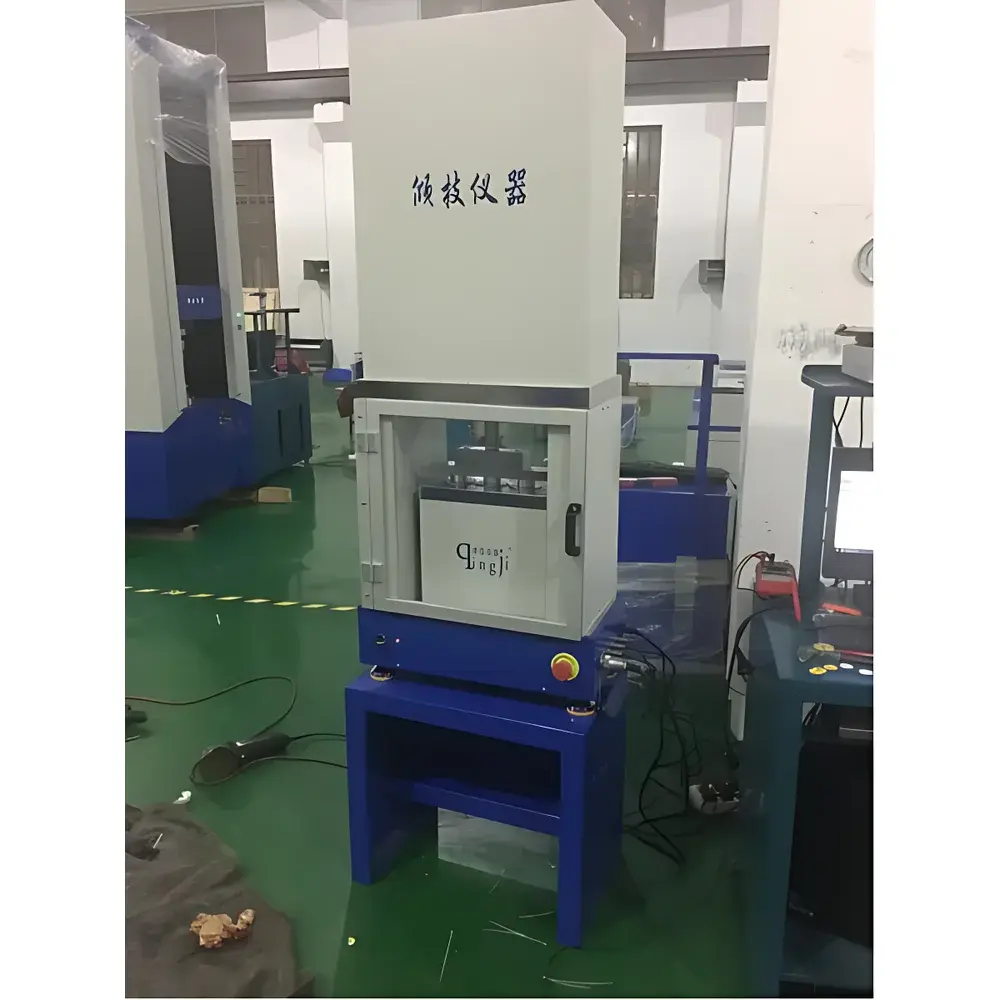
Tri-Site Spring Fatigue Testing Machine QJPL-3KN
| Origin | Shanghai, China |
|---|---|
| Manufacturer Type | Authorized Distributor |
| Origin Category | Domestic (PRC) |
| Model | QJPL-3KN |
| Max Test Load | 3 kN |
| Frequency Range | 0.001–10 Hz (amplitude-dependent) |
| Actuator Stroke | 50 mm (adjustable mid-stroke) |
| Effective Test Width | 60 mm × 3 stations |
| Max Spring OD | ≤60 mm |
| Max Free Length | ≤240 mm |
| Amplitude Range | 0.001–50 mm |
| Load Accuracy Class | 0.5 |
| Load Measurement Range | 0.2–100% FS |
| Load Resolution | 1/30,000 full scale (10 kHz dynamic sampling) |
| Displacement Measurement Accuracy | ±0.002 mm |
| Deformation Accuracy | ±1% of reading |
| Speed Control | Dual-speed (fast/slow), jog-capable |
| Safety Features | Mechanical limit switches, overload protection (10% over capacity), automatic return post-test |
| Power Supply | 220 V AC, 2 kW |
| Host Weight | ~850 kg |
| Included | 10 custom spring compression fatigue fixtures (dimensionally matched to user-provided samples), proprietary fatigue control software suite (with backup DVD), operation manual & interface cables |
Overview
The Tri-Site Spring Fatigue Testing Machine QJPL-3KN is an electro-hydraulic servo-controlled fatigue testing system engineered for high-reproducibility axial fatigue evaluation of metallic and composite elastic components under controlled cyclic loading. Based on the principle of closed-loop force and displacement feedback control, the system applies precisely regulated sinusoidal, trapezoidal, or user-defined waveforms to simulate real-world service conditions—including clutch springs, buffer springs, pneumatic actuator springs, cylindrical helical compression springs, and torsion-resistant coil forms. Its tri-station architecture enables concurrent fatigue testing of up to three independent specimens—reducing inter-sample variability and accelerating statistical life-data acquisition in accordance with ASTM E466 and ISO 10293 standards for spring endurance characterization.
Key Features
- Electro-hydraulic servo actuation delivering stable, low-noise dynamic force output with minimal phase lag across the full frequency spectrum (0.001–10 Hz)
- Three independent test stations (60 mm spacing), each equipped with precision-aligned compression platens and adjustable height stops for rapid specimen setup
- High-fidelity load cell (0.5 accuracy class) with 1/30,000 full-scale resolution and 10 kHz dynamic sampling capability—enabling accurate capture of transient load peaks and hysteresis loops
- Linear variable differential transformer (LVDT)-based displacement measurement with ±0.002 mm absolute accuracy and sub-micron repeatability
- Full-range, no-dual-range load sensing: maintains constant resolution from 0.2% to 100% of 3 kN maximum capacity without range switching artifacts
- Programmable amplitude control (0.001–50 mm) synchronized with frequency modulation—supporting both low-strain high-cycle (HCF) and high-strain low-cycle (LCF) regimes
- Dual-speed motorized crosshead with jog functionality and mechanical end-stop protection—facilitating safe specimen loading and alignment verification
- Integrated overload cutoff (10% above rated capacity), emergency stop circuitry, and automatic return-to-zero positioning upon test completion or fault detection
Sample Compatibility & Compliance
The QJPL-3KN accommodates compression-type springs with outer diameters up to 60 mm and free lengths within 240 mm. Fixture sets—including ten application-specific compression dies—are manufactured per dimensional specifications provided by the end user, ensuring consistent boundary conditions across test batches. The system complies with mechanical safety requirements outlined in ISO 12100 and EN 60204-1. Data acquisition and reporting workflows support audit-ready documentation aligned with GLP and GMP environments; raw waveform data (force vs. displacement vs. time) is timestamped and stored in vendor-neutral ASCII format, enabling traceability for FDA 21 CFR Part 11–compliant validation protocols when paired with optional electronic signature modules.
Software & Data Management
The embedded fatigue control software provides intuitive test configuration via waveform editor, cycle counter, and real-time parameter monitoring. Users define test profiles including load amplitude, frequency, dwell time, stop criteria (e.g., cycle count, stiffness degradation >5%, or fracture detection), and conditional branching logic. All test sequences are saved as XML-based templates for version control and SOP enforcement. Raw data streams are logged at ≥1 kHz sampling rate and exported in CSV or MATLAB-compatible .mat format. Software includes built-in S–N curve generation, Weibull distribution fitting, and statistical outlier detection per ISO 16835. Backup media (DVD-ROM) contains full installer, license key, and encrypted firmware recovery image.
Applications
- Endurance validation of automotive clutch and suspension springs under variable amplitude spectra
- Comparative fatigue life assessment of heat-treated vs. shot-peened spring steels
- Accelerated life testing of medical device actuator springs (e.g., surgical staplers, implant delivery systems)
- Quality conformance testing per DIN 2091 and GB/T 23935 for industrial compression springs
- Research into viscoelastic relaxation effects in polymer-composite coil springs
- Calibration reference testing for third-party metrology labs performing ISO/IEC 17025-accredited spring evaluations
FAQ
Can the system perform tests on non-cylindrical springs, such as conical or barrel-shaped designs?
Yes—custom fixture tooling can be designed to accommodate tapered or variable-pitch geometries, provided dimensional drawings and loading axis constraints are supplied during pre-installation engineering review.
Is remote operation supported for unattended overnight testing?
The system supports TCP/IP-based network connectivity and can be integrated into facility-wide SCADA or LIMS platforms using Modbus TCP or OPC UA drivers—enabling secure remote start/stop, real-time status polling, and alarm notification via SMTP or SNMP.
What maintenance intervals are recommended for hydraulic components?
Hydraulic oil and filter replacement is required every 2,000 operating hours or biannually—whichever occurs first—using ISO VG 32 anti-wear mineral oil meeting DIN 51524 Part 2 specifications.
Does the software support automated pass/fail decision logic based on stiffness decay thresholds?
Yes—users may configure dynamic pass/fail rules triggered by real-time slope analysis of the force-displacement loop envelope, with configurable hysteresis width and minimum cycle dwell before evaluation.
Are calibration certificates included with initial delivery?
A NIST-traceable as-delivered calibration certificate covering load, displacement, and timing channels is issued prior to shipment; annual recalibration services are available through authorized service centers with ISO/IEC 17025 accreditation.



