
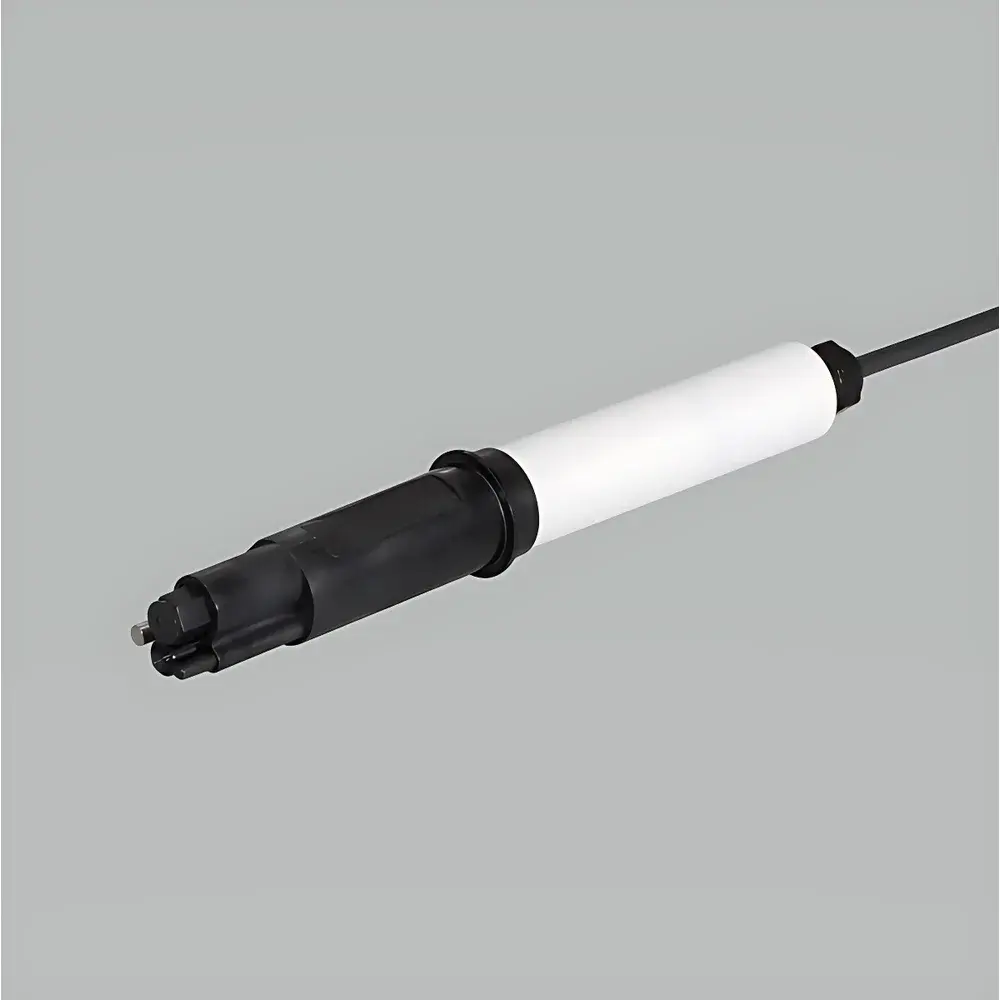
TriOS TpH-D Digital Differential pH Sensor
| Brand | TriOS |
|---|---|
| Origin | Germany |
| Model | TpH-D |
| Measurement Principle | Potentiometric Analysis |
| pH Range | 0–14 pH |
| Temperature Range | 0–65 °C |
| Resolution | 0.01 pH / 0.1 °C |
| Accuracy | ±0.06 pH / ±0.5 °C |
| Repeatability | ±0.05 pH (pH 7), ±0.1 pH (pH 1 & 13) |
| Drift (24 h) | <0.03 pH |
| Response Time T90 | ≤5 s |
| Temperature Compensation | Pt1000 |
| Output Interface | RS-485, Modbus RTU |
| Power Supply | 12–24 VDC (±10%) |
| Power Consumption | 0.2 W |
| Housing Material | PPS / PET / NBR |
| Dimensions (L×D) | 225 × 32 mm |
| Weight | 180 g |
| IP Rating | IP68 |
| Max Operating Pressure | 3 bar (typical), 1 bar (in flow cell) |
| Flow Rate Compatibility | 0–3 m/s |
| Cable Options | 0.5 m, 2 m, 10 m fixed |
| Maintenance Interval | ≤0.5 h/month |
| Calibration Interval | Every 4 weeks |
| Sample Temp. | +2–+40 °C |
| Ambient Temp. | −5–+55 °C |
| Storage Temp. | +5–+15 °C |
Overview
The TriOS TpH-D Digital Differential pH Sensor is an industrial-grade, potentiometric measurement instrument engineered for long-term stability and high reproducibility in demanding water quality monitoring applications. Unlike conventional combination pH electrodes, the TpH-D employs a true differential measurement architecture—featuring a dedicated sensing electrode and a physically isolated reference electrode housed within a sealed, double-junction design. This configuration eliminates direct contact between the reference electrolyte and the sample matrix, thereby preventing reference poisoning, clogging, and electrolyte dilution—common failure modes in wastewater influent, industrial effluent, and high-solids process streams. The sensor operates on the Nernst principle, generating a voltage proportional to hydrogen ion activity, with built-in Pt1000 temperature compensation ensuring accurate pH values across its full 0–14 pH range and operational temperature span of 0–65 °C. Its robust PPS/PET/NBR housing and IP68-rated construction support continuous submersion and mechanical resilience in harsh environmental installations.
Key Features
- Digital Modbus RTU output via RS-485 interface—enabling direct integration into SCADA, PLC, and distributed I/O systems without analog signal conditioning or external converters.
- Differential electrode architecture with salt-bridge technology resistant to scaling and fouling—extending service life and reducing maintenance frequency in high-TSS, high-COD, or sulfide-rich media.
- Full digital calibration and diagnostics accessible via Modbus registers—eliminating manual potentiometer adjustments and supporting remote verification and traceable recalibration logs.
- No moving parts or liquid-filled junctions—ensuring mechanical reliability, minimal drift (<0.03 pH over 24 h), and rapid response (T90 ≤ 5 s).
- Configurable cable lengths (0.5 m, 2 m, 10 m) with M12 8-pin connector—optimized for DIN-rail mounting with TriBox3, TriBox Mini, or HS100 modules.
Sample Compatibility & Compliance
The TpH-D is validated for continuous immersion in aqueous matrices including raw sewage, activated sludge, cooling water, leachate, and treated effluent. Its sealed reference system complies with ISO 10523 and ASTM D1293 requirements for pH measurement integrity under variable ionic strength and redox conditions. The sensor meets EN 61326-1 (EMC) and EN 61000-6-2/6-4 for industrial environments. While not intrinsically safe, it is rated for use in non-hazardous zones per IEC 60079-0. For GLP/GMP-regulated applications, its Modbus-based calibration history, timestamped diagnostics, and deterministic response behavior support audit-ready data provenance when deployed with TriOS controllers featuring 21 CFR Part 11-compliant logging firmware.
Software & Data Management
TriOS provides free configuration software (TriOS ConfigTool) for parameter setup, zero/span calibration, slope verification, and diagnostic readout—including real-time voltage, temperature, and internal impedance monitoring. All calibration events are stored as timestamped records in non-volatile memory. When paired with TriBox3 or HS100 DIN-rail controllers, the sensor supports scheduled auto-calibration routines, alarm thresholds (e.g., pH deviation >0.2 pH), and event-triggered data logging at user-defined intervals (minimum 2 s). Raw Modbus registers allow seamless mapping into third-party historian platforms (e.g., Ignition, Siemens Desigo, or Wonderware) for trend analysis, compliance reporting, and predictive maintenance modeling.
Applications
- Influent monitoring at municipal and industrial wastewater treatment plants—where traditional electrodes suffer rapid drift due to H₂S, grease, and particulate fouling.
- Real-time pH control in chemical dosing loops (e.g., lime softening, coagulant addition, or acid neutralization).
- Process validation in food & beverage, pharmaceutical, and semiconductor ultrapure water systems requiring stable baseline performance.
- Long-term environmental monitoring in rivers, reservoirs, and stormwater outfalls—leveraging its low-maintenance design and IP68 rating for unattended operation.
- Integration into compact analyzer skids with flow cells (2–4 L/min) for inline measurement under controlled hydraulic conditions.
FAQ
What distinguishes the TpH-D from standard combination pH sensors?
The TpH-D uses a physically separated reference electrode and a corrosion-resistant salt bridge—preventing electrolyte contamination and reference potential instability common in aggressive media.
Can the sensor be calibrated in situ without removal from the process?
Yes—full two-point calibration (pH 4 and pH 7 or pH 7 and pH 10) is performed digitally via Modbus commands; no physical access to the electrode surface is required.
Is temperature compensation automatic and integrated?
Yes—the built-in Pt1000 RTD provides continuous, hardware-level temperature measurement; compensation is applied internally prior to pH calculation.
What is the recommended maintenance schedule?
Mechanical cleaning is typically required ≤0.5 hours per month; full calibration is recommended every 4 weeks, though extended intervals may be justified based on historical drift analysis.
Does the sensor support multi-parameter integration?
Yes—when installed alongside TriOS optical DO, turbidity, or UV254 sensors on the same TriBox platform, all parameters are time-synchronized and transmitted via a single Modbus address space.
Related Products







