
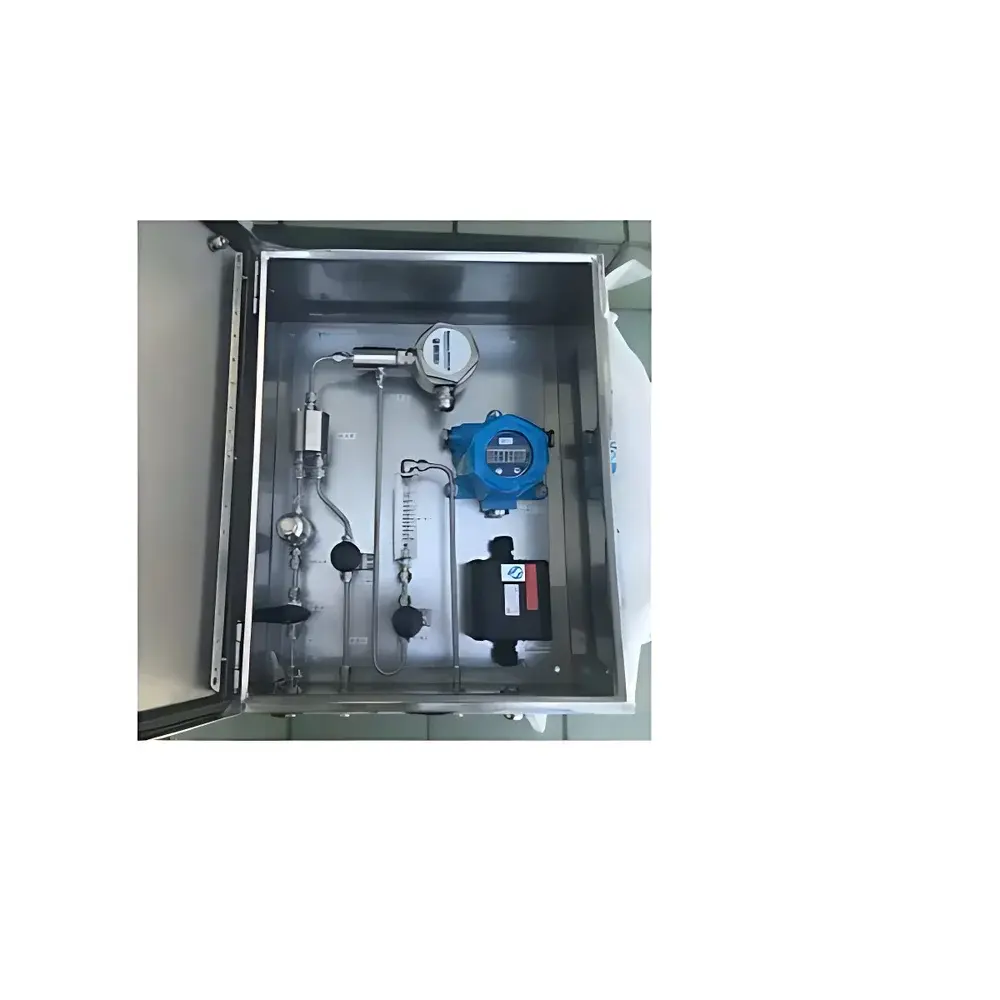
TRQ-600 Online CNG Dew Point Analyzer
| Origin | UK |
|---|---|
| Manufacturer Type | Authorized Distributor |
| Origin Category | Imported |
| Model | TRQ-600 |
| Product Type | Online Dew Point Analyzer |
| Measurement Principle | Ceramic Capacitive Sensor (Hygrometric Impedance) |
| Operating Temperature | -20 °C to +50 °C |
| Accuracy | ±1 °C dew point (+20 °C to −60 °C) / ±2 °C dew point (−60 °C to −100 °C) |
| Repeatability | 0.5 °C dew point |
| Response Time (T95) | 5 min (dry-to-wet transition) |
| Dew Point Range | −100 °C to +20 °C |
| Output Signal | 4–20 mA (2-wire, loop-powered) |
| Supply Voltage | 12–28 V DC |
| Max. Load Resistance | 250 Ω @ 12 V / 500 Ω @ 24 V |
| Current Consumption | ≤23 mA |
| Moisture Output Options | dew point (°C), ppmv H₂O (0–3000 ppmv) |
| Sample Compatibility | Oil-tolerant ceramic sensing element with integrated hydrophobic particulate and molecular sieve filtration |
Overview
The TRQ-600 Online CNG Dew Point Analyzer is an industrial-grade, in-line hygrometer engineered for continuous, real-time monitoring of water vapor content in compressed natural gas (CNG) streams at refueling stations and pipeline delivery points. Unlike conventional chilled-mirror or aluminum oxide sensors, the TRQ-600 employs a high-stability ceramic capacitive sensing element—based on impedance-based hygrometry—that maintains calibration integrity in the presence of compressor lubricating oil aerosols, hydrocarbon condensates, and fine desiccant dust common in CNG drying systems. Its design addresses the critical operational requirement defined by ISO 8573-3 (compressed air purity classes) and EN 16708:2015 (natural gas quality specifications), where dew point must be maintained below −40 °C (typically −60 °C or lower) at operating pressures exceeding 200 bar to prevent ice formation, hydrate blockages, and valve corrosion.
Key Features
- Ceramic capacitive sensor with integrated hydrophobic pre-filter and molecular sieve trap—rejects oil mist, particulates, and adsorbed hydrocarbons without signal drift
- True in-situ measurement capability: no sample conditioning required beyond pressure regulation and particulate filtration
- Extended dew point range from −100 °C to +20 °C, supporting both upstream (pre-dryer) and downstream (post-dryer) monitoring configurations
- High repeatability (±0.5 °C dew point) and traceable accuracy per NIST-traceable calibration protocols
- Robust 2-wire 4–20 mA output with full-scale programmability for dew point (°C) or moisture concentration (ppmv)
- Wide operating temperature envelope (−20 °C to +50 °C ambient) and IP65-rated enclosure suitable for outdoor CNG station deployment
- Low power consumption (<23 mA) enabling integration into existing station SCADA or PLC control loops without auxiliary power infrastructure
Sample Compatibility & Compliance
The TRQ-600 is specifically validated for use in high-pressure, oil-contaminated CNG process streams. Its sampling interface complies with ISO 8573-1 Class 2 solid particle and Class 1 oil aerosol requirements when installed with recommended stainless-steel inlet tubing, pressure-reducing regulators (to ≤10 bar sample pressure), and inline coalescing filters rated to 0.1 µm. All wetted materials—including sensor housing, filter cartridges, and flow restrictors—are certified for compatibility with natural gas per ASTM D1835 and EN 16708. The analyzer meets electromagnetic compatibility (EMC) requirements per IEC 61326-1 and carries CE marking for use in Zone 2 hazardous areas (ATEX/IECEx optional variants available). Data logging and alarm outputs support compliance with ISO/IEC 17025 laboratory quality management and GMP-aligned station maintenance records.
Software & Data Management
While the TRQ-600 operates as a standalone analog transmitter, its 4–20 mA output integrates seamlessly with distributed control systems (DCS), programmable logic controllers (PLCs), and cloud-based asset monitoring platforms. Optional HART-enabled versions provide digital diagnostics—including sensor health status, zero drift alerts, and calibration due-date tracking—via standard field communicators. All configuration parameters (span, offset, damping, unit selection) are adjustable without hardware modification. Audit trails generated during commissioning and recalibration align with FDA 21 CFR Part 11 electronic record requirements when paired with validated data acquisition software. Firmware updates are performed via portable HART communicator or Modbus RTU gateway (optional).
Applications
- Continuous dew point verification upstream and downstream of non-regenerative desiccant dryers in CNG refueling stations
- Performance validation of heatless and heated purge dryers during commissioning and routine QA audits
- Early detection of desiccant breakthrough, filter saturation, or dryer bypass events
- Compliance monitoring against national fuel standards (e.g., GB 18047–2017, EN 16708:2015, SAE J2223)
- Integration into predictive maintenance programs using dew point trend analysis and rate-of-change thresholds
- Supporting third-party certification for ISO 9001 and ISO/IEC 17025 accredited testing laboratories
FAQ
Does the TRQ-600 require periodic zero/span calibration in the field?
No—its ceramic sensor exhibits negligible long-term drift. Annual verification against a certified chilled-mirror reference (e.g., Michell Optidew) is recommended per ISO/IEC 17025 clause 6.5.2.
Can it measure dew point accurately in the presence of compressor oil carryover?
Yes—the integrated hydrophobic membrane and molecular sieve stage remove >99.9% of oil aerosols and desiccant fines prior to sensing, eliminating fouling-related inaccuracies observed with metal-oxide or polymer film sensors.
Is the TRQ-600 compatible with high-pressure CNG lines (>200 bar)?
The analyzer itself operates at reduced sample pressure (≤10 bar); however, it is routinely deployed with certified pressure-reduction manifolds meeting ASME B31.8 and PED 2014/68/EU requirements for upstream connection to 250 bar CNG headers.
What is the minimum detectable dew point and corresponding ppmv resolution?
At −80 °C dew point, the equivalent moisture concentration is ~0.2 ppmv; the instrument resolves changes of ≤0.3 ppmv across the full 0–3000 ppmv range, enabling detection of early-stage dryer degradation.




