
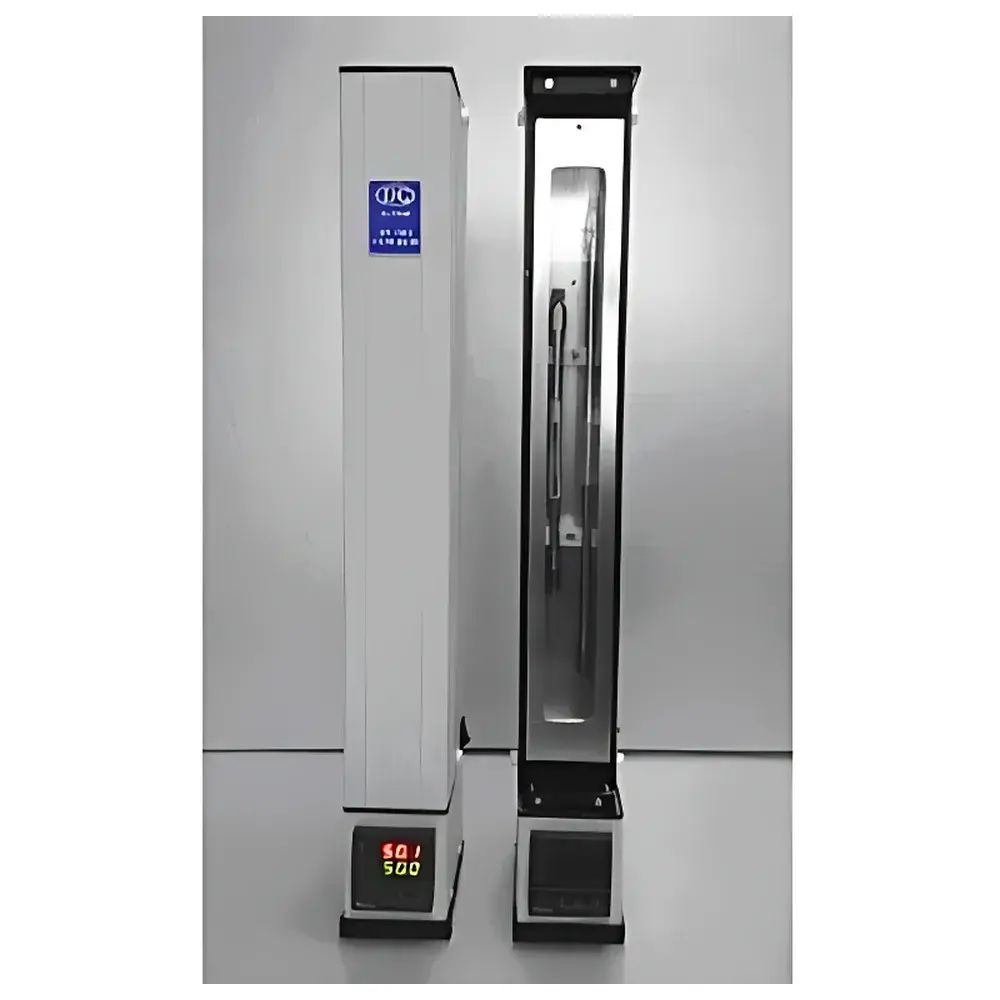
Truelab DT-230A Column Oven for HPLC Systems
| Brand | Truelab |
|---|---|
| Origin | Shanghai, China |
| Model | DT-230A |
| Temperature Range | Ambient to 100 °C |
| Temperature Stability | ±0.1 °C |
| Temperature Accuracy | ±0.5 °C at 50 °C |
| Repeatability | ±0.1 °C |
| Power Supply | 220 V, 50 Hz |
| Heating Chamber Dimensions (L×W×H) | 350 × 50 × 50 mm |
| Display | Dual-line LED with touch-sensitive controls |
| Safety Features | Over-temperature alarm and automatic power cutoff |
| Mounting Flexibility | Vertical or horizontal orientation |
| Viewing Window | Transparent front panel for real-time column observation |
| Lid Mechanism | Magnetic latch closure |
Overview
The Truelab DT-230A Column Oven is a precision temperature-controlled enclosure engineered specifically for high-performance liquid chromatography (HPLC) systems. It maintains consistent thermal conditions around analytical or preparative chromatographic columns—critical for method robustness, retention time stability, peak symmetry, and resolution reproducibility. In regulated environments governed by pharmacopoeial standards—including USP , EP 2.2.46, and ChP General Chapter 0512—column temperature is a defined system suitability parameter. Variations exceeding ±1 °C can induce measurable shifts in k′ (capacity factor), α (selectivity), and N (plate count), thereby compromising method transfer and validation integrity. The DT-230A employs a PID-controlled resistive heating system with high-resolution platinum RTD sensing, delivering tight thermal uniformity across the chamber volume. Its thermally insulated housing minimizes ambient drift, while the low-mass heating element enables rapid equilibration—typically within 8–12 minutes from ambient to 60 °C.
Key Features
- Precision temperature regulation with ±0.1 °C stability and ±0.5 °C accuracy at 50 °C—validated per ASTM E2779-21 guidelines for laboratory ovens
- Dual-line LED display with intuitive touch-sensitive interface for direct setpoint entry and real-time temperature readout
- Magnetically latched, transparent front panel enabling non-invasive visual monitoring of column connections, solvent lines, and packing integrity
- Configurable orientation: vertically mounted to integrate seamlessly with stacked HPLC modules (pump, autosampler, detector), or horizontally positioned for benchtop space optimization
- Integrated safety architecture featuring independent over-temperature cutoff circuitry compliant with IEC 61010-1:2010 requirements
- Compact heating chamber (350 × 50 × 50 mm) accommodating one standard 250 × 4.6 mm column or two narrow-bore columns (e.g., 150 × 2.1 mm) without tubing interference
Sample Compatibility & Compliance
The DT-230A supports all common stainless steel, PEEK, and fused-silica capillary columns used in reversed-phase, HILIC, ion-exchange, and size-exclusion chromatography. It is compatible with both isocratic and gradient elution methods across mobile phase compositions containing water, acetonitrile, methanol, and buffers (pH 2–9). No modifications are required for use with UHPLC systems operating up to 1000 bar, as the oven exerts no mechanical load on column hardware. From a regulatory perspective, the device supports GLP and GMP workflows through deterministic thermal performance, documented calibration traceability (NIST-traceable RTD sensor), and audit-ready operational logs when paired with optional RS-232/USB data export firmware.
Software & Data Management
While the DT-230A operates as a standalone analog-controlled unit, its digital interface supports external logging via TTL-level serial output (RS-232, 9600 baud). When connected to a PC or LIMS workstation, users may record timestamped temperature profiles synchronized with chromatographic acquisition software (e.g., Empower, Chromeleon, OpenLab CDS). All internal control parameters—including PID coefficients, alarm thresholds, and auto-tuning history—are retained in non-volatile memory during power cycles. Firmware updates are performed via secure UART bootloader protocol; no proprietary drivers or cloud dependencies are required.
Applications
- Pharmaceutical QC/QA testing where column temperature is specified in monographs (e.g., assay of paracetamol, dissolution profiling of extended-release tablets)
- Method development studies evaluating temperature-dependent selectivity in chiral separations using polysaccharide-based CSPs
- Stability-indicating assays requiring consistent retention windows across multi-day sequence runs
- Environmental analysis of polar pesticides under HILIC conditions, where sub-ambient column cooling is not needed but precise 35–45 °C control improves peak shape
- Academic research labs performing kinetic modeling of retention behavior using van’t Hoff plots
FAQ
Does the DT-230A support external temperature probe input for chamber verification?
Yes—its rear-panel BNC port accepts calibrated PT100 probes for independent validation per ISO/IEC 17025 clause 6.5.2.
Can it be integrated into an automated HPLC sequence via digital I/O?
No native dry-contact triggering is provided; however, optional relay module (TR-DIO-1) enables start/stop synchronization with pump or detector signals.
Is the viewing window resistant to organic solvent vapors?
The tempered borosilicate glass panel is chemically inert to acetonitrile, methanol, THF, and chloroform vapors under normal operating conditions.
What is the maximum column internal diameter supported in vertical orientation?
Up to 10.0 mm ID columns (e.g., preparative 250 × 10 mm) fit with adequate clearance for fittings and ferrules.
How often does the unit require recalibration?
Annual verification against a certified reference thermometer is recommended; factory calibration certificate includes as-found/as-left data per ISO/IEC 17025 Annex A.






