
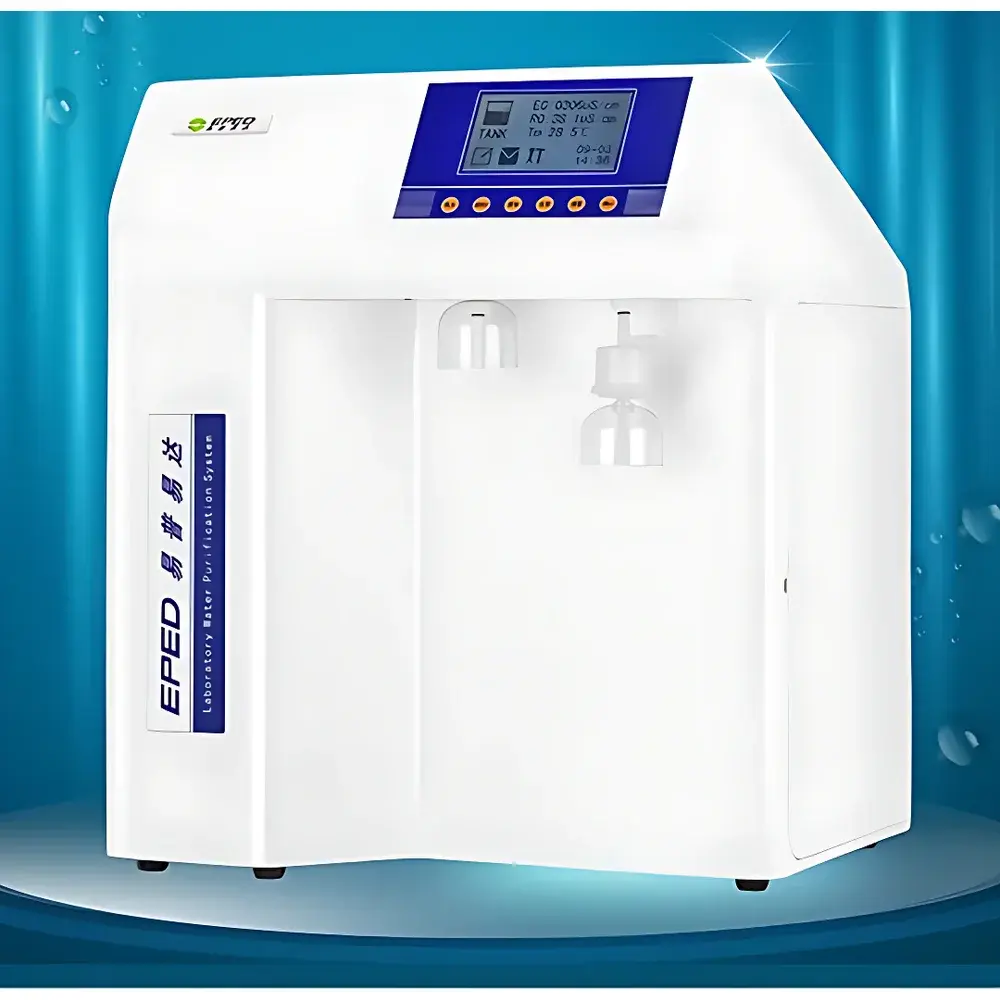
Truelab PLUS-E2 Ultra Pure Water System (Municipal Tap Water Feed)
| Brand | Truelab |
|---|---|
| Origin | Jiangsu, China |
| Manufacturer Type | Authorized Distributor |
| Country of Origin | China |
| Model | E2-TS / E2-TH / E2-TF / E2-TJ |
| Price Range | USD 1,400 – 4,200 (FOB) |
| Purified Water Grade | ASTM Type I (Ultra-Pure), GB/T 6682-2008 Grade I |
| Resistivity | 18.2 MΩ·cm @ 25 °C |
| Heavy Metals & Soluble Silica | <0.1 ppb |
| Total Organic Carbon (TOC) | <3 ppb (E2-TS/E2-TF), <5 ppb (E2-TH), <10 ppb (E2-TJ) |
| Endotoxin | <0.001 EU/mL (E2-TS/E2-TF), <0.002 EU/mL (E2-TH) |
| Microbial Count | <0.1 CFU/mL |
| Particles (>0.2 µm) | <1 CFU/mL |
| RNase | <0.01 ng/mL (E2-TS/E2-TF) |
| DNase | <4 pg/µL (E2-TS/E2-TF) |
| Feed Water Requirement | Municipal tap water, TDS <200 ppm, 5–45 °C, pressure 1.0–4.0 kgf/cm² |
| Flow Rate | 5–40 L/h (adjustable), instantaneous output 1.5–2.0 L/min (with pressurized tank) |
| Dimensions (W×D×H) | 500 × 400 × 580 mm |
| Weight | ~38 kg |
| Power | 220 VAC, 50 Hz, 50–80 W |
| Noise Level | <50 dB(A) |
| Certifications | NSF-certified tubing and fittings, RO membrane: Dow FilmTec™, UV lamp: dual-wavelength (185/254 nm), low-voltage DC control architecture (24 VDC), IPX1-rated enclosure |
Overview
The Truelab PLUS-E2 Ultra Pure Water System is an integrated, laboratory-grade purification platform engineered to produce both Type II (RO/DI) and ASTM Type I ultra-pure water directly from municipal tap water feed. It employs a multi-stage purification architecture—comprising pre-filtration (PP + AC), high-rejection reverse osmosis (Dow FilmTec™ RO membrane), dual-wavelength UV photooxidation (185 nm + 254 nm), ultrafiltration (UF), and terminal polishing via proprietary high-capacity ion-exchange modules—to consistently deliver water meeting or exceeding the most stringent international specifications for analytical, life science, and trace-element applications. The system operates under continuous conductivity and TOC monitoring, with real-time feedback across three critical points: feed water, RO permeate, and final UP water. Its thermally compensated, 0.01 cm⁻¹ cell constant resistivity sensor ensures metrologically traceable conductivity measurement per ISO/IEC 17025 requirements. Designed for reliability in regulated environments, the PLUS-E2 integrates fail-safe dry-run protection, automatic RO membrane flush scheduling, and programmable alarm thresholds compliant with GLP documentation workflows.
Key Features
- Modular purification train: PF + PP + AC + Dow FilmTec™ RO + dual-wavelength UV (185/254 nm) + UF + high-capacity ion-exchange columns (3 L + 5 L nuclear-grade resin)
- Two configurable ultra-purification modules: 160×80×390 mm two-column DI assembly and 160×160×390 mm medical-grade fused-quartz four-column UP module—heat-bonded, adhesive-free construction eliminates leachables
- 5.0-inch full-color capacitive touchscreen interface with animated menu navigation, four-digit user password protection, and dual-level access (factory + operator)
- Real-time, three-point online water quality monitoring: source, RO, and UP streams—including resistivity, TOC, temperature, and pressure—with auto-compensation algorithms
- Programmable UV lamp runtime logging, RO flush interval scheduling, and consumable lifetime tracking (PP, AC, RO, UV, UF, UP columns) with visual replacement alerts
- Low-voltage 24 VDC control architecture, ABS engineering-grade housing, and fully isolated wet/dry compartment design compliant with IEC 61010-1 for humid laboratory environments
- NSF-certified fluid path components; electromagnetic compatibility (EMC) certified per EN 61326-1 for stable operation near sensitive instrumentation (e.g., ICP-MS, HPLC)
Sample Compatibility & Compliance
The PLUS-E2 is validated for use across multiple water grade classifications per globally recognized standards: ASTM D1193-20 (Type I), CLSI EP22-A, USP , EP 2.2.44, and GB/T 6682-2008 (Grade I). Its terminal UF and optional endotoxin/nuclease removal cartridges enable compliance with ISO 13485 and FDA 21 CFR Part 11 when paired with audit-trail-enabled data export. All wetted materials—including tubing, quick-connect fittings, and column housings—carry NSF/ANSI Standard 61 certification for potable water contact. The system supports full traceability: one year of operational logs (including timestamped resistivity, TOC, pressure, and alarm events) are stored internally and exportable via USB to Excel-compatible CSV files. Calibration records, maintenance history, and consumable usage timelines are retained with user attribution and time-stamped metadata—facilitating internal audits and regulatory inspections under GLP or GMP frameworks.
Software & Data Management
The embedded control firmware provides granular data governance without third-party software dependencies. Users configure sampling intervals (1–60 min), set custom alarm thresholds (e.g., resistivity drop >0.1 MΩ·cm within 5 min), and define automated reporting windows. All operational parameters—including UV lamp hours, RO flush cycles, column service time, and daily volume summaries—are logged with ISO 8601 timestamps. Data export via USB yields structured .CSV files compatible with LIMS integration or statistical process control (SPC) analysis. Password-protected configuration menus prevent unauthorized parameter changes; factory reset requires dual-level authentication. Audit trails capture operator ID, action type (e.g., “column replacement initiated”), and timestamp—fully satisfying ALCOA+ principles (Attributable, Legible, Contemporaneous, Original, Accurate, Complete, Consistent, Enduring, Available).
Applications
The PLUS-E2 serves as a primary water source for high-sensitivity analytical platforms requiring ultralow background interference: HPLC mobile phase preparation, ICP-MS calibration standards, GC-MS solvent dilution, and TOC system blanks. In life sciences, it supplies nuclease-free water for qPCR master mixes, CRISPR reagent formulation, mammalian cell culture media, and electrophoresis buffers. Trace metal analysis (GFAAS, ICP-OES) benefits from its sub-0.1 ppb heavy metal specification, while endotoxin-sensitive applications—including monoclonal antibody purification and stem cell differentiation—leverage the <0.001 EU/mL output (E2-TS/E2-TF models). The modular design allows application-specific customization: E2-TH includes enhanced TOC reduction for VOC-sensitive GC methods; E2-TJ delivers cost-optimized Type I water for routine buffer preparation and glassware rinsing.
FAQ
What feed water quality is required for optimal RO membrane performance?
Municipal tap water with TDS ≤200 ppm, temperature 5–45 °C, and inlet pressure 1.0–4.0 kgf/cm² is recommended. For TDS >200 ppm, an external softener is advised to mitigate scaling.
How does the dual-wavelength UV lamp contribute to water purity?
The 254 nm wavelength inactivates microorganisms, while 185 nm photolyzes organic molecules into CO₂ and H₂O—reducing TOC to <3 ppb and minimizing downstream carbon buildup in ion-exchange resins.
Can the system be integrated with existing lab infrastructure?
Yes—it supports both pressurized storage tanks (12 L standard) and gravity-fed reservoirs, with analog 0–5 V output signals for remote monitoring and digital I/O for PLC interfacing.
Is the system suitable for ISO 17025-accredited laboratories?
Yes. Its calibrated sensors, full audit trail, electronic signature support, and documented uncertainty budgets align with ISO/IEC 17025:2017 Clause 7.7 on measurement traceability and result validity.
What maintenance intervals are recommended for consumables?
PP/AC pre-filters: 3–6 months; RO membrane: 12–24 months (dependent on feed quality); UV lamp: 9,000–12,000 hours; UP columns: 6–18 months (monitored via resistivity decay rate and TOC rise).



